
The pitch arrives in four parts. It never closes, you need less money to start, you get more leverage, and there is no rule stopping you trading as often as you like. Put like that, the case for why forex is better than stocks sounds settled. Run the same four claims through the questions a business owner would actually ask, though, and three of them turn out to be the same fact wearing different clothes, and that fact is not an advantage.
Start with the only thing a regulator publishes about risk
Before any of the marketing, there is a public document in which people whose job is measuring risk have written down how dangerous they think each instrument is. It is worth reading as a ranking rather than a rulebook.
The European Securities and Markets Authority set leverage limits for retail clients that vary, in its words, "according to the volatility of the underlying": 30:1 for major currency pairs, 20:1 for non major pairs, gold and major indices, 10:1 for commodities other than gold, 5:1 for individual equities, and 2:1 for cryptocurrencies.
On the American side, the Commodity Futures Trading Commission sets a floor rather than a ceiling. Regulation 5.9 requires a minimum security deposit of "2% of the notional value of the retail forex transaction for major currency pairs and 5% of the notional value of the retail forex transaction for all other currency pairs", which works out at 50:1 and 20:1.
Now read those two lists as a business owner rather than as a trader. A regulator is not telling you currencies are safer than shares. It is telling you how much of your own money it insists you put behind each one before it will let you take the position. Those are different statements, and confusing them is the root of nearly every bad decision in this comparison.
Why forex is better than stocks, claim by claim
Claim one: it ties up less capital
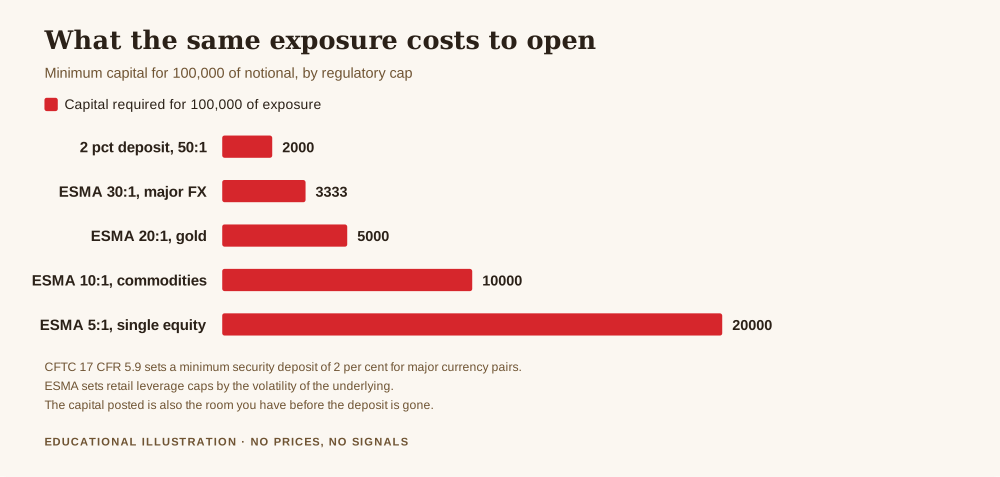
This one is simply true, and the size of it surprises people. For 100,000 of exposure, the minimum capital required under each cap is: 2,000 at the CFTC's 2 per cent major pair deposit, 3,333 at ESMA's 30:1, 5,000 at 20:1, 10,000 at 10:1, 20,000 at the 5:1 single equity cap, and 50,000 at 2:1 for crypto.
The same exposure therefore needs six times the capital as a single equity CFD that it needs as a major currency pair. If your constraint is capital, that gap is real and it matters.
But flip it over. The capital you post is the room you have. At a 2 per cent deposit, a 2.00 per cent adverse move on the notional equals the entire deposit. At 30:1 it takes 3.33 per cent, at 20:1 it takes 5.00 per cent, and at the 5:1 equity cap it takes a 20.00 per cent move. The product that asks for the least money is the product that gives you the least distance before the money is gone. One sentence, two readings, and the marketing only ever shows you one of them.
Claim two: a 1 per cent move does more for you
It does more to you, in both directions, and here is the arithmetic in a single line. A 1 per cent move on the notional, expressed as a share of the minimum margin posted, is 50.0 per cent at a 2 per cent deposit, 30.0 per cent at 30:1, 20.0 per cent at 20:1, 10.0 per cent at 10:1, 5.0 per cent at 5:1 and 2.0 per cent at 2:1.
Half your posted margin on a 1 per cent move. That is what the leverage claim means once you stop calling it an advantage. In a business, nobody describes an arrangement where a one per cent variance moves half the committed capital as efficiency. They call it fragility, and they price it accordingly.
There is a second mechanism underneath. ESMA standardised a margin close out rule at 50 per cent of minimum required margin. If your equity equals exactly the minimum margin at entry, close out arrives after a 1.67 per cent adverse move at 30:1, 2.50 per cent at 20:1, and 10.00 per cent at 5:1. The position does not need to be wrong for long. It needs to be wrong for a moment.
Claim three: it never closes
The currency market quotes around the clock from the Sunday evening open to the Friday evening close, which on that assumption is 24 hours across five days, or 120 hours a week. A United States equity regular session runs 6.5 hours a day, five days, or 32.5 hours. That is 3.69 times as many hours, and across 52 weeks it is 6,240 hours against 1,690, a difference of 4,550 hours a year.
Here is the part the pitch omits. You are not going to use them. Three hours a day, five days a week, is 15 hours, which is 12.5 per cent of the hours the currency market is open. The other 87.5 per cent is not opportunity, it is exposure you are not watching and temptation you have to decline repeatedly.
A shop that is open 120 hours a week with one member of staff is not a bigger business than a shop open 32.5 hours. It is the same business with a staffing problem. The genuine advantage here is not the total, it is that you get to choose which hours, which matters enormously if you have a job. That is a scheduling benefit and it is worth something real. It is just not the thing being sold.
Claim four: there is no rule stopping you trading often
Retail currency trading in the United States is regulated by the CFTC and the National Futures Association rather than by the equity market rules, and the day trading restrictions that apply to margin accounts at broker dealers come from a different rulebook, FINRA Rule 4210, which sets its own minimum equity conditions for accounts flagged as pattern day traders. Read the rule itself rather than a forum summary of it, because the thresholds and the definition both matter and both get misquoted.
What I will say plainly is this. "No rule stops me trading as often as I want" is only an advantage if the frequency was being limited by the rule rather than by the strategy. For almost everyone who says it, the rule was never the binding constraint. The account was.
What the comparison looks like from inside a business
Strip away the product talk and a one person trading operation has four questions about any market it might run in.
- How much capital does it lock up, and for how long? Currencies win on the first half, decisively. On the second half it depends entirely on your holding period, and a leveraged position held for weeks is a different animal from the same position held for hours.
- What is the fixed cost of being open? Data, platform, and your own hours. Equities can carry real market data costs, and the currency market generally does not. That is a genuine line item in favour of currencies and nobody mentions it, because it is boring.
- What can end the business in a single event? This is where the leverage arithmetic above belongs, and it is the question most beginners never ask. A 20.00 per cent move to clear your deposit versus a 2.00 per cent move is not a detail, it is the difference between an operation that can absorb a shock and one that cannot.
- How many things do I have to understand? A handful of major currency pairs against thousands of listed companies. For a single operator with limited hours, a small universe is a structural advantage, and it is the most underrated point in the whole comparison.
Notice that the honest scorecard is mixed. Currencies win on capital efficiency, fixed costs and the size of the universe. Shares win on how much room an ordinary bad day leaves you, on the fact that you own something that can pay you while you wait, and on not needing to be right about timing to make the position work.
What the inbox says about who is asking
I get this question most often from people for whom the capital line is the only line that matters. One reader wrote: "I can't start with that much, I'm new to this and I can't afford it yet." Another: "I've been reading for six months. I have a small 100 dollar capital, I'm not yet profitable." A third: "I entered the market with only 100 dollars, trying to level it up slowly to control and learn." A fourth asked the question underneath all of them: "Should I get a prop firm to solve the equity problem, or trade minimally with the small capital I have?"
Roughly 151 messages in my inbox touch on trading a small account, which is a keyword count rather than a survey, and the pattern in them is consistent. The people most attracted to the lower capital requirement are the people least able to survive the smaller room that comes with it. That is not an argument against them trading. It is an argument for sizing as though the leverage cap did not exist, which is the whole point of the next section.
One more, because it is the most important sentence anybody has sent me on this subject: "Okay but I want you to know, I can't afford to lose all again."
How to decide this properly, in four steps
- Write down your constraint before you compare anything. If it is capital, currencies answer it. If it is hours, currencies answer it. If it is tolerance for a bad week, shares answer it. Most people never name the constraint, which is why the comparison feels unresolvable.
- Size from your risk per trade, never from the margin requirement. The cap tells you the maximum the rules allow. It is not a recommendation, and treating it as one is the single most expensive habit in this business.
- Price the fixed costs for a full year before you commit. Data, platform, the subscription you forgot. A market that is cheaper to be open in is a real advantage for a small operation, and it only shows up when you total twelve months.
- Decide in advance what ends the experiment. A capital level, a date, or both, written down while you are calm. Businesses that survive are the ones that decided what failure looks like before they met it.
Get the free REX one page trading business plan, including the capital and cost lines that decide which market a one person operation can actually afford to run in. One email, no spam, unsubscribe anytime.
Get the free business plan →Frequently asked questions
So is there a straight answer to why forex is better than stocks?
No, and anyone giving you one is selling something. Currencies require less capital for the same exposure, cost less to be open in, and offer a small universe to learn. Shares give you far more room before an adverse move clears your deposit, and an asset that exists independently of your timing. Which set matters is decided by your constraint, not by the market.
Does more leverage mean more profit?
It means more of everything per unit of capital, which includes the part that ends accounts. At a 2 per cent deposit a 1 per cent move on the notional is 50.0 per cent of the margin posted. The same move at the 5:1 single equity cap is 5.0 per cent. Nothing about the market changed between those two lines, only how much of your money stands behind the position.
Is the 24 hour market an advantage for someone with a job?
Yes, and this is the claim that survives scrutiny best. The benefit is not the 120 hours a week, it is that you choose which of them you use. Three hours a day is 12.5 per cent of the open hours, and a market that lets you pick those three around your employment is genuinely solving a scheduling problem that an equity session cannot.
Do I need less money to start in currencies?
To open a position, yes, by a wide margin. To run it as a business, the honest answer is that the required capital is set by your risk per trade and your cost base rather than by the minimum deposit. The minimum deposit tells you what a broker will accept, not what an operation needs to survive its first bad month.
Are the rules actually different for day trading?
They come from different places. Retail currency trading in the United States sits under the CFTC and the National Futures Association, while day trading in a margin account at a broker dealer is governed by FINRA Rule 4210, which sets its own minimum equity conditions. Read the rule text rather than a summary, and remember that the absence of a rule is only useful if the rule was what stood between you and a better outcome.
What about costs, which is cheaper?
It depends on what you trade and how often, so treat anyone quoting a single number with suspicion. The structural point for a small operation is that currencies usually carry no separate market data bill, while equities often do. Total twelve months of every fixed line before deciding, because that is where the difference shows up rather than in any single transaction.
Where this leaves you
The claim behind why forex is better than stocks is mostly one fact repeated four ways: the capital requirement is lower. That fact is true, verifiable in the regulations, and the direct cause of the thing that empties accounts, because the capital you post is the room you have. Take the lower requirement if capital is your binding constraint, then size as though it did not exist. Run it that way and the question stops being which market is better and becomes which market your business can afford to be open in, which is a question you can actually answer with a spreadsheet.
The leverage limits of 30:1, 20:1, 10:1, 5:1 and 2:1, the phrase about varying according to the volatility of the underlying, and the margin close out rule at 50 per cent of minimum required margin are from the European Securities and Markets Authority's final product intervention measures on contracts for difference and binary options. The minimum security deposits of 2 per cent for major currency pairs and 5 per cent for all other pairs are quoted from 17 CFR 5.9 as published by the United States Government Publishing Office. The figures of 2,000, 3,333, 5,000, 10,000, 20,000 and 50,000 of required capital, the six times ratio, the 2.00, 3.33, 5.00 and 20.00 per cent moves that clear a deposit, the 50.0, 30.0, 20.0, 10.0, 5.0 and 2.0 per cent margin impacts of a 1 per cent move, the 1.67, 2.50 and 10.00 per cent close out points, the 120 and 32.5 hours a week, the 3.69 ratio, the 6,240 and 1,690 hours a year and the 12.5 per cent figure were all calculated here from those published rules and from two stated assumptions: that the currency market quotes 24 hours across five days, and that an equity regular session runs 6.5 hours across five days, holidays ignored on both sides. The reader quotes are real messages, shortened and stripped of anything identifying. No price, instrument or broker is recommended anywhere in this article.
If you are costing this out properly, fixed and variable costs of a trading business is the full line by line, what market data fees are covers the bill that only one side of this comparison tends to receive, and how much to spend on your trading setup keeps the capital expenditure honest. If the share side is the one you are weighing, do I need a broker to buy stocks covers the access question, and what currency your trading account should be in is the decision most people make by accident. Underneath all of it, the one page trading business plan is where the constraint gets written down before anything gets compared.
REX publishes the operating side of trading: the limits, the costs and the reviews that keep a one person business open. The free business plan above is the one page version of everything used here. Following along is free, the Kit is optional, and nothing here promises a profit.
About the author. Rex writes REX Trading Signal for people who want to run an account like a business rather than a hobby, because the operators who last are the ones who wrote the rules down before the market tested them. This is education and not financial advice, rules differ by country and by regulator, and no entry, stop or target discussed should be treated as a signal.