
So what are market data fees? They are what the exchange charges you for the right to see its prices in real time, billed monthly, whether or not you place a single trade. Most retail traders meet them as a confusing line on a statement, assume it is a platform charge, and never look again.
That is a mistake if you run the account as a business, because this is one of the few costs on your books that is genuinely fixed. Commission scales with activity. Spread scales with activity. A data subscription arrives on the first of the month regardless, which puts it in the same category as rent.
There is also a trap in it that catches exactly the sort of person reading this: the same feed is sold at two very different prices, and the thing that decides which price you pay is not how much data you use. It is what you are. Incorporate your trading, and the bill can multiply.
Every figure below is read from Interactive Brokers' published market data pricing on 11 October 2026, with the arithmetic shown. It is one broker's schedule, in US dollars, and fees change.
What are market data fees actually paying for
The exchange owns its order book. When you see a live bid and offer on COMEX gold, that information was generated by the exchange's matching engine, and the exchange licenses it. Your broker is a distributor. It collects the fee and passes it on, usually at cost for the exchange portion.
This is why the charge does not disappear when you switch to a cheaper broker. You are not paying your broker for the data. You are paying the exchange through your broker, and the exchange's rate card does not care which door you came through.
It is also why free delayed data exists. The same published schedule shows COMEX and CME data delayed by ten minutes, at no charge. Ten minute old prices have no licensing value to a trader, so the exchange gives them away. The fee is not for the numbers. It is for the immediacy.
Three things get billed separately, and the distinction matters for what you actually need. Level 1 is top of book, the best bid and offer and the last trade. Level 2 is depth, the resting orders behind the top. Snapshots are single quotes on request, charged per quote instead of monthly.
The same feed, at two very different prices
Here are the COMEX numbers from that schedule. A non-professional subscriber pays 1.55 a month for Level 1 and 12.10 a month for Level 2, which is 13.65 for both. A professional subscriber pays 145.00 a month for the Level 1 and Level 2 package.
That is the same data, from the same exchange, through the same broker, at 10.6 times the price. Measured on Level 1 alone, where the non-professional rate is 1.55, the ratio is over ninety to one.
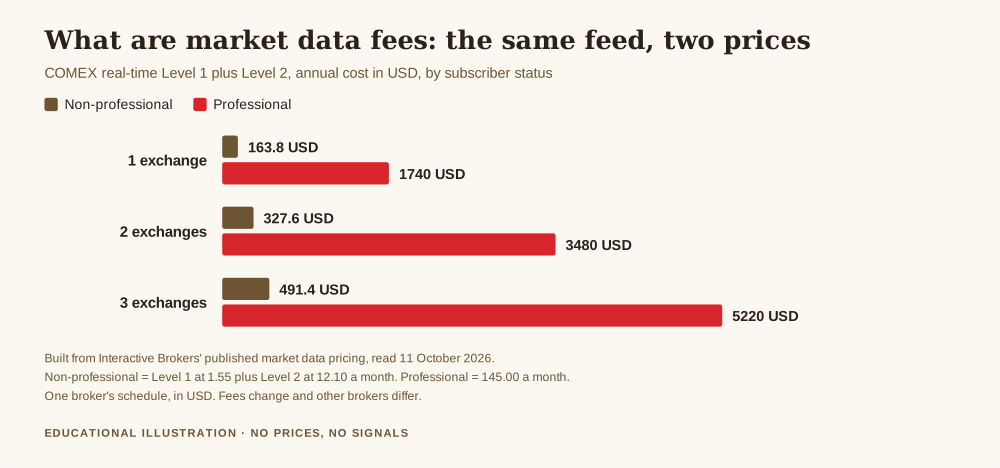
Annualised, that is 163.80 a year against 1,740.00, a difference of 1,576.20 for an identical service. And futures traders rarely need one exchange. If you follow gold on COMEX, equity index futures on CME and grains on CBOT, each is billed separately. Three exchanges costs a non-professional 491.40 a year and a professional 5,220.00.
For a one person operation, 5,220 a year of fixed overhead is not a rounding error. It is a number that has to be earned back before anything else happens, and it arrives whether the year goes well or badly.
What makes you a professional, and why it is not what you think
You might reasonably assume the professional rate is for people trading large size, or trading for a living. It is neither. The classification turns on registration status and legal form.
The published definition puts into the professional category organisations, which it spells out as corporations, limited liability companies and partnerships, along with anyone using the data for business purposes, registered securities or investment advisers, and employees of financial services firms. A non-professional is an individual who is not registered with a financial regulator, is not acting as an investment adviser, and is not employed by a financial institution in a role that requires registration.
Read that first category again, because it is the part that catches readers of this journal. Corporations, limited liability companies and partnerships. Not large ones. Any of them.
Which produces an awkward result. Treating your trading as a business is the argument this whole site makes. But if you act on it by putting the account inside a company, you may have moved yourself from the 13.65 column to the 145.00 column, and the data you receive will be byte for byte identical. On a three exchange setup that single structural decision costs about 4,728.60 a year in data alone.
I am not telling you to avoid incorporating. There are real reasons to do it, and they are the subject of how to open a trading company. I am telling you that market data belongs on the cost side of that decision, and almost nobody puts it there. Check your own exchanges' definitions before you file, because the classification is set by each exchange's rules and the broker only applies them.
The waiver, and the incentive buried in it
Brokers often waive a monthly data fee if the account generates enough commission. The same schedule shows thresholds of 5, 20 or 30 in monthly commissions depending on the package.
Treat that as the arithmetic problem it is. If the threshold is 5 and the fee is 12.10, generating that commission to avoid the fee leaves you 7.10 better off. If the threshold is 20 to avoid the same 12.10, you have spent 20 to save 12.10 and you are 7.90 worse off than if you had simply paid. At a 30 threshold you are 17.90 worse off.
And that assumes the trades were worth doing. If you place trades you would not otherwise have placed in order to clear a commission threshold, the commission is not the real cost. The real cost is the expectancy of trades taken for an administrative reason, which is the definition of a bad trade regardless of what it saves on a data bill. The habit that comes from this is covered in how to not over trade.
The correct order of operations is simple. Decide your trading activity first, on its own merits. Then look at where that activity lands you against the thresholds. Never the other way around.
Snapshots, and when flat beats per unit
There is a third option that suits low frequency operations, and most people never consider it. Instead of a monthly subscription you can pay per quote: 0.01 a snapshot for US listed equities and ETFs, 0.03 for everything else, with the first 1.00 each month waived.
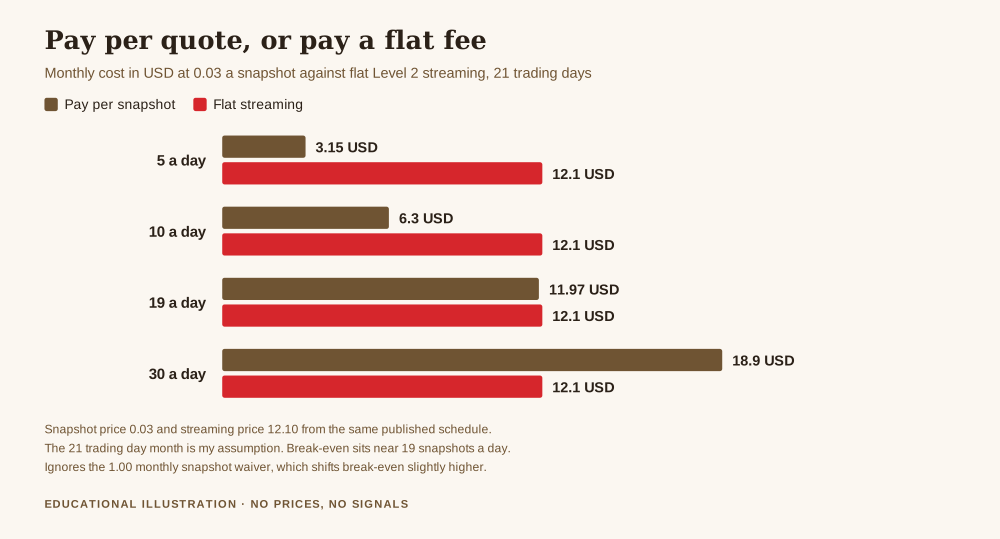
The break-even is straightforward. A 12.10 monthly streaming subscription equals 12.10 divided by 0.03, which is about 403 snapshots a month. Spread over a 21 day trading month, my assumption, that is roughly 19 quote requests a day. Below that, paying per quote is cheaper. Above it, the subscription wins.
Nineteen a day is more than a swing trader checking two instruments each morning uses, and far less than a day trader uses before lunch. So the answer genuinely differs by operation, which is the point. The schedule also notes that if your snapshot charges in a month reach the cost of the streaming service, you are upgraded to streaming automatically for that month, so the downside of guessing wrong is capped.
What the rules require, and where they stop
It is worth knowing that fee levels are not entirely unregulated, and equally worth knowing how narrow that protection is.
Under Regulation NMS, 17 CFR 242.603 requires that an exclusive processor distributing quotation and transaction information do so "on terms that are fair and reasonable", and that exchanges and brokers distributing it do so "on terms that are not unreasonably discriminatory".
Now the limitation, and it is a large one. That rule applies to NMS stocks, meaning US listed equities. The COMEX and CME figures above are futures data, which sits outside Regulation NMS entirely and is governed by each exchange's own licensing terms under a different regulator. So the fairness standard you might assume covers your gold futures feed does not reach it.
Which leaves the futures trader with the ordinary remedy rather than a regulatory one: read the rate card, work out what you need, and decline what you do not. The same discipline applied to every other line in fixed and variable costs of a trading business.
Putting it on the books
Three practical conclusions from the numbers above.
Buy depth only if your method uses depth. Level 2 is 12.10 of the 13.65 non-professional bill, so it is 89 per cent of the cost. If your entries come from structure on a chart and you never read the book, you are paying for a window you do not look through. Drop to Level 1 and the bill falls to 1.55.
Count exchanges, not platforms. The fee is per exchange. Watching one extra market out of curiosity adds a line to a monthly bill forever. Curiosity is cheaper on delayed data.
Put the fee in the plan before the structure decision. This is the one that actually costs people money, and it costs them silently. The place I keep this is the one page trading business plan, where fixed costs get written down before they are incurred rather than discovered afterwards.
One caution on a tempting way to think about this. Dividing the annual fee by your trade count makes the number look small: 163.80 across 100 trades is 1.64 a trade, and across 500 trades it is 33 cents. That arithmetic is correct and it is a trap, because the total bill has not changed. It has only been divided into smaller pieces. Trading more does not make a fixed cost cheaper, it just spreads it, and the same illusion applied to time is in how many hours a week should I trade.
What these numbers do not tell you
Some limits, stated plainly.
This is one broker's published schedule on one day. Interactive Brokers is a reasonable reference because it publishes rates openly, but another broker will differ, and these figures will be out of date eventually. The method survives the numbers: find your broker's schedule, find your classification, do the division yourself.
The figures are also US exchange figures in US dollars. European, Asian and other venues price differently, and a trader on a non US platform should not assume these ratios transfer.
Classification is determined by the exchange's rules, not by your broker and not by this article. If your situation is near the boundary, which is to say you are considering a company, or you hold any registration, or you work in financial services, the only reliable answer comes from the exchange's own subscriber qualification documents or from your broker's compliance desk.
And none of this is a view on whether real time depth is worth buying for your method. That depends on what your method actually reads, which only you can answer.
Get the free REX one page business plan, the sheet where the fixed costs get written down before they are incurred rather than discovered on a statement. One email, no spam, unsubscribe anytime.
Get the free business plan →Frequently asked questions
What are market data fees on a brokerage statement?
A monthly charge for real time prices from a specific exchange, licensed by that exchange and collected by your broker. It is billed per exchange and per user, it is separate from commission and spread, and it is charged whether or not you trade that month.
Why is my market data fee so much higher than someone else's?
Almost always because you are classified as a professional subscriber and they are not. On the COMEX figures above that is 145.00 a month against 13.65 for identical data. The classification follows registration status and legal structure, including whether the account sits inside a company, rather than how much you trade.
Can I trade without paying for market data?
Yes, on delayed data, which the same schedule provides for COMEX and CME at a ten minute delay for nothing. That is workable for position traders and for study, and unworkable for anything requiring a current price at the moment of the decision. Pay per snapshot quotes are the middle option.
Does putting my trading in a company increase my market data fees?
It can, significantly, because corporations, limited liability companies and partnerships fall within the professional subscriber definition. Confirm it against your own exchanges before you file, and if it applies, carry it into the decision as an annual cost rather than meeting it later on a statement.
Is Level 2 data worth the money?
Only if your method reads the order book. On the figures above Level 2 is 12.10 of a 13.65 monthly bill, so nearly all of the cost, and a trader working from chart structure is buying something they never look at. The honest test is whether you can name a decision you made last month that used depth.
Where REX Trading Signal fits
REX Trading Signal is a free journal about running a trading account like a business, which mostly means knowing what a thing costs before it appears on a statement. Nothing here is sold on a promise of returns and there is no signal service to subscribe to. The free one page business plan is where the fixed costs get listed before they are committed to. The piece underneath all of it is the one page trading business plan, and the cost line most often overlooked next to this one is in how much should I spend on my trading setup.
About the author. Rex writes REX Trading Signal. He went to look up a single data subscription charge, found the same feed priced at ten times more for a company than for a person, and realised the advice he gives about treating trading as a business has a line item nobody mentions. He now reads rate cards before rearranging anything.
Risk disclosure. This article is educational and is not financial advice. Trading gold and other leveraged products carries a high risk of losing money rapidly, and no entry, stop or target discussed should be treated as a signal. All fee figures are quoted from Interactive Brokers' published market data pricing page as read on 11 October 2026, in US dollars, for the COMEX real time subscriptions named, and they are subject to change. The annual totals, the ratio between subscriber classes, the waiver comparison, the snapshot break-even and the per trade division are my own arithmetic from those published rates, using a 21 day trading month where stated. Subscriber classification is set by each exchange, not by me. Decide your own risk, and never trade money you cannot afford to lose.