
A reader sent me a photograph of his desk last month. Three monitors on an arm, a new machine, a mechanical keyboard, and a chair that cost more than his first car's first service. Underneath it he had written one line: account balance, two thousand one hundred dollars. He was asking whether he should add a fourth screen. The question he meant to ask, and the one worth answering, is how much should I spend on my trading setup, and the honest answer is that it is not a gear question at all. It is a capital expenditure decision, and businesses have a way of making those.
Every other cost in this business gets examined. People argue about spreads measured in fractions of a dollar and commissions of a few dollars a side. Then they spend three thousand dollars on hardware in an afternoon without writing a single number down, because that purchase feels like an investment in themselves rather than a line in the accounts. It is a line in the accounts. This article puts it there.
Everything numerical below is my own calculation from assumptions I state as I go, apart from the tax figures, which are quoted from the Internal Revenue Service publication I link. Nothing here is tax advice or financial advice.
How much should I spend on my trading setup? Start by spreading it properly
The first error is treating a one off purchase as a one off event. A business does not do that. It spreads the cost of a long lived asset across the years it will actually be used, because that is the only way to see what it costs to run.
You do not have to invent the useful life. The tax code has already picked one. Computers and peripherals fall under five year property in the Internal Revenue Service's Publication 946, How To Depreciate Property, and its Table A-1 sets out the half year convention schedule for five year property as 20.00 per cent in year one, then 32.00, 19.20, 11.52, 11.52 and 5.76 per cent, which is six calendar years because the half year convention splits the first year.
On a three thousand dollar setup that works out as 600 dollars, then 960, 576, 345.60, 345.60 and 172.80, summing to exactly the three thousand you paid. Whether or not you ever file that schedule, it is a sound answer to the question of how long the thing is supposed to last. Five years. So spread the money over five years and see what you are really committing to.
What that actually costs per trade
A three thousand dollar setup over five years is 600 dollars a year. Now divide it by how often you trade, because that is the number that belongs beside your spread and your commission:
- At 100 trades a year, it costs 6.00 dollars a trade.
- At 200 trades a year, 3.00 dollars a trade.
- At 400 trades a year, 1.50 dollars a trade.
- At 800 trades a year, 0.75 dollars a trade.
That reframes the argument completely. For an active trader, a serious setup costs less per trade than the commission, and arguing about it is wasted breath. For someone taking a hundred trades a year, it is six dollars every time they click, which is a real cost sitting quietly on top of every single position, and it never appears on a statement.
The same arithmetic on a fifteen hundred dollar setup gives 300 dollars a year, so 3.00 dollars a trade at a hundred trades and 0.38 at eight hundred. The gear is not expensive or cheap in the abstract. It is expensive or cheap relative to how much you use it, exactly like a van.
The number that should stop you: cost as a share of the account
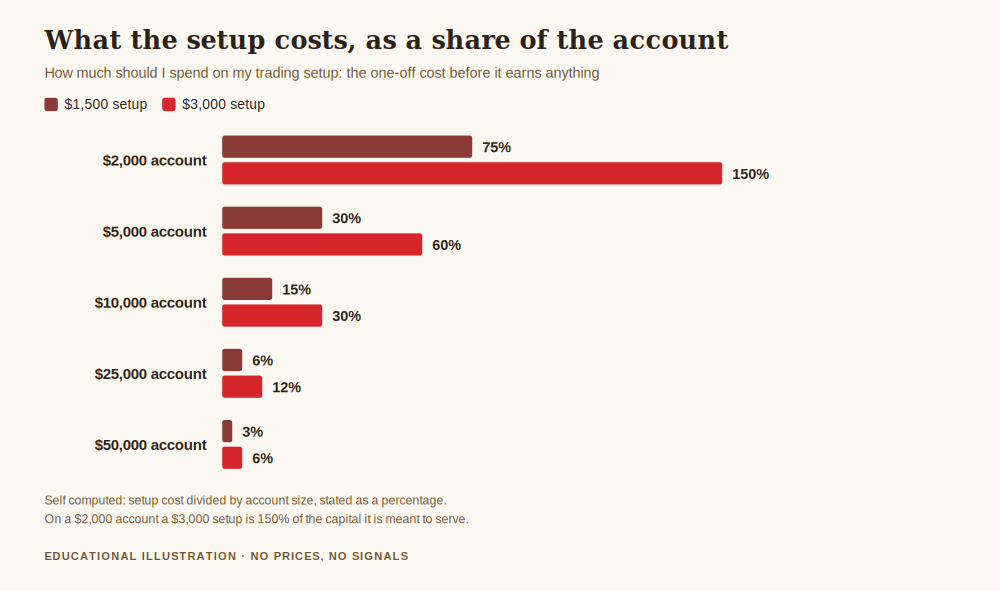
Here is the comparison that answers my reader's question without my having to say anything unkind about the chair. Take the setup cost as a straight percentage of trading capital:
- On a 2,000 dollar account, a 1,500 dollar setup is 75 per cent of capital and a 3,000 dollar setup is 150 per cent.
- On a 5,000 dollar account, 30 and 60 per cent.
- On a 10,000 dollar account, 15 and 30 per cent.
- On a 25,000 dollar account, 6 and 12 per cent.
- On a 50,000 dollar account, 3 and 6 per cent.
A business that spends 150 per cent of its working capital on fixtures before it has proven it can trade is not equipping itself, it is spending its inventory. The equipment cannot generate anything on its own. Only the capital can, and every dollar moved into hardware is a dollar that is no longer available to be risked, sized or held in reserve.
There is a cleaner way to feel this. Express the setup in R, the money you risk on one trade. A three thousand dollar setup is 120R for someone risking 25 dollars a trade, 60R at 50 dollars, 30R at 100 dollars, 12R at 250 and 6R at 500. On a 10,000 dollar account risking one per cent, it is 30R. You would not take a thirty R loss without an inquest. Spending thirty R on a desk deserves at least the same meeting.
Recurring costs overtake the hardware faster than you think
The purchase gets all the attention and the subscriptions get none, which is backwards. Take a plausible stack: a virtual private server at 30 dollars a month, a charting platform at 15, a data feed at 60. That is 105 dollars a month, 1,260 a year, and 6,300 across the same five years.
The individual case for one of those lines, the virtual private server, is worked through in how to use VPS for forex trading, where the expected saving turns out to depend entirely on where your stops actually rest. A three thousand dollar one off purchase is overtaken by that 105 dollar monthly stack in 28.6 months. By year five the subscriptions have cost more than twice the hardware. Yet almost nobody runs an annual review of what they are still paying for, and the thing about a monthly charge is that it survives by being small enough to ignore.
If you only take one action from this article, make it this one: list every recurring charge attached to your trading, with its annual cost, once a year. The exercise usually pays for itself the first time. The broader treatment is in the fixed and variable costs of a trading business, and those totals feed straight into your break even point.
The test that replaces the wishlist
Businesses buy equipment to remove a constraint or a failure mode. They do not buy it to feel equipped. Three questions sort almost every purchase, and they are the ones I ask before anything leaves the account.
What failure does this remove? A second screen that stops you closing the order ticket to check the higher timeframe removes a real failure mode. A fourth screen that shows a market you do not trade removes nothing. If you cannot name the failure, you are buying reassurance.
Has the failure actually happened to me? Not in theory, in your records. If your journal shows three trades mishandled because the platform froze, a virtual private server is a measured response to a measured problem. If it has never happened, you are insuring against someone else's story.
What does it cost per trade, and would I accept that as a spread increase? This is the one that settles it. Six dollars a trade is roughly a meaningful widening of your cost per round turn. If you would switch brokers over a cost like that, you should hesitate over equipment that costs the same.
Notice none of these asks whether you can afford it. You can almost always afford it. The question is whether the business gets anything back, and the honest answer is often no, because equipment does not change your expectancy. It changes reliability and friction. Those are worth money, but a bounded amount of money, and the bound is set by how much the failures were actually costing you.
One mistake costs more than most of the gear
Here is the comparison that reframes the whole debate. On a 10,000 dollar account risking two per cent, one R is 200 dollars, so a single three R mistake, one position sized wrongly or held through something you had promised yourself you would avoid, costs 600 dollars. That is a fifth of the three thousand dollar setup, gone in an afternoon, with nothing to show.
On a 25,000 dollar account at two per cent, that same three R mistake costs 1,500 dollars, which is an entire mid range setup. The largest line in most trading businesses is not equipment and it is not costs. It is the difference between the plan and what actually got done, and no amount of hardware narrows that gap. A written process does, and it is free. That is the subject of the one page trading business plan, which is the piece this one sits underneath.
On the tax question, and its limits
People reach for the tax argument to justify the purchase, so it is worth being precise about what it does and does not do.
The section 179 limits are not your constraint. Publication 946, in the edition for preparing 2025 returns, puts the maximum section 179 expense deduction at 2,500,000 dollars for tax years beginning in 2025. No retail trading business is anywhere near that ceiling, so the cap is never what stops you.
The real question is whether the expense is deductible at all, and that turns on whether your activity is treated as a business rather than investing. The Internal Revenue Service sets out the conditions in its guidance on traders in securities, and the test is stricter than most people assume. I have written about what that means for your records in how to keep track of day trading for taxes.
Two limits to hold on to. A deduction returns a fraction of the cost, never the cost, so tax treatment can make a justified purchase cheaper but cannot make an unjustified one sensible. And all of this is United States specific and depends on circumstances I know nothing about. Nothing here is tax advice, and the person to ask is someone qualified in your jurisdiction.
Get the free REX one page business plan, the sheet I use to run an account like a business, including the annual cost review that stops subscriptions going unexamined. One email, no spam, unsubscribe anytime.
Get the free business plan →Frequently asked questions
How much should I spend on my trading setup if I am starting out?
There is no universal figure, and anyone who gives you one is guessing. What the arithmetic supports is a proportion test rather than an amount: on a 2,000 dollar account a 3,000 dollar setup is 150 per cent of your capital, while on a 50,000 dollar account it is 6 per cent. The same equipment is reckless in one business and trivial in another.
Do more monitors make you a better trader?
Equipment does not change your expectancy. It can remove specific failure modes, such as closing a ticket to check another timeframe, and that is worth a bounded amount of money. The bound is whatever those failures were actually costing you, which your records can tell you and a shopping list cannot.
How do I work out what my setup costs per trade?
Spread the purchase over five years, which is the useful life the tax code assumes for this class of equipment, then divide by your annual trade count. A 3,000 dollar setup is 600 dollars a year, which is 6.00 dollars a trade at 100 trades a year and 0.75 at 800.
Is a virtual private server worth it?
Ask whether the failure it prevents has happened to you, in your own records, and what it cost when it did. At 30 dollars a month it is 1,800 dollars over five years, so it needs to be solving a real and recurring problem rather than a hypothetical one.
Can I deduct my trading computer?
That depends on whether your activity is treated as a business rather than investing, which is a stricter test than most people expect, and on your jurisdiction. The section 179 ceiling of 2,500,000 dollars for tax years beginning in 2025 is never the binding constraint for a retail trader. This is not tax advice, and the question belongs with a qualified professional.
What is the single cheapest upgrade?
A written process, which costs nothing. On a 25,000 dollar account at two per cent risk, one three R mistake costs 1,500 dollars, which is an entire setup. Hardware does not narrow the gap between the plan and what you actually did.
Where REX fits
REX Trading Signal is a free journal about running a trading account the way you would run a business, with books, costs, policies and an operating manual. Everything here is free to read. The one optional piece is the one page business plan above. I do not promise profits, I do not sell a method, and I do not think anyone can tell you what your account will do. The piece this one hangs off is the one page trading business plan, and the cost side continues in fixed and variable costs of a trading business and the break even point of your trading business.
About the author. Rex runs his account from a written operating manual and treats every purchase as a line in the accounts, having once bought a monitor he used for exactly nothing. He would rather show you the arithmetic than the desk. Nothing in this article is financial or tax advice, and no entry, stop or target discussed should be treated as a signal.