
A member in the group posted his year end numbers last month and asked why the figure in his bank statement did not match the figure on his broker statement. He had made just under 9 per cent in the account. In the money he actually spends, he was up about 2 per cent. Nothing had gone wrong, nobody had taken a fee, and no trade had been mismarked. The gap was entirely the exchange rate, and it prompted the question this article is about: what currency should my trading account be in, and what does the answer actually cost?
Most traders treat the account denomination as an administrative detail set once during signup and never revisited. It is not a detail. For a business whose costs and life are in one currency and whose account is in another, it is a permanent unhedged position roughly the size of the entire balance, and it is the only position in the business that nobody ever sized deliberately.
What currency should my trading account be in, and why it is a position at all
Start with the arithmetic, because it is simpler than it sounds. Suppose your account is denominated in US dollars and you live somewhere that spends euro. You place no trades for a year, and the balance is identical in dollars on the last day as on the first. Your wealth, measured in the money you buy groceries with, has still changed, by exactly the amount the dollar moved against the euro.
That is the definition of a position. The value of something you hold varies with a market price, and you keep the gain or wear the loss. The only unusual thing about this one is that you did not choose it, you cannot see it on your platform, and it does not appear in your trade log.
It is worth being precise about who this applies to. It is not about which currency pairs you trade. You can trade gold all day and hold no view on the euro. It is about the denomination of the balance sitting in the account between trades, which for most retail traders is the great majority of the time and the whole of the balance.
How large that second position has actually been
I took the daily noon buying rates published by the Federal Reserve in release H.10, from the third of January 2000 to the twenty fifth of September 2026, and measured a simple thing: for each calendar year, how much did one US dollar change in value against three home currencies, assuming the account balance in dollars never moved at all.
Across 27 full calendar years, the median year moved the balance by 7.0 per cent for a euro based owner, 6.1 per cent for a pound based owner and 7.7 per cent for a yen based owner, counting the size of the move and ignoring its direction.
The years that matter more are the large ones. The worst single year for a euro based owner was 2003, when a flat dollar account lost 17.8 per cent of its value at home. For a yen based owner, 2008 cost 17.2 per cent. For a pound based owner 2008 went the other way and added 35.6 per cent, which is the same point wearing a friendlier face: a move that large in your favour is not prudence, it is a large unmanaged exposure that happened to land well.
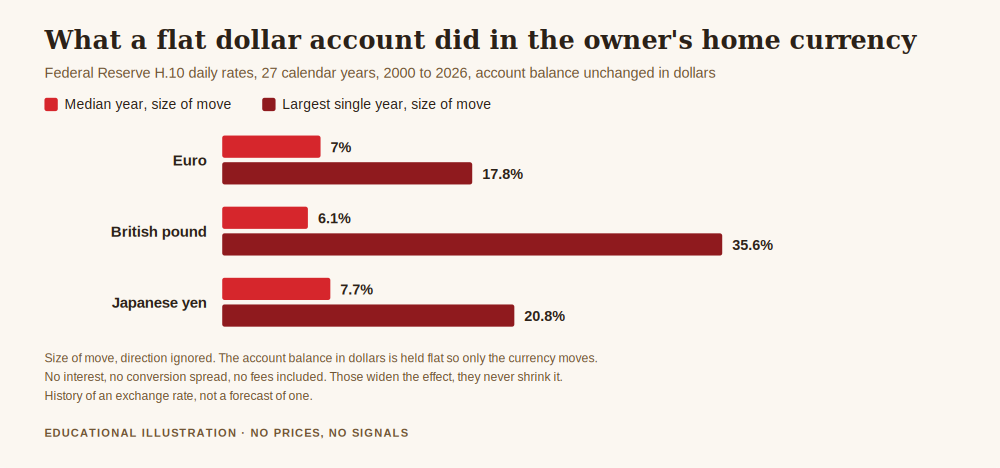
How often is it big enough to matter? For a euro based owner the currency alone moved more than 5 per cent in 19 of the 27 years, and more than 10 per cent in 7 of them. For the pound, 16 years and 8 years. For the yen, 16 years and 13 years. So the answer is not "occasionally, in a crisis". A move large enough to reshape the year's result is the normal case rather than the exception.
Put in the terms a business uses, the currency leg alone carried an annualised volatility of 9.1 per cent for the euro, 9.3 per cent for the pound and 9.9 per cent for the yen, computed from daily changes. Most traders I know would think hard before adding a position with a 9 per cent annual standard deviation on top of their strategy. Most of them already have one.
What it does to a good year
Here is the version that tends to land. Take a business that has a 12 per cent year in the account. I am using 12 per cent as a fixed reference figure to make the arithmetic legible, not as a target, a forecast or a claim about what anyone earns.
Combine that 12 per cent with the worst currency year in the sample and the euro based owner finishes at minus 7.9 per cent at home. The yen based owner finishes at minus 7.3 per cent. A year that was good by every measure inside the account is a losing year in the money that pays the rent, and no trading decision caused it.
The long run version is gentler but still real. A business that earned exactly 0 per cent in dollars from 2000 to 2026 finished down 10.9 per cent measured in euro, up 22.8 per cent measured in pounds, and up 54.6 per cent measured in yen. That last figure is about 1.64 per cent a year of pure currency drift, in this case favourable. The direction was luck. The exposure was structural.
So what should you actually do about it
I am not going to tell you which currency to pick, because the right answer depends on facts about your life that I do not have. What I can give you is the way a business would decide it, which is three questions in order.
One, what currency do your obligations arrive in? Rent, food, school fees, tax. This is the only currency in which your results actually mean anything, and it is the currency your books should report in regardless of what the account is denominated in. If your statement and your reporting currency differ, you need a conversion line in the accounts, not a shrug.
Two, does your broker offer an account in that currency, and at what cost? Many do. The trade-off is usually a slightly worse spread or a conversion charge per trade on instruments quoted in dollars. That is a real cost and it should be measured rather than assumed, but it is a known, small, recurring cost being paid to remove an unknown, large, one-off one. Businesses make that trade all the time and call it insurance.
Three, if you keep the account in a foreign currency, is the exposure deliberate and sized? There is a perfectly respectable answer here, which is yes, I am comfortable holding dollars, I consider it a diversifier, and I have decided this on purpose. That is a position with a rationale. What is not defensible is holding it by accident because of a dropdown menu you clicked once and have not thought about since.
The bookkeeping consequence matters more than most people expect. If you report in your home currency, every withdrawal crystallises a currency result that belongs in the accounts separately from trading results. Keeping those two lines apart is what lets you tell whether a flat year was a flat strategy or a strong strategy wearing a bad exchange rate, and that distinction sits at the centre of your monthly profit and loss review.
None of this changes how you trade. It changes what you measure, and it removes one way for a decent year to disappear without anyone being able to explain where it went.
Get the free REX one page trading business plan, including the reporting currency line this article argues you should fill in before you look at another result. One email, no spam, unsubscribe anytime.
Get the free business plan →Frequently asked questions
Does the account currency change my profit and loss on a trade?
Not the economics of the trade itself, which is why this is so easy to miss. If you trade gold quoted in dollars, the result of that trade is a dollar result whatever your account is denominated in, and the broker converts it. What the account currency changes is the value of the balance sitting between trades, and that balance is usually the large majority of your capital for the large majority of the year. The trade is unaffected. The business is not.
Is a dollar account better because gold is quoted in dollars?
It removes a conversion step on each trade, which is a genuine convenience and a small saving. It does not remove the exposure, it relocates it, because the balance is still in a currency you do not spend. Whether the per trade saving outweighs a currency leg with a roughly 9 per cent annualised volatility depends on how much you trade against how long the balance sits there. For most retail sized accounts the balance sits there far longer than it trades.
Where do these numbers come from?
Daily noon buying rates from Federal Reserve release H.10, from January 2000 to September 2026, 6,703 observations per currency. For each calendar year I measured the change in what one US dollar is worth in the home currency, first quote to last, holding the dollar balance flat so only the currency moves. There is no interest, no conversion spread and no fee in these figures, all of which would make the effect larger rather than smaller.
Should I hedge the exposure instead of changing the account?
You can, and for a large enough balance that is what a company would do. For most retail sized accounts the cost and the complexity of maintaining a hedge outweigh the benefit compared to the simpler route of denominating the account in the currency you actually spend. The hedge also has to be managed, which adds a second thing to get wrong. Simpler is usually better here.
What about a currency that is not in this data?
The three here are liquid major currencies and are, if anything, the calm end of the range. A home currency with higher volatility or a long term drift against the dollar makes the effect larger, not smaller, so treat these figures as a floor rather than a typical case. The method is the point, and you can run it on your own currency with the same H.10 release.
Is 12 per cent a realistic return?
It is not a claim of any kind. I picked a single round figure and held it fixed so the currency arithmetic would be readable, and any other number behaves the same way. Nothing in this article forecasts a return, promises one, or suggests any level of profit is achievable. Whatever your result is, the currency leg sits on top of it.
Where REX fits
REX Trading Signal is free, and it treats a trading account as a business with books, costs and a hurdle rate rather than a scoreboard. There is no profit promise here and there never will be, because nobody can make one honestly. The Telegram channel is where the same thinking gets applied to what the market is doing that day.
If you are tightening up the books, how to calculate real rate of return deals with the other silent adjustment that sits between a headline number and what it buys, and how to pay yourself from your trading business is where the conversion actually happens. Both sit underneath the one page trading business plan template, which is where the reporting currency belongs. The full library is at all REX articles.
About the author. Rex writes REX Trading Signal and treats an account as a business with books, costs and a hurdle rate rather than a scoreboard. He ran a dollar account from a euro life for three years and only found the missing money when he started reporting in one currency instead of two. Nothing in this article is financial, legal or tax advice, and no entry, stop or target discussed should be treated as a signal.
Sources and method. Exchange rates are the daily noon buying rates published by the Federal Reserve in statistical release H.10, covering 3 January 2000 to 25 September 2026, 6,703 daily observations for each of the euro, the British pound and the Japanese yen. Every figure here is my own arithmetic on that series: annual changes are first quote to last quote of each calendar year with the dollar balance held flat, and annualised volatility is the standard deviation of daily log changes scaled by the square root of 252. No interest, conversion spread or fee is included, and each of those would widen the effect. The 12 per cent figure is a fixed illustrative reference chosen to make the arithmetic readable, not a target, a forecast or a claim about achievable returns. Past exchange rate behaviour is not a forecast of future behaviour. Trading carries risk of loss.