
Somebody asked me this last month and I gave the short answer, which is yes, and then spent the rest of the week thinking the short answer was useless. Do I need a broker to buy stocks is a question about a supplier, and in a business you do not answer a supplier question with yes. You answer it with what the supplier does, what you are paying them for, and what happens to your inventory if they stop existing.
So here is the long answer, written the way I would write it for any other supplier in the business. What the role is, what the law obliges them to do with your property, and what you actually recover when the arrangement fails. The numbers are from the statute and the rule book, and the arithmetic on top of them is mine.
Do I need a broker to buy stocks, and what the answer actually means
For practical purposes, yes. You cannot walk onto an exchange. Access is intermediated, and the firm that intermediates it is a registered broker dealer. That part is not interesting. What is interesting is that the same firm is usually doing three separate jobs for you at once, and most people only notice the first.
Job one is access. They route your order somewhere it can be matched. Job two is custody. They hold the securities and the cash afterwards, in their name, on your behalf. Job three is record keeping. Their books are the evidence of what you own. Three jobs, one invoice, and only the first one is what the marketing talks about.
In business terms, you have outsourced your warehouse, your purchasing desk and your inventory ledger to a single supplier, and you are judging them on the purchasing desk. That is the mistake. The purchasing desk is the cheapest of the three to replace.
What the rule book obliges your supplier to do
The custody job is not left to goodwill. In the United States it is written into the customer protection rule, 17 CFR 240.15c3-3, titled "Customer protection, reserves and custody of securities". Paragraph (b)(1) is one sentence and worth reading slowly: "A broker or dealer shall promptly obtain and shall thereafter maintain the physical possession or control of all fully-paid securities and excess margin securities carried by a broker or dealer for the account of customers."
Two phrases in there do the work. "Fully-paid" means securities you own outright rather than ones financed on margin. "Excess margin securities" means the slice of your margined holdings worth more than the firm needs to secure what you owe. Everything in those two categories has to be segregated and kept out of the firm's own business.
Which tells you where the line sits. The part of your position that is genuinely yours is supposed to be ring fenced. The part that is financed by the broker is not in that protected pool in the same way, because you have pledged it. Leverage does not only change your exposure to the market. It changes the legal character of what the firm is holding for you.
What you recover when the supplier fails
Now the part people assume is a blanket guarantee. In the United States, if a brokerage fails, the Securities Investor Protection Act provides advances through SIPC. The statute, 15 U.S.C. 78fff-3, says SIPC shall advance to the trustee such moneys "not to exceed $500,000 for each customer" to satisfy the amount by which a customer's net equity claim exceeds their ratable share of customer property. Subsection (d) defines a separate, lower ceiling for cash: the standard maximum cash advance amount means $250,000, subject to an inflation review.
Five hundred thousand dollars is a fixed number, and a fixed number behaves very differently against different account sizes. On my arithmetic, holding the cap constant: a 100,000 account is fully covered, a 500,000 account is fully covered, a 1,000,000 account is 50 per cent covered, a 2,000,000 account is 25 per cent covered, and a 5,000,000 account is 10 per cent covered.
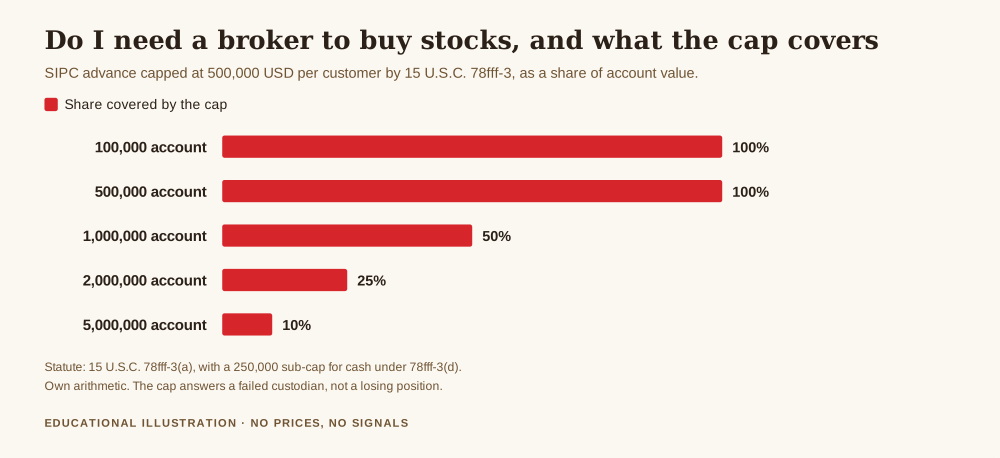
Nobody tells you this when the account grows. The protection does not scale with you. It is the same ceiling at every size, which means the percentage of your business standing behind a single supplier rises quietly every year you do well. That is textbook concentration risk, and I have written about it before in concentration risk in your trading business.
The cap is not insurance on your opinion
This needs saying plainly because the misunderstanding is common and expensive. The statutory advance is about a failed custodian, not a failed position. It exists for the case where the firm holding your property cannot produce it. It does nothing at all about a holding that fell in value. There is no cap, no scheme and no trustee for being wrong.
And it is United States law. If your broker sits in another jurisdiction, a different scheme with a different ceiling applies, or none does. Check which one covers you rather than assuming a number you read somewhere travels.
Two things in the statute worth knowing before you need them
First, capacities. Section 78fff-3(a)(2) says a customer who holds accounts with the debtor in separate capacities shall be deemed to be a different customer in each capacity. Two genuine capacities means two caps, so 1,000,000 of protection, and three means 1,500,000. The word doing the work is genuine. This is a statutory definition about the legal character of an account, not a trick for multiplying coverage by opening more logins, and getting it right is a conversation with somebody qualified rather than a decision made on a website.
Second, the cash sub-cap, which catches people who think of cash as the safe part. On a 600,000 account held 40 per cent in cash, that is 240,000, inside the 250,000 cash ceiling. Move the same account to 60 per cent cash and it is 360,000, of which 110,000 sits outside the cash ceiling. Going to cash reduced your market risk and increased the share of your balance beyond the sub-cap. Both things are true at once, and only one of them is usually noticed.
There is a third detail I find quietly instructive. Subsection (e) sets out the inflation review of the cash figure every five years, and paragraph (2) says that if the adjusted amount is not a multiple of 10,000 it is rounded down to the nearest 10,000. Rounded down. Up to 9,999 of indexation can be discarded at each review. That is not a scandal, it is just how the drafting works, but it tells you the ceiling is a legislative artefact rather than a measure of your exposure.
What my inbox sounds like on this subject
Roughly 258 messages in my inbox touch on trust and choosing who to deal with. That is a keyword count across the inbox rather than a survey, so read it as an indication of how often this comes up, not as a statistic. What strikes me is that almost none of these people are asking about returns. They are asking who is holding their money.
"Nothing much, just starting from scratch, just trusted someone with my account and they blew everything in one day," one wrote. Another: "To be honest, when I first deposited 50,000 dollars, I was very afraid of being scammed by other brokers and losing my money." A third, plainly: "It's not that I don't trust you, but seeing such reviews I decided to withdraw." And a fourth, who had worked out the mechanism without the vocabulary: "All the big platforms hold funds for a long time before they are released, they make sure it's legit."
That last one is the right instinct. Custody is a process with rules attached, and the rules are readable. The fear in those messages is reasonable. The answer to it is paperwork, not reassurance.
Where this leaves a gold or forex account
Most readers here are not buying shares. They are trading XAUUSD with a retail broker, and the honest translation is uncomfortable: the protections quoted above are written for securities accounts. A retail contract for difference or spot metal position is not a share held in custody for you. It is a contract with the firm itself, which means the firm is not your warehouse, it is your counterparty.
That removes the separation that paragraph (b)(1) is designed to create. There is no segregated pool of your own metal sitting somewhere with your name on it. So the diligence you would otherwise outsource to a statutory scheme has to be done by you, in advance, on the firm. Which regulator, which entity, what client money rules, what the published financials say. I set out how I run that review in choosing a broker like a business partner, and the operational failure cases are in what happens if your broker platform goes down.
The supplier review I run once a year
Write down the legal entity you actually contracted with, not the brand on the website. They are often not the same, and the entity decides which rules apply.
Write down which protection scheme covers that entity, and its ceiling, and then write the ceiling as a percentage of your current balance. That percentage is the number that matters, and it changes every year without anybody telling you.
Write down what would happen to open positions, not just balances, if the firm stopped trading tomorrow morning.
Write down how long a withdrawal has actually taken, from your own records, not from the published policy. A supplier's real terms are the ones they perform, not the ones they advertise.
Four lines, once a year. It is the same review I would run on any supplier holding a large share of the firm's inventory, and the whole framework sits in the one page trading business plan.
What this article is not saying
It is not saying any broker is unsafe. The rules quoted here exist precisely because the ordinary case is a regulated firm doing the custody job properly, and the overwhelming majority do.
It is not telling you to split accounts, move jurisdiction or change firm. Those decisions have costs of their own and they depend on facts about you that I do not have.
And it is not legal or tax advice. It is a reading of two published documents, both linked, with the arithmetic shown so you can replace my account sizes with yours.
Get the free REX one page trading business plan, the operating rules on a single sheet, including the annual supplier review this article describes. One email, no spam, unsubscribe anytime.
Get the free business plan →Frequently asked questions
Do I need a broker to buy stocks, in one line?
In practice yes, because exchange access is intermediated, and the same firm usually also holds your securities and keeps the record of what you own. The useful question is not whether you need one, it is what the law obliges that firm to do with your property.
Is my money safe if the broker fails?
In the United States, 15 U.S.C. 78fff-3 provides SIPC advances of up to 500,000 dollars for each customer, with cash claims limited to a standard maximum cash advance amount of 250,000 dollars. That covers a failed custodian, not a losing position, and other jurisdictions have their own schemes and ceilings.
Does the protection grow with my account?
No. The cap is fixed, so the covered share falls as the balance rises. On my arithmetic it is 100 per cent of a 500,000 account, 50 per cent of a 1,000,000 account and 10 per cent of a 5,000,000 account.
Are my shares kept separate from the broker's own assets?
17 CFR 240.15c3-3(b)(1) requires a broker or dealer to promptly obtain and maintain physical possession or control of all fully-paid securities and excess margin securities carried for customer accounts. Securities financed on margin sit differently, because you have pledged them.
Does any of this apply to my gold CFD account?
Generally not. A retail contract for difference or spot metal position is a contract with the firm rather than a security held in custody for you, so the firm is your counterparty. The due diligence has to be done on the firm in advance, because there is no segregated pool standing behind you in the same way.
Where did these numbers come from?
The 500,000 dollar advance, the 250,000 dollar standard maximum cash advance amount, the separate capacities provision and the rounding down to the nearest 10,000 at each five year inflation review are from 15 U.S.C. 78fff-3. The possession or control sentence is quoted from 17 CFR 240.15c3-3(b)(1) as published on govinfo. Both links were read on 30 October 2026. The coverage percentages, the 240,000 and 360,000 cash cases and the 110,000 shortfall are my own arithmetic on the account sizes stated, which are illustrations rather than recommendations. The reader quotes are real messages, anonymised, counted by keyword rather than surveyed.
Where REX Trading Signal Fits
REX Trading Signal is free to follow. The daily record goes up on Telegram with the losing days included. There is a free one page business plan for anyone who wants the operating rules in one document, including the annual supplier review, and an optional Kit for people who want the full system. Nothing here promises a profit and nothing here is a signal service.
About the author. Rex writes REX Trading Signal. He runs the account as a business, which mostly means knowing who is holding the inventory and on what terms before worrying about what the inventory is worth. Nothing in this article is a recommendation to trade, it is not legal advice, and no entry, stop or target discussed should be treated as a signal.