
Every business plan has a section people skip writing, and it is the one about closing. Not the exit strategy in the optimistic sense, the other one: the conditions under which this stops being a business and starts being a hobby that costs money. When should you quit trading is that section, and an account without it is an account that will find out by running out.
Almost everything written on this question is either motivational, telling you never to quit, or defeatist, telling you the odds are hopeless. Both are useless, because both are answers to a question that has not been specified. A shop does not close because the owner feels discouraged on a Tuesday. It closes when a condition written down in advance is met, and the whole value of writing it down in advance is that you are sober when you write it.
This article is about specifying the condition. It is also about the three completely different exits that get muddled together under the same word.
When Should You Quit Trading, and Which Kind of Quitting You Mean
Three decisions share one verb, and confusing them is why the question feels unanswerable.
Stopping for the session or the month. This is an operational control, a limit hit and a shop closed for the day. It has nothing to do with the viability of the business, and knowing when to stop trading covers it in full. Someone who hits a daily stop has not failed. They have used a working control.
Retiring a method. This is a product decision. One line stopped selling, so it comes off the shelf and the capital goes somewhere else. Retiring a trading strategy is a normal event in a going concern, not a verdict on the owner.
Winding down the business. This is the one nobody plans. It means the enterprise itself, not this method or this week, stops being a reasonable use of the capital and the hours. That is what this article is about, and it deserves the same cold treatment any other shutdown decision would get.
Notice that only the third one is permanent, and notice how often people reach for it when they have actually hit the first.
Price the Base Rate Before You Judge Your Own Results
Before any personal number means anything, you need the industry number, the way anyone opening a restaurant should know what fraction of restaurants close.
When ESMA introduced its retail measures on 27 March 2018, the finding underpinning them was that 74 to 89 per cent of retail accounts typically lose money, with average losses per client ranging from 1,600 to 29,000 euros. That is a published regulatory finding across member states, not a slogan.
Read it as an operator rather than as a victim. It tells you that difficulty is the normal condition of this business, so difficulty by itself is not evidence that yours has failed. It also tells you that the optimistic assumption, that persistence alone converts into competence, is contradicted by the base rate. Persistence is necessary. It is demonstrably not sufficient, and a shutdown criterion is what stops you from testing that proposition with all of your money.
The Runway Calculation, Which Is Where the Answer Actually Lives
Here is the arithmetic that turns the question into a date on a calendar.
Take a business with 20,000 US dollars of capital and fixed running costs of 120 dollars a month, for data, a platform and a server. Now take a monthly risk ceiling, the most this business is permitted to lose in any month, and ask the pessimistic question every operator should ask: if every single month from here loses the full ceiling, how long before we reach a wind-down line set at 30 per cent of capital gone?
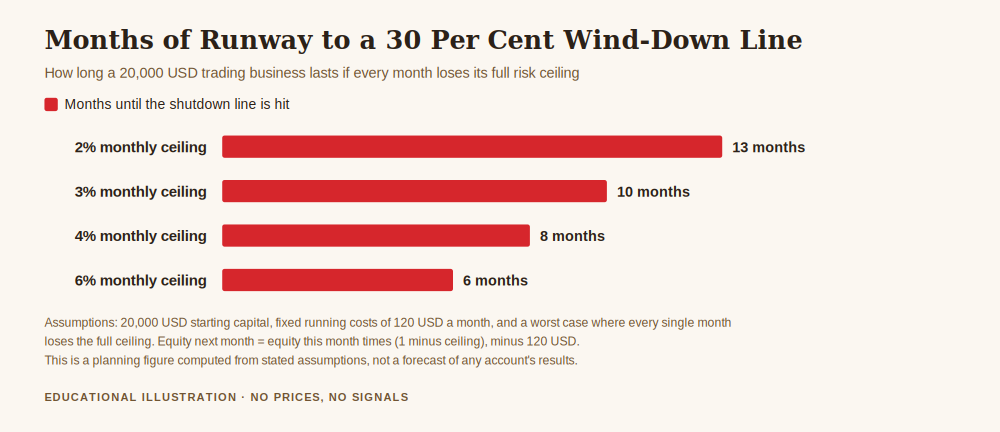
At a 2 per cent monthly ceiling, 13 months. At 3 per cent, 10 months. At 4 per cent, 8 months. At 6 per cent, 6 months. Every one of those is a worst case that will almost certainly not happen exactly, and that is the point of a worst case. It is the planning figure, not the forecast.
Carry the 4 per cent case further and the shape becomes clearer. After six months the account is down 25.0 per cent, after twelve it is down 44.5 per cent, after eighteen 59.8 per cent, and after twenty-four 71.8 per cent. The line is not linear, because each month's loss is taken on a smaller base while the fixed costs stay the same size. Late months hurt disproportionately, which is exactly when people are most reluctant to stop.
Two things fall out of this that are worth having in writing.
The first is that your risk ceiling is not only a risk control, it is a clock. Choosing 6 per cent a month over 2 per cent is choosing six months of runway over thirteen. Whether the method needs thirteen months to prove itself is a separate question, and if it does, then 6 per cent was never affordable regardless of how it felt.
The second is that the wind-down line has to be set in advance, at a level you can still recover from. A business that decides to close at 30 per cent down still has 70 per cent of its capital. One that waits until 80 per cent down has almost nothing left to redeploy, and by then the recovery arithmetic has become the dominant fact of its life.
The Cost Nobody Puts on the Balance Sheet
Capital is the visible input. Time is the larger one, and leaving it out of the accounts is how a failing business looks cheaper than it is.
Suppose this business takes fifteen hours a week, which is modest for anyone doing their own analysis, journalling and review. That is roughly 65 hours a month, or 780 hours in a year. Price those hours at a stated alternative value of 20 dollars an hour, which is only a figure for the arithmetic and not a claim about what your hours are worth, and the year cost 15,600 dollars of time against 20,000 dollars of capital.
Run it for two years and the time bill is 1,560 hours, or 31,200 dollars, which is 1.56 times the entire capital of the business. Most people deciding whether to continue are weighing only the capital, which means they are weighing the smaller number and ignoring the larger one.
This is opportunity cost stated in the plainest possible terms. It does not tell you to quit. It tells you that "I have not lost much money" is an incomplete defence of continuing, and that the honest ledger has two columns.
What a Real Shutdown Criterion Looks Like
A criterion you can act on has four properties, and vague intentions have none of them.
- It is a number, decided while you are flat and calm. "I will close the business if capital falls 30 per cent from the starting figure" is a rule. "I will stop if things do not improve" is a mood with a future tense.
- It has a time limit as well as a money limit. Capital preserved while nothing improves for two years is not success, it is a slower version of the same outcome, with the time bill above running the whole while.
- It names what would count as improvement. Not profit, which arrives too slowly and too noisily to steer by, but process: rules followed, risk taken as planned, the metrics the business actually tracks moving in the right direction.
- It is written where you will find it. A criterion held in your head will be renegotiated by the version of you who is 28 per cent down, and that person is not a neutral party.
Write it once, into the business plan, beside the risk limits. It takes four lines.
Two Bad Reasons to Quit, and Two Good Ones
Not every impulse to stop is information.
The bad reasons are short. A losing streak inside your planned risk is not a reason, because that is the product performing as designed, and a business that closes on its first ordinary bad quarter never had a plan. A single large loss taken inside the rules is not a reason either, it is a cost line, and a losing trade is a business expense covers why treating it as a verdict damages the next decision.
The good reasons are also short, and they are structural rather than emotional. The first is that the business no longer fits the life it has to live in: the hours are not there, the capital is needed elsewhere, or the stress is being paid for by someone who did not agree to pay it. That is a legitimate wind-down and it says nothing about ability. The second is that the criterion you wrote down has been met. That is the whole purpose of having written it, and the moment it is met is precisely the moment you will want to argue with it.
If You Do Wind Down, Do It Like a Business
A closure done properly leaves you with assets. A closure done in a panic leaves you with a story.
Close the positions deliberately rather than abandoning the terminal with trades open. Withdraw the remaining capital rather than leaving it to drift. Keep the records, because the journal and the statements are the asset you built and the only thing that can tell a future version of you what actually happened. Write one page on what you would need to see before reopening, and be specific, because "when I feel ready" will be true on any given Thursday.
And leave the door open without leaving the account open. Plenty of people wind down, spend two years building capital and skill elsewhere, and come back with the thing they were missing the first time. That is an ordinary business path. It is not a failure, and the version who quits cleanly at 30 per cent down has vastly more optionality than the one who stayed until there was nothing left to decide with.
Get the free REX one page trading business plan, the sheet where your risk limit, your review schedule and the shutdown line described on this page live together instead of in your head. One email, no spam, unsubscribe anytime.
Get the free business plan →Frequently Asked Questions
When should you quit trading, in one sentence?
When a condition you wrote down while calm has been met, either the capital line or the time limit, or when the business no longer fits the life it has to run inside. Not when a losing week makes the question feel urgent.
Is a 30 per cent drawdown the right shutdown line?
It is the figure used in the arithmetic above, chosen because it leaves 70 per cent of the capital intact and available. The right line for you depends on what the capital is for and what else you have, and this article deliberately does not set it for you. What it argues is that the line should exist and should be numeric.
How long should I give it before deciding?
Long enough that the sample means something and short enough that the time bill stays affordable. The runway chart above is the constraint on the second half of that sentence: your monthly risk ceiling decides how many months you can actually fund, and a method needing longer than your runway is a method you cannot afford to test.
Should I quit if I keep breaking my own rules?
That is a different diagnosis, and it usually points to process rather than closure. Rules broken repeatedly mean the rules are unworkable, the size is too large to sit with, or the review is not happening. Fix the smallest of those first, and set a date by which the rule-breaking has to have stopped.
Where did the numbers in this article come from?
The 74 to 89 per cent retail loss range and the average loss figures are quoted from the ESMA measures linked in the text, checked live before publication. The runway figures are computed from stated assumptions: 20,000 dollars of capital, 120 dollars a month of fixed costs, and a worst case in which every month loses the full ceiling, with next month's equity equal to this month's times one minus the ceiling, minus the fixed costs. The time cost is 15 hours a week priced at an assumed 20 dollars an hour. None of it is a forecast or a performance claim.
Where REX Fits
REX is free to follow. Daily XAUUSD setups posted live on Telegram with a stop loss, a reason and a rule, wins and losses alike. There is a free one page business plan for anyone who wants the operating structure in one place, and an optional Kit for people who want the full method. Nothing here promises a profit and nothing here is a signal service.
The shutdown line belongs in the plan next to the risk limits. The one page trading business plan template is the pillar this article sits under, how to know if trading is for you is the same decision taken at the other end, before the business opens, and the break-even point of your trading business is the cost line the runway calculation above rests on. More about who writes this is on the about page.
About the author. Rex writes REX Trading Signal and looks at an account the way an owner looks at a set of books, which includes being willing to read the page about closing. He thinks the refusal to write a shutdown criterion is the most expensive piece of optimism in this business. Nothing in this article is a recommendation to trade, and no entry, stop or target discussed should be treated as a signal.
Disclaimer: This article is general educational content about business planning, runway arithmetic and decision criteria in retail trading. It is not financial advice, not investment advice and not a recommendation to trade, to continue trading, to stop trading, or to use any firm or product. Regulatory wording is quoted from the source linked in the text and may change, and rules vary by jurisdiction. Trading leveraged products carries a substantial risk of loss and most retail accounts lose money. Figures are illustrative calculations from stated assumptions, not predictions or performance claims.