
Every real business has a closing time. The restaurant stops seating at ten, the workshop downs tools at five, and nobody involved treats it as a failure of ambition. Trading is the only business I know of where the operator sits at the desk until something makes them leave, and where leaving voluntarily is quietly regarded as weakness. So this is the operations question worth settling before you next sit down: how to know when to stop trading, decided in advance, by a rule, in the same way you would decide any other limit in a business you actually owned.
I want to be precise about the scope. This is not an article about giving up. It is about the two stopping rules every trading business needs, one for the day and one for the account, and about the arithmetic that says why the second one has to exist before you need it.
How to Know When to Stop Trading Starts With a Closing Time
A limit is not a prediction. When a shop sets a float for the till, it is not forecasting a robbery. It is deciding, while calm, how much it is willing to lose in the worst version of an ordinary day, and then arranging things so that the worst version cannot get worse than that.
Your trading day works the same way, except that the loss is not capped by anything physical. The market will keep quoting. The platform will keep accepting orders. Nothing external stops you, which means the only closing time you will ever have is the one you install yourself, and you have to install it on a day when nothing is going wrong, because a limit written mid-drawdown is not a limit, it is a negotiation.
The Arithmetic That Makes Stopping Compulsory
Here is why the daily rule matters more than it looks. Recovering from a loss is not symmetric with taking it, because the gain has to be earned on a smaller balance.
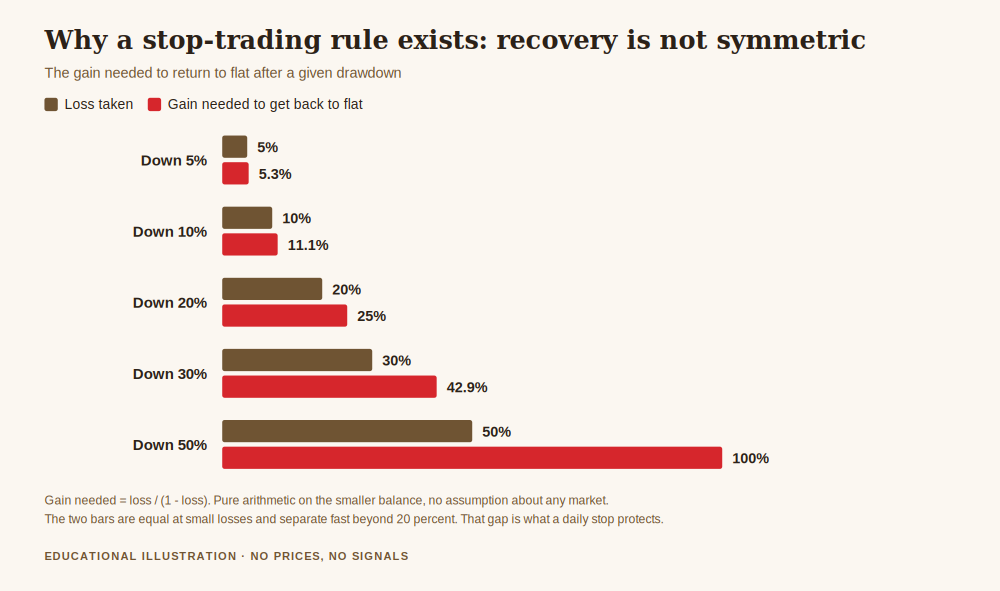
The formula is simply the loss divided by one minus the loss. Down 5 percent and you need 5.3 percent to get level, which is close enough to symmetric that nobody notices. Down 10 percent and you need 11.1 percent. Down 20 percent and you need 25 percent. Down 30 percent and you need 42.9 percent. Down 50 percent and you need to double what is left just to get back to where you started.
That curve is the whole argument. In the shallow zone the penalty for a bad day is roughly proportional and the business absorbs it. Past about 20 percent the penalty starts compounding against you, and the account stops being a business with a bad quarter and becomes a business that needs an exceptional run just to be ordinary again. A stop-trading rule is the mechanism that keeps you in the shallow part of that curve. It is not caution, it is arithmetic.
Rule One: The Daily Stop, and What It Should Cost You
A daily stop is a maximum loss for one session, expressed in R, where 1R is the loss on a single trade taken at your normal risk. Three R is a common and defensible ceiling. Hit it, and the desk closes, whatever the chart is doing.
The objection is always the same, and it is a fair one: will that not fire constantly? Let us size it rather than argue about it. Assume you take three setups on a normal day and each has a 55 percent chance of being a loser, which is entirely compatible with a profitable business if your winners are larger than your losers. The chance of all three losing is 0.55 cubed, which is 16.6 percent, or roughly one day in six. Over 250 sessions that is about 42 days a year. Push the loss probability to 60 percent and it is 21.6 percent of days, about 54 sessions a year.
So yes, it fires often. That is the correct answer, not a problem with the rule. A limit that almost never triggers is set too wide to be doing any work, and one that fires one day in six is doing exactly the job it was installed for. Those numbers are worked from stated assumptions rather than measured from anyone's account, and if your own trade count or hit rate differs, redo the multiplication, it takes ten seconds.
What the Rule Is Actually Protecting You From
Not the three losses. The three losses were priced in the moment you sized them, and a 3R day is a survivable, boring, entirely normal outcome.
What it protects you from is the fourth trade, and the fifth, taken at four times the usual size, because at that point the objective has quietly changed from running the business to getting the money back today. Follow that through. A day where the stop is honoured costs 3R and ends. The same day continued at quadruple size, with three more losers, costs 12R more, for a total of 15R. If 1R is one percent of the account, that is a 15 percent hole where a 3 percent one was scheduled, and it now requires a 17.6 percent gain to repair.
One decision, taken while annoyed, converted a routine Tuesday into a quarter of remedial work. The daily stop is not there to protect you from the market. It is there to protect the business from its operator on the specific afternoons when the operator should not be trusted with the platform. Every serious business has controls of this kind, and none of them are insults to the person they constrain.
Rule Two: The Account Stop, or When to Close the Shop for the Month
The second rule operates on a longer clock. A monthly or account level drawdown limit, often somewhere between 6 and 10 percent, is the point at which you stop trading live entirely, rather than for the afternoon.
Stopping here is not a punishment, it is a diagnostic pause, and it should be written down as a defined procedure rather than left to mood. The account goes flat. You spend the time reviewing the last thirty trades to find out whether you departed from the plan, whether the plan itself has stopped working, or whether this is ordinary variance in a method that is still sound. Those three findings lead to three completely different actions, and you cannot tell them apart while positions are open and money is moving.
Set the return conditions in advance too, otherwise the pause ends the first time you feel better, which is not evidence of anything. A defined re-entry looks like a written review completed, a stated reason for the drawdown, and a return at reduced size for a defined number of trades before normal size resumes. The one page trading business plan template exists precisely so that these limits live on paper rather than in memory, which is the only place they survive contact with a bad week.
The Third Kind of Stopping, and It Is Not About Losses
There is a version of this question that has nothing to do with drawdown, and it is the one most likely to apply to you today.
Stop when the conditions your method needs are absent. If your process is built on a session that is not running, or on a structure that has not formed, then trading is not the business operating, it is the business inventing work to justify the hours. A quiet market is not an underperforming market, it is a market with nothing to sell you, and the correct response is the one any shop takes on a slow day. This is the whole subject of what a business owner does when the market goes quiet.
Stop when you are not fit to operate. Illness, exhaustion, a bad night, a real problem elsewhere in your life. No other business would let someone in that state near the equipment, and the fact that trading requires no physical exertion has convinced a lot of people that it requires no capacity either. It requires more.
Stop when the market state has changed underneath the method rather than the method having failed. That is a different finding from a drawdown, and it leads to retiring the strategy rather than pausing the operator, which is why the review at the account stop matters so much.
Writing the Rule So It Survives the Day It Is Needed
A rule you hold in your head is not a rule, it is an intention, and intentions lose arguments to open positions. Three things make the difference between a control that works and one that reads well.
Write it as a number, before the session. Three R, or a fixed cash figure, decided while flat. Vague formulations like "stop when it feels wrong" fail exactly when they are needed, because during a losing run everything feels wrong and nothing feels decisive.
Make stopping physical. Close the platform, close the charts, leave the room. A rule that permits you to keep watching is a rule that will be renegotiated within the hour, because watching is how the fourth trade gets proposed in the first place.
Log the stop as a normal business event. It goes in the journal alongside everything else: date, the level that triggered it, what happened before. After a few months you have a record of how often it fires and what preceded it, which is the only way to find out whether your real problem is a daily loss limit or something upstream of it, such as trading a session your method was never built for.
The Number That Puts This in Context
It is worth knowing what the regulators observed when they looked at retail accounts in aggregate. When the European Securities and Markets Authority introduced its restrictions on contracts for difference, it recorded that "74-89% of retail accounts typically lose money on their investments", and it capped retail leverage on gold at 20:1 in response.
Read that as an operations finding rather than a warning label. A regulator looked at the industry, concluded that most accounts were losing, and imposed a ceiling on how fast that could happen. Somebody is going to set a limit on your trading business. The only question is whether it is you, in advance, at a level you chose, or someone else, after the fact, at a level chosen for the average of everyone. Knowing how to know when to stop trading is just the decision to be the one holding the pen.
Get the free REX one page business plan, the sheet where the daily stop, the account drawdown limit and the return conditions live in one place instead of in your memory. One email, no spam, unsubscribe anytime.
Get the free business plan →Frequently Asked Questions
How to know when to stop trading for the day, in one sentence?
When you reach the loss limit you wrote down before the session started, and not one trade later, regardless of what the chart is showing at that moment.
Is a 3R daily stop too tight?
On the worked assumptions above it fires roughly one day in six, or about 42 sessions a year, which is frequent enough to be doing real work and rare enough to leave a normal business operating. If yours never fires, it is set too wide to protect anything.
Should I stop after a big win as well?
There is a reasonable case for it. The trade taken immediately after an unusually good one is often sized on confidence rather than on the plan, which is the same failure mode as revenge trading wearing better clothes. A daily profit target is a weaker control than a loss limit, but it removes one predictable error.
What if I stop and the setup I wanted then works perfectly?
It will happen, and often. The cost of the rule is the trades it makes you miss, and that cost is real. It is the premium you pay for the guarantee that no single session can put you in the steep part of the recovery curve, and on any long enough sample, that is the cheaper of the two arrangements.
How long should the account level pause last?
Long enough to complete the review, not a fixed number of days. Returning because the calendar says so misses the point, since the pause exists to produce a finding, not to serve a sentence.
Where REX Fits
REX Trading Signal is free to follow. Daily XAUUSD analysis with the reasoning attached, losing days included, plus an optional Kit for people who want the operating system written down. Nothing here promises a profit and nothing here ever will.
A stopping rule is a control, and controls belong in writing. The one page trading business plan template is where the daily stop and the drawdown limit go. How to manage risk in gold trading covers the sizing decision that sets what 1R actually costs you, which is upstream of every number in this article. The trading rules checklist is the pre-session version of the same discipline, and why most traders blow their accounts describes what the steep end of that recovery curve looks like from the inside.
About the author. Rex writes REX Trading Signal. He is interested in the unglamorous half of this business, the costs, the controls and the review dates, on the view that an account survives on its operating discipline long before it succeeds on its ideas.
Disclaimer: This article is general educational content about risk controls for an active trading account. It is not financial advice, not investment advice, and not a recommendation to adopt any particular limit, method or instrument. Trading gold, CFDs and leveraged products carries a high risk of losing money rapidly, and no entry, stop or target discussed should be treated as a signal. The figure that "74-89% of retail accounts typically lose money on their investments" and the 20:1 retail leverage cap on gold are quoted from the European Securities and Markets Authority announcement of 27 March 2018, and describe retail contract for difference accounts across the European Union at that time rather than gold trading specifically or the present day. The recovery figures of 5.3, 11.1, 25, 42.9 and 100 percent were computed by me as loss divided by one minus loss, which is arithmetic on a balance and assumes no deposits or withdrawals. The daily stop frequencies of 16.6 percent, about 42 sessions, 21.6 percent and about 54 sessions were computed by me on stated assumptions: three independent setups per session, a per-trade loss probability of 55 or 60 percent, and 250 sessions in a year. Real trades are not independent and real loss rates vary, so these illustrate the scale of the question rather than predicting anyone's results. The 3R and 15R figures and the 17.6 percent recovery are arithmetic illustrations on a stated 1 percent risk unit, and are neither targets nor claims about returns. The 3R daily limit and the 6 to 10 percent account limit are examples of commonly used ceilings, not recommendations, and the right level depends on circumstances this article knows nothing about. No gold price level is quoted anywhere in this article and no trading results are represented.