
Nobody opens a restaurant without asking whether they can stand the hours. They ask it before the lease, not after, because the honest answer changes what happens to their money. Trading is the only business I know where people skip that step entirely, fund an account first and find out afterwards. So let us do it properly and in the right order: how to know if trading is for you, decided the way a business owner decides whether to open at all.
This is a feasibility check, not encouragement. I am going to give you four tests with numbers attached, and two of the four are designed to talk you out of it. If they do, that is the check working. Walking away after a fortnight of arithmetic is the cheapest outcome available on this page, and it is a legitimate result rather than a failure. No gold price appears here, and nothing in this article is a signal.
How to Know If Trading Is for You: Start With the Base Rate
A business owner assessing a market looks at what happens to the people already in it. Not the ones on the poster, all of them.
That number exists, and it comes from a regulator rather than a marketing department. When the European Securities and Markets Authority announced its restrictions on contracts for difference on 27 March 2018, it published what the national regulators had found across EU jurisdictions: 74 to 89 percent of retail accounts typically lose money, with average losses per client ranging from 1,600 to 29,000 euros.
Read that as an operator, not as a victim. It is not a prophecy about you, and it is not a reason nobody should do this. It is a base rate, and base rates are how you size an opportunity. If you were shown a franchise where three quarters to nine tenths of the operators lost money, you would not refuse to look at it. You would ask a much better question, which is what the surviving minority did differently, and whether you are willing to do that thing for years before it pays.
Notice the second half of the finding, because almost nobody quotes it. The average loss per client ran from 1,600 to 29,000 euros. That is a range of costs, not a range of tragedies, and it converts the whole question into arithmetic you can actually do. On an annual income of 30,000 euros, the low end of that range is 5.3 percent of a year's income and the high end is 96.7 percent of it. On 60,000, the same figures are 2.7 percent and 48.3 percent.
My own arithmetic on their published range, and the assumption is stated: I am treating the average loss as a first year cost of learning, paid out of money that is already spare. Now the test is answerable. Would the high end of that range change how you live? If yes, you have not found a reason to be discouraged. You have found out that you are not funded for this yet, which is a completely different problem with a completely different solution.
Test Two: Can You Sit Through the Streaks?
This is the test almost nobody runs, and in my experience it is the one that actually decides who stays.
People imagine that a working method feels like working. It does not. A method with a genuine edge still produces long runs of losses, and the runs are much longer than intuition suggests. So I calculated exactly how long, over a year of trading.
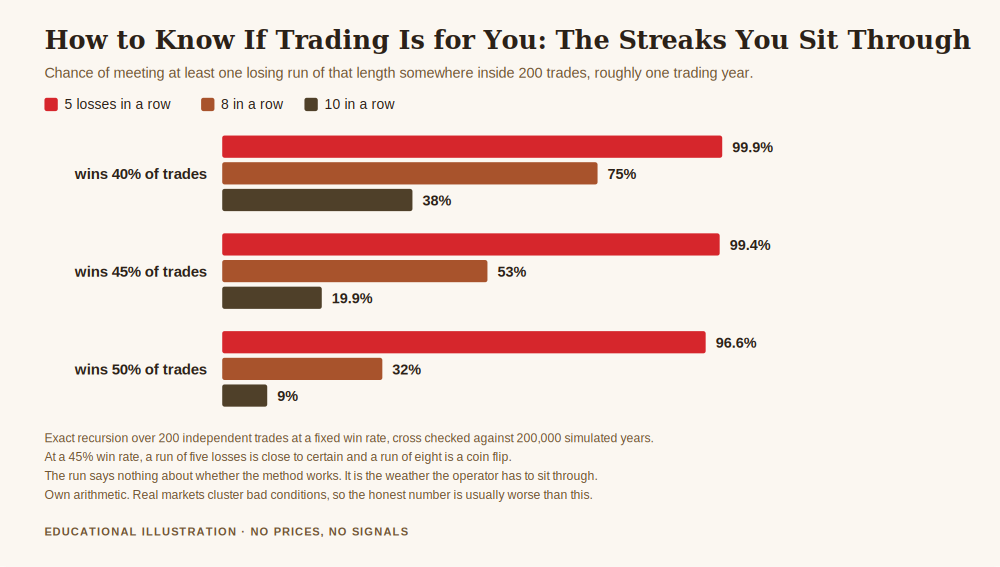
Take 200 trades, which is roughly one a trading day for a year, and a win rate of 45 percent. The probability of meeting at least one run of five consecutive losses somewhere in that year is 99.4 percent. A run of eight in a row is 53 percent, close enough to a coin flip. A run of ten in a row is 19.9 percent, so it turns up in about one year in five.
Those are exact figures from a recursion over independent trades at a fixed win rate, cross checked against 200,000 simulated years. And even at a 50 percent win rate, which is better than most people ever achieve after costs, eight losses in a row still arrive in about a third of years.
Read what that means carefully, because it is the whole test. Nothing in those numbers says the method is broken. A run of eight is what a 45 percent win rate looks like from the inside, every year, by construction. The question the arithmetic puts to you is not whether you can find a better method. It is whether you can execute the same rules on the ninth trade, at the same size, after eight consecutive losses, with your own money gone and nobody to talk to about it.
Most people cannot, and the failure does not look like giving up. It looks like a small, reasonable adjustment on trade seven. That is the moment the business ends, and it is worth knowing in advance that the moment is coming, because it is scheduled by the mathematics rather than by bad luck. I wrote the ceiling side of this in how to know when to stop trading.
One honest caveat in the other direction. Real markets cluster their bad conditions rather than dealing them independently, so the true streaks are usually worse than the table above, not better.
Test Three: Do You Have the Hours, at the Right Hours?
This one is dull and it disqualifies more people than temperament does.
A trading business needs three separate blocks of time, and they are not interchangeable. There is time in front of the market, which has to coincide with the hours you have chosen to trade rather than the hours you happen to be free. There is preparation before it and a review after it, which is where the actual improvement happens. And there is the administrative block, the records and the monthly accounts, which nobody wants and which is the difference between a business and a hobby.
Be specific. Write down which hours of which days you can be at a screen, reliably, for the next twelve months, allowing for your job, your family and the weeks you will be ill. Then check that block against the session you intend to trade. A great deal of misery comes from people trying to trade a session that overlaps their working day, then blaming their psychology for what is really a scheduling conflict. If the honest answer is a few hours in the evening, that is workable, but it decides your market and your holding period for you, and the decision is better made now than by accident. How to day trade with a full time job goes through the constraint properly.
The part people forget is that the preparation and review blocks are not optional extras. Skip them and you have not saved time, you have removed the mechanism by which the first block gets better. You are then simply paying for lessons and throwing away the notes.
Test Four: Are You Willing to Keep the Books?
Ask yourself, honestly, whether you would record every trade, including the ones taken outside your rules, especially those, in a form you would be willing to show someone.
This sounds like a small administrative question. It is the largest of the four, because it is the only one that tests whether you will operate this as a business at all. Without a record you cannot tell a bad method from a bad run, which means you cannot make a single evidence based decision for as long as you trade. You will change methods after losses and keep methods after wins, which is exactly backwards, and no amount of intelligence compensates for it.
It also predicts the others. Someone who will keep an honest record during a losing month will generally sit through the streak in test two, because they can see it is a streak. Someone who will not is reacting to feelings without data, and the streak will end them. The trading journal template is the version I use, and treat trading like a business is the argument behind it.
Get the free REX one page business plan, the sheet where you write down the four answers on this page while you are calm, so that a bad month cannot quietly rewrite them later. One email, no spam, unsubscribe anytime.
Get the free business plan →Frequently Asked Questions
How to know if trading is for you, in one answer?
Run four checks before you fund anything: whether the money you would put at risk is genuinely spare, whether you can execute the same rules after eight consecutive losses, whether your available hours match the session you intend to trade, and whether you will keep an honest record. Three yeses and one no is a no for now, not forever.
Does a losing streak mean my method does not work?
Usually not. At a 45 percent win rate over 200 trades, a run of five losses is 99.4 percent likely and a run of eight is 53 percent likely. Those runs are what the win rate looks like from the inside. Judging a method by its worst streak is judging it by the part that carries the least information.
Is a 74 to 89 percent loss rate a reason not to start?
It is a reason to start differently. It tells you the default outcome is a loss, so anything that resembles the default approach is unlikely to work. It says nothing about you specifically, and it is drawn from retail CFD accounts in EU jurisdictions rather than from every trader everywhere.
How much capital do I need before this is sensible?
There is no universal figure, and anyone who gives you one does not know your circumstances. The test that does work is the one above: could you lose the entire amount, and would that change how you live? If it would, the amount is too large for you regardless of what it is.
Can I answer these tests before I have traded at all?
Partly. The capital and hours tests you can answer today. The streak test you can only estimate, which is why a period of recorded, small or simulated trading through a genuine losing run is worth more than any amount of reading, including this article.
What if the honest answer is no?
Then you have saved yourself a range of money that a regulator measured at 1,600 to 29,000 euros per client, plus a year of evenings. That is a good result from a feasibility check, and it is the result most feasibility checks in every industry are supposed to produce.
Where did the figures in this article come from?
The 74 to 89 percent loss range and the 1,600 to 29,000 euro average loss range are quoted from ESMA's announcement of 27 March 2018, linked above. All streak probabilities are my own arithmetic, an exact recursion over 200 independent trades at a fixed win rate, cross checked against 200,000 simulations, and the income percentages are simple division on the ESMA range with the assumptions stated in the text.
Where REX Fits
REX Trading Signal is free to follow. Gold analysis and trade ideas posted with the reasoning attached, losing days included, plus an optional Kit for people who want the operating side written down. Nothing here promises a return, because a business that promises returns is not a business.
That is also why this article is happy to talk you out of it. The one page trading business plan template is the pillar this sits under, and it is where the four answers above belong in writing. Treat trading like a business is the argument in full, the fixed and variable costs of a trading business is the feasibility question asked about money instead of temperament, and when should you go full time as a trader is the same decision taken years later with far more at stake.
About the author. Rex writes REX Trading Signal. He is interested in the unglamorous half of this business, the costs, the controls and the review dates, on the view that the interesting half takes care of itself once the dull half is written down.
Disclaimer: This article is general educational content about assessing whether to commit capital and time to trading, and about the arithmetic of losing streaks. It is not financial advice, not career advice, not a recommendation to buy or sell any asset, and not a solicitation to trade. The 74 to 89 percent retail loss range and the 1,600 to 29,000 euro average loss range are quoted from the European Securities and Markets Authority announcement of 27 March 2018 and describe retail CFD accounts in EU jurisdictions during that period; rules and outcomes differ by jurisdiction and change over time. Every probability and percentage of income is my own arithmetic on the stated assumptions, and is not a forecast, not a measurement of any market, and not a claim about anyone's results. No gold price appears in this article. Trading gold, CFDs and leveraged products carries a high risk of losing money rapidly, and no entry, stop or target discussed should be treated as a signal. Readers should consider their own circumstances and speak to a licensed professional in their jurisdiction.