
It arrives as a good problem. The account has grown, the method has held up for a few months, and the obvious next step is to trade bigger. So the question becomes how to scale forex account size sensibly, and most people answer it by simply increasing the lot size one morning and seeing what happens.
That is not scaling. That is a capacity decision taken without a capacity plan, and it is the single most common way a business that was working stops working. A haulage firm that doubles its fleet without doubling its maintenance, its drivers and its cash buffer does not become twice the business. It becomes a fragile version of the old one.
An account behaves the same way, with one difference that makes it harsher: the downside scales at exactly the same rate as the upside, and the repair cost does not scale linearly at all. This article is about the arithmetic of that, and about what a written scaling rule looks like.
How to Scale Forex Account Size Without Doubling Your Fragility
Start with the thing that actually changes when you scale, because it is not your profit.
If you risk a fixed percentage of equity per trade, your position size already scales automatically. Grow the account by 40 percent and every position is 40 percent larger without you touching anything. That is fixed fractional sizing, and it is the default most people should stay on, because it scales the business in proportion to the capital that supports it.
What people usually mean by scaling is something different: increasing the percentage risked per trade. That is not growth, it is a change in the risk profile of the business, and it deserves to be treated as the significant decision it is rather than as a small adjustment to a number in a box.
The distinction matters because the two have completely different risk consequences. Growing the account and keeping the percentage fixed leaves your worst case unchanged as a share of capital. Raising the percentage moves your worst case, permanently, on every trade you take from then on.
The Arithmetic That Makes Scaling Expensive
Here is the fact that should sit at the top of any scaling plan, and it is pure arithmetic with no assumptions about markets at all.
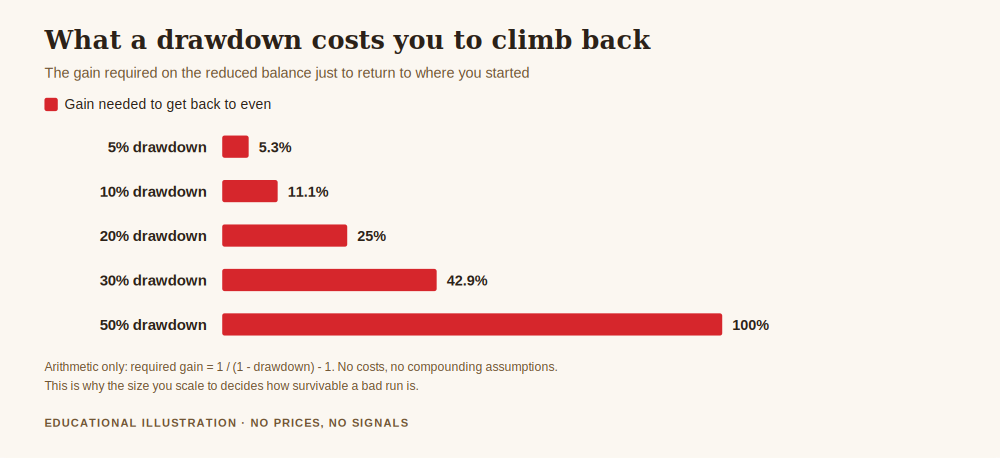
A drawdown and its recovery are not symmetrical, because the gain has to be earned on a smaller balance than the loss was taken on. Lose 10 percent and you need 11.1 percent to get back. Lose 20 percent and you need 25 percent. Lose 30 percent and you need 42.9 percent. Lose half and you need to double what is left. The formula is one divided by one minus the drawdown, minus one, and the chart above plots it.
Now connect that to position size. If your risk per trade is 1 percent, it takes 22.2 consecutive losses to reach a 20 percent drawdown. At 2 percent it takes 11. At 3 percent it takes 7.3. At 5 percent it takes 4.4.
Read those two paragraphs together and the cost of scaling becomes concrete. Moving from 1 percent to 3 percent did not triple your risk. It cut the number of bad trades you can absorb before needing a 25 percent gain from twenty two down to seven, and seven is a number that occurs.
How Often Seven Losses in a Row Actually Happen
This is where intuition fails badly, so it is worth computing rather than guessing.
Assume a method that loses 55 percent of its individual trades, which is entirely normal for an approach that makes its money from the size of its winners rather than their frequency. Assume trades are independent, which is a simplification but a reasonable one for this purpose. Over a run of 100 trades, the probability of hitting at least one streak of six consecutive losses is 72.9 percent. For a streak of seven, it is 49.7 percent.
Those figures come from a Markov chain over the streak length, and I checked them against a 200,000 run simulation, which agreed to the decimal shown. The point is not the precision. The point is that a seven loss streak inside a hundred trades is roughly a coin flip, not a disaster scenario.
So a trader at 3 percent risk is not running a small chance of a 20 percent drawdown. They are running an ordinary chance of it, within a single normal year of trading. Whether that is acceptable is a business decision, and it is a legitimate one to make deliberately. What is not legitimate is making it accidentally, by typing a bigger number into the lot field on a good Monday.
The Ceiling Somebody Else Sets
There is also a hard limit on scaling that has nothing to do with your preferences, and it is worth knowing where it sits.
Retail leverage is capped by regulation in many jurisdictions. Under the product intervention measures introduced by the European Securities and Markets Authority, retail leverage on gold is capped at 20 to 1, with 30 to 1 for major currency pairs. At 20 to 1, the margin required is 5 percent of the notional position, so your account size sets a ceiling on the size you can carry regardless of how confident you feel.
The same measures impose a margin close out at 50 percent of the required margin, on a per account basis, and negative balance protection so that a retail client cannot lose more than the account holds. Read those as what they are: a regulator installing the risk limits that a large share of accounts had not installed for themselves. The same source records that 74 to 89 percent of retail accounts typically lose money, with average losses per client ranging from 1,600 to 29,000 euros.
That range is the part worth dwelling on for a scaling article. Those clients traded the same markets in the same period. The difference between the bottom and the top of that range is substantially a difference in how much was risked per decision, which is precisely the variable you are proposing to increase.
A Scaling Rule You Can Actually Write Down
A business scales on triggers that were defined before the moment of decision, not on how the last few weeks felt. Here is the shape of a rule that works, with the numbers left for you to set.
- Scale on a trade count, not on a balance. A minimum number of trades since the last change, so that you are responding to a sample rather than to a run. Balance targets reward luck. Trade counts at least require persistence.
- Scale in steps, and make them small. Moving risk per trade from 1 percent to 1.25 percent is a business decision you can reverse. Moving it to 3 percent is a different business, and you will not find out which one you prefer until the streak arrives.
- Define the step down before the step up. This is the half everyone skips. Write the drawdown level at which size returns to the previous step, and treat it as automatic. A business with no plan to reduce capacity in a downturn is not a business with a growth plan, it is a business with a hope.
- Keep the review schedule ahead of the size. If you were reviewing weekly at the old size, you review weekly at the new one before it takes effect, not after something goes wrong.
- Withdraw something on the way up. Capital that has left the account cannot be given back to the market. A firm that never takes a distribution is not growing, it is accumulating exposure.
The step down rule is the one that turns this from a wish into a system. Scaling up is easy to do and feels like progress. Scaling back down is unpleasant, arrives exactly when your judgement is worst, and is the only thing that makes the step up survivable.
Capacity Has a Second Limit, and It Is Not Your Account
Money is not the only thing that has to scale, and it is usually not the first constraint you meet.
The same positions that felt routine at one size feel different at four times that size, and the person managing them is the same person. Rules that were easy to follow when a loss was a rounding error become genuinely hard when a loss is a month of expenses. This is not a character flaw, it is a predictable feature of scaling, and businesses handle it by moving in steps small enough that the operator stays the same operator.
Liquidity is the other quiet limit. At small size your orders take the price you see. At some larger size they do not, and that transition is invisible until it has already cost you. If you are scaling, add average slippage per trade to your review sheet and watch whether it drifts as size grows. A rising cost there is your account telling you it has outgrown the way you are executing, which is a capacity problem no risk percentage will fix.
What Scaling Is Actually For
Worth asking plainly, because the answer changes the plan.
If the aim is to reach a particular income, then the question is what capital produces that income at a survivable risk level, and the answer is usually that the capital needs to grow rather than the percentage. That is a slower and much duller project than raising the risk, and it is the one that leaves a business standing.
If the aim is to get there faster than the capital allows, then scaling is being asked to do the job that capital should do, and the arithmetic above is the price of that substitution. It is not a moral failing to want it. It is just important to price it before signing.
Run the account like a business and this stops being a difficult decision. A business owner asks what capacity the balance sheet supports, writes the trigger to add capacity and the trigger to remove it, and then executes the plan rather than the mood. The rest is bookkeeping.
Get the free REX one page trading business plan, the sheet where your risk limit, your scaling triggers and your review schedule live on a single page instead of in your head. One email, no spam, unsubscribe anytime.
Get the free business plan →Frequently Asked Questions
How to scale forex account size safely, in one sentence?
Increase size in small steps on a pre written trigger, with an equally pre written rule for reducing it again, so that the decision is never made in the middle of a good run or a bad one.
Should I increase lot size or risk percentage?
They are different things. If you risk a fixed percentage of equity, lot size already grows with the account and no decision is needed. Raising the percentage is the decision, and it changes your worst case on every future trade rather than just the next one.
What drawdown should trigger scaling back down?
That is yours to set, and the important part is that it exists in writing before you need it. Whatever level you choose, note from the chart above what it will cost to repair, because that gain has to be earned on the reduced balance.
Is a 20 percent drawdown recoverable?
Arithmetically it needs a 25 percent gain on what remains. Whether it is recoverable in practice depends on whether the method still works and whether the person is still following it, and the second of those is what usually fails after a large drawdown.
Does compounding mean I am already scaling?
Yes, and that is the point worth understanding. Fixed fractional sizing compounds the business automatically while holding the risk profile constant, which is why it is the default rather than a limitation to be escaped.
Where did the numbers in this article come from?
The leverage cap, the margin close out rule and the retail loss range are quoted from the ESMA measures linked above, checked live before publication. The recovery percentages are one divided by one minus the drawdown, minus one. The losing streak counts are the log of 0.8 divided by the log of one minus the risk per trade. The streak probabilities assume independent trades with a 55 percent chance of a loss over 100 trades, computed with a Markov chain and verified against a 200,000 run simulation. None of them is a forecast or a performance claim.
Where REX Fits
REX Trading Signal is free to follow. Daily XAU/USD analysis with the reasoning written down before the trade, losing days included, on Telegram. There is a free one page business plan for anyone who wants their limits and costs in one place, and an optional Kit for people who want the full system. Nothing here promises a profit, and nothing here is a signal service.
Capacity decisions belong in the plan, not in the moment. The one page trading business plan template is the pillar this article belongs under, when to scale up your trading business covers the readiness signals that come before the arithmetic here, the trading 1 percent rule explains the level most of these calculations start from, and how to start compound trading deals with the growth that happens without raising risk at all. More about who writes this is on the about page.
About the author. Rex writes REX Trading Signal and treats an account as a business with books, limits and a review schedule rather than a series of opinions. He is unreasonably interested in the costs people leave off the plan, which is usually where the plan fails. Nothing in this article is a recommendation to trade, and no entry, stop or target discussed should be treated as a signal.
Disclaimer: This article is general educational content about position sizing, drawdown arithmetic and capacity planning in retail trading. It is not financial advice, not investment advice and not a recommendation to use any firm, product or risk level. Regulatory wording is quoted from the source linked in the text and may change, and rules vary by jurisdiction. Trading leveraged products carries a substantial risk of loss and most retail accounts lose money. Figures are illustrative calculations from stated assumptions, not predictions or performance claims.