
Everybody spends their evenings studying entries. Almost nobody studies the exit, and I do not mean the decision of when to get out, which gets argued about endlessly. I mean the plumbing. What happens when you sell a trade, mechanically, in the seconds after you press the button and in the weeks after that when the number has to appear in your books. It is the least glamorous page in this business and it is the one that quietly decides what your year looks like.
The reason it matters is that closing a position is not one event. It is five, and only one of them is the price you got.
Readers tell me about the exit far more often than they tell me about the entry. One wrote: "but I get scared when it doesnt move my way and close it fast." Another: "yes if I didn't intervene the profit would have come out but I was afraid that the capital would be lost." A third, with admirable honesty: "I always see blue but a lot of the time I tend to get greedy and it eventually goes to sl." Roughly 169 messages in my inbox touch on fear and greed around a position, which is a keyword count rather than a survey, and the great majority of them are about getting out rather than getting in.
Those are emotional problems and they are real. But underneath them sits a set of mechanical facts that most people have never been told, and knowing them makes the emotional part easier to manage. So let us go through the plumbing.
What happens when you sell a trade, step by step
Start with the part that confuses people most. When you close a long position, you are not handing anything back. You are opening an equal and opposite position, and the two cancel.
That is the standard mechanism across derivative markets. The CFTC puts it plainly in its basics of futures trading: most contracts are liquidated before the delivery date. Delivery is the thing the contract is built around, and it is not what normally happens. The normal outcome is an offsetting trade, and that is what your sell button does.
Five things fire when it goes through, in this order.
One, your order meets the book. You take whatever price is available for your size, which is the bid rather than the mid. That gap is a cost, it is paid at the exit as well as at the entry, and it is why the round trip is the unit that matters rather than the single transaction.
Two, the position is netted off. Your long and the new short cancel, and the position disappears from your platform. The exposure is gone from that moment, and so is every risk attached to it, including the overnight gap risk you were carrying without being charged for it.
Three, the financing meter stops. This is the one almost nobody counts, and we will do the arithmetic on it below.
Four, the margin is released. The capital the broker had locked against the position comes back into your free margin. Before you reach for it, note what just happened: your capacity to take risk expanded at the exact moment your judgement was most affected by the result you just took.
Five, the result becomes real. The profit or loss moves from floating to realised. Nothing about your net worth changed at that instant. What changed is that an estimate became a fact, and facts are what your accounts, your tax return and your monthly review are built from.
The cost that only stops when you close
Here is the mechanical fact that most affects a trading business, and it runs on a clock rather than on a chart.
A leveraged long position is borrowed money, and borrowed money costs the benchmark rate plus whatever the lender adds. The benchmark is published. The Federal Reserve's H.15 selected interest rates release, dated 16 October 2026, puts the effective federal funds rate at 3.88 per cent, and it had sat at exactly that level every day of the preceding week.
Now the assumptions, written out so you can disagree with them. Take a long position with a notional value of 50,000 US dollars. Assume your broker charges the benchmark plus a markup of 2.5 percentage points, which is ordinary rather than extreme, and that it uses a 360 day year, which most do. That is an all in financing rate of 6.38 per cent.
The daily cost is 50,000 multiplied by 0.0638, divided by 360. That is 8.86 US dollars a day. Which does not sound like anything, so here it is over time.
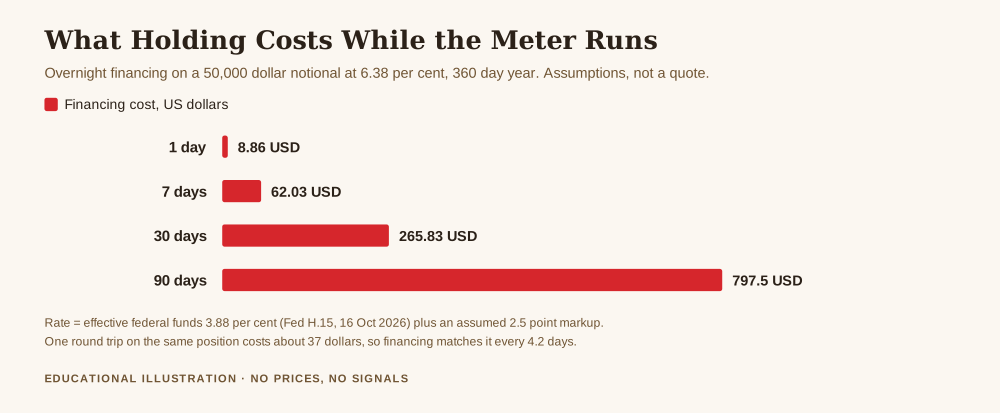
Seven days is 62.03 dollars. Thirty days is 265.83. Ninety days is 797.50. Nobody decides to spend 797 dollars on a position. They decide to give it more time, four separate times, and the invoice arrives afterwards in a form that never appears on the chart.
Closing is what stops that meter. That is the business case for the exit, and it is entirely separate from whether the trade was right.
What the round trip costs, and how to size it
The other cost is the one you pay twice. Take a position of one hundred ounces of gold. Assume a spread of 30 cents an ounce and a commission of 7 dollars for the round turn, both of which are illustrative rather than quoted from any broker.
The spread costs 100 multiplied by 0.30, which is 30 dollars. Add the commission and the round trip costs 37 dollars. Put another way, the market has to move 37 cents an ounce in your favour before the position is level, and that is 0.074 per cent of a 50,000 dollar notional.
Now put the two costs next to each other, because the comparison is the useful part. At 8.86 dollars a day, the financing on that position equals one full round trip every 4.2 days.
That ratio is worth keeping. It says that if you are holding positions for more than about four days, the cost of carrying them has quietly become larger than the cost of trading them, and any cost analysis that only counts spread and commission is understating your expenses by more than half. It also says the reverse: for a position held intraday, financing is irrelevant and the round trip is everything.
Neither statement tells you how long to hold anything. They tell you which cost line to watch, which is a different and more useful thing.
What lands on your books
A closed trade is a transaction, and transactions belong in a ledger. Three numbers come out of every exit and they need separating.
The gross result is the price difference multiplied by the size. The costs are the spread, the commission and the accumulated financing. The net result is what actually happened, and it is the only one of the three that belongs in your performance record.
The gap between gross and net is where self deception lives. Thirty closed trades at 37 dollars of friction each is 1,110 dollars of expense in a month, and if your record only counts price moves, that money disappears from your understanding of your own business while leaving your account perfectly accurately. You can be right about direction and wrong about the enterprise.
This is also the moment the trade becomes a tax event in most jurisdictions, because realised results are what tax systems recognise. The place to capture all of it is at the exit, when the numbers exist and you still remember the reasoning, which is the argument made in how to keep a trading journal like a professional and in how to keep track of day trading for taxes. A closed trade you did not write down is an expense you cannot see and a lesson you cannot repeat.
The ninety seconds after, which nobody plans for
There is one more thing that happens when you sell a trade, and it does not appear in any specification.
Your margin is free, your screen is clear, and you have just had an emotional experience. A reader described the sequence exactly: "The drawdown reached 150 dollars, and I was afraid of losing the account but afterwards it closed in profit." Relief is not a neutral state. Neither is frustration at an exit that turned out to be early. Both reliably produce a next trade that was not in the plan, taken at a size that was not in the plan, using margin that was released ninety seconds ago.
A business handles this with procedure rather than willpower. Record the trade before you look at the chart again. That is one rule, it takes two minutes, and it occupies precisely the window in which the unplanned trade usually gets taken. The discipline is not in resisting the urge. It is in having something specific to do instead, which is the same principle as knowing when to stop trading for the day.
What this article does not say
It does not say when to close anything. There is no holding period here that is better than another, and no exit rule. Those depend on a strategy I know nothing about.
It does not quote any broker's costs. The 2.5 point markup, the 30 cent spread and the 7 dollar commission are stated assumptions so that the arithmetic is checkable. Your own numbers are in your contract and on your statement, and you should substitute them.
It does not say long holds are expensive and short holds are cheap. It says the two have different cost structures, and the crossover on these assumptions is 4.2 days.
Get the free REX one page trading business plan, the document where your cost lines and your limits get written down before the market asks you about them. One email, no spam, unsubscribe anytime.
Get the free business plan →Frequently asked questions
What happens when you sell a trade, in one sentence?
You open an equal and opposite position that nets the first one off, pay the spread a second time, stop the financing meter, release the margin back into your account and turn a floating result into a realised one.
Do I own anything that gets handed over when I close?
No. Most derivative contracts are liquidated before delivery rather than settled by it, as the CFTC describes in its basics of futures trading. Closing is an offsetting trade, not a handover.
Why does holding a position cost money overnight?
Because leverage is borrowed money and borrowed money carries the benchmark rate plus a markup. With the effective federal funds rate at 3.88 per cent and an assumed markup of 2.5 points, a 50,000 dollar notional costs about 8.86 dollars a day on a 360 day year.
Is the financing cost big enough to care about?
It depends entirely on holding period. One day is 8.86 dollars. Ninety days is 797.50 on the same assumptions. On these numbers the financing equals one full round trip every 4.2 days, so past roughly four days it becomes your largest trading expense.
What should I write down when a trade closes?
The gross result, the costs split into spread, commission and financing, the net result, and one line on why you exited when you did. The costs are the part people skip, and they are the part that changes the picture.
Why do I keep taking a bad trade right after closing a good one?
Because the margin came back at the same moment the emotion peaked. Treat the two minutes after an exit as part of the trade and fill them with recording the result rather than with looking for the next position.
Where REX Trading Signal fits
REX Trading Signal is a free channel about running a trading account the way you would run a small business, with a risk ceiling, a cost line and a review you actually do. There is nothing sold here on a promise of returns. The free business plan template is one page, and its job is to make you write the limits down before the market asks you about them. The piece everything else hangs off is the one page trading business plan template.
About the author. Rex writes REX Trading Signal. He once held a position for eleven weeks, congratulated himself on the patience, and found when he finally totalled the statement that the carry had eaten most of the result he was proud of. He writes about operations because the parts of this business that end accounts are rarely the parts that look interesting.
Sources and method. The statement that most futures contracts are liquidated before the delivery date is from the CFTC's basics of futures trading page, linked above and checked live before publication. The effective federal funds rate of 3.88 per cent, unchanged across 9 to 15 October 2026, is from the Federal Reserve's H.15 selected interest rates release dated 16 October 2026, also linked and checked live. The daily financing figure of 8.86 dollars, the holding period totals of 62.03, 265.83 and 797.50 dollars, the round trip cost of 37 dollars, the 37 cent per ounce break even, the 0.074 per cent of notional and the 4.2 day crossover are my own arithmetic on stated assumptions: a 50,000 dollar notional, a broker markup of 2.5 percentage points over the benchmark, a 360 day year, a position of one hundred ounces, a spread of 30 cents an ounce and a 7 dollar round turn commission. The markup, spread and commission are illustrative and are not quoted from any broker. Reader quotations are real messages, anonymised and lightly edited, and the count of roughly 169 is a keyword count of my inbox rather than a survey.
This article is educational and is not financial advice. Trading gold and other leveraged products carries a high risk of losing money rapidly, and no entry, stop or target discussed should be treated as a signal. No holding period, exit rule or cost figure here is a recommendation, and no gold price is quoted anywhere in this article. Decide your own risk, and never trade money you cannot afford to lose.