

Most traders think about tax once a year, in a panic, from a folder of broker statements they have not opened since the day they arrived. That is not a tax problem, it is a bookkeeping failure with a deadline attached. Knowing how to keep track of day trading for taxes is really a question about whether your trading business has a ledger at all, and the answer for most people is that it does not.
Every other business you can name captures a transaction when the transaction happens. The till roll prints at the point of sale, not in the following March. A trading business is the only kind I know of where otherwise organised people accept that the books will be reconstructed months later from memory and PDF statements. This article is about closing that gap, and it starts with the number that makes the gap expensive.
The Volume Problem Nobody Sizes in Advance
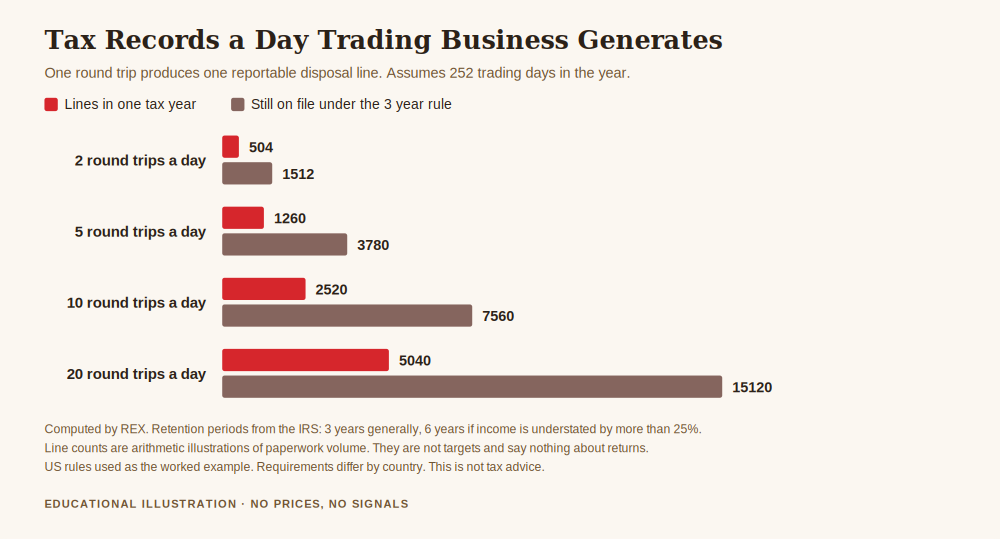
Here is the arithmetic that reframes this from an admin chore into an operations problem. Define a round trip as one purchase and its matching sale, which produces one reportable disposal line. Assume 252 trading days in a year, which is roughly a full US market calendar.
At a genuinely modest 2 round trips a day, you generate 504 reportable lines in one tax year. At 5 a day, 1,260. At 10 a day, 2,520. At 20 a day, which plenty of active traders exceed without thinking of themselves as high frequency, 5,040.
Now apply retention, and it multiplies again. The IRS general rule is to keep records for three years. At 5 round trips a day, that means 3,780 lines live in your filing obligation at any given moment. If the six year rule applies, 7,560. Under the seven year rule, 8,820.
And here is the cost of leaving it to the end. Reconstructing a line after the fact means matching a buy to a sell, confirming the cost basis and checking whether a wash sale applies. Call that 30 seconds a line if you are working from statements rather than a running log, which is optimistic. At 1,260 lines that is about 10 hours. At 2,520 lines it is about 21 hours, which is roughly three working days spent producing information you already had at the moment each trade closed and then threw away.
That is the whole argument for capturing at trade time. Not diligence, not virtue, just the observation that the same work costs a few seconds now and 30 seconds later, and you will be doing it either way.
How to Keep Track of Day Trading for Taxes, Field by Field
A trading ledger is not complicated. It is a table where one row is one disposal, and it needs to carry enough that no future reconstruction is ever required. The fields that actually matter:
- Instrument and quantity. The exact symbol as your broker records it, not the shorthand you use in your head.
- Acquisition date and disposal date. Both, per lot. This is what determines holding period treatment.
- Cost basis and proceeds. Gross, before and after fees, with the fees recorded separately rather than netted invisibly.
- Commissions, fees and financing. Separately identified, because they affect basis and because you want them visible as a cost of doing business.
- Currency and conversion rate if you trade anything not denominated in your reporting currency.
- Broker and account identifier. Obvious until you have three accounts and a year of history.
- A wash sale flag, which I come back to below.
Two operational rules make the ledger trustworthy rather than decorative. First, capture at the close of each session, not at the close of the year. Second, reconcile monthly against the broker's own statement, and treat any difference as something to resolve that month while you can still remember what happened. A ledger that has never been reconciled is a second set of guesses, not a control.
The tooling matters far less than people want it to. A spreadsheet that is reconciled monthly beats expensive software that is filled in every March.
What the IRS Requires You to Keep, and For How Long
The retention rules are published and they are short enough to quote. The IRS guidance on how long to keep records says to keep records for 3 years in the ordinary case. It extends to 6 years "if you do not report income that you should report, and it is more than 25% of the gross income shown on your return". It runs to 7 years "if you file a claim for a loss from worthless securities or bad debt deduction". And it says to keep records indefinitely if you do not file a return, or if you file a fraudulent one.
The important thing about those periods is that they are counted from the filing, not from the trade, and the longer ones are exactly the situations where your records are most likely to be examined. The three year figure is the number to plan around and the six and seven year figures are the reason not to delete anything on schedule.
Trader Status Is a Test You Have to Evidence
This is where recordkeeping stops being administrative and starts being financially consequential.
The IRS sets out conditions in Topic no. 429, Traders in securities. To be considered a trader rather than an investor, "you must seek to profit from daily market movements in the prices of securities and not from dividends, interest, or capital appreciation", your "activity must be substantial", and you "must carry on the activity with continuity and regularity".
In assessing that, the IRS considers "typical holding periods for securities bought and sold; the frequency and dollar amount of your trades during the year; the extent to which you pursue the activity to produce income for a livelihood; and the amount of time you devote to the activity".
Read that list again as a business owner rather than a taxpayer. Holding periods, frequency, dollar amounts, time devoted. Every single criterion is a claim about your records. You cannot assert continuity and regularity from memory, and a folder of unreconciled statements is a weak way to evidence something the tax authority evaluates on the facts.
There is also the mark to market election under section 475(f), which allows a qualifying trader to treat gains and losses as ordinary rather than capital, reporting on Form 4797 instead of Schedule D. Where a valid election is in force, the IRS notes that "the limitations on capital losses, the wash sale rules, and certain other rules do not apply". The timing is unforgiving: the election must be made "by the due date (not including extensions) of the tax return for the year prior to the year for which you intend the election to become effective". In other words it is decided a year ahead, which is a planning decision, and planning decisions need books.
I am not going to tell you whether to make that election. It has real consequences in both directions and it is a conversation for a tax professional who can see your whole position. What I will say is that the conversation is impossible without records.
The Wash Sale Rule Is a Recordkeeping Problem in Disguise
Absent a valid mark to market election, the wash sale rules apply, and they are the single strongest argument for per lot records. A wash sale defers a loss when you repurchase a substantially identical security inside the defined window, and the disallowed amount adjusts the basis of the replacement position rather than disappearing.
The practical consequence for an active trader is that you cannot evaluate a wash sale by looking at one trade. You have to look at a window around it, across accounts. If your records are a pile of monthly PDFs, that analysis is close to impossible to do correctly, and it is the kind of error that compounds silently across a year of activity. IRS Publication 550 covers the detail, and the reporting itself lands on Form 8949.
Get the free REX one page business plan, the sheet where the drawdown limit, the review date and the monthly reconciliation live in one place instead of in your memory. One email, no spam, unsubscribe anytime.
Get the free business plan →What This Does Not Say
This is not tax advice. I am describing a bookkeeping system and quoting published rules. What any of it means for your return depends on facts I do not have, and a qualified professional in your jurisdiction is the right person to ask. That is not a disclaimer bolted on at the end, it is the actual recommendation.
It does not apply everywhere. The rules quoted here are United States rules, used as the worked example because they are published in plain language and easy to link. Treatment of trading income differs enormously between countries, and some jurisdictions treat it in ways that have no US analogue at all. The ledger discipline travels. The rules do not.
It does not say more trading is better. The volume figures are illustrations of paperwork, and 5,040 lines a year is a description of an administrative burden, not an achievement. Nothing in this article says anything about whether any of those trades made money.
And it does not promise that good records improve your results. They improve your ability to know what your results were, which is a smaller claim and a more defensible one.
Frequently Asked Questions
How to keep track of day trading for taxes if my broker already sends a statement?
Broker statements are the thing you reconcile against, not a substitute for your own ledger. They can be incomplete across multiple accounts, they use the broker's conventions rather than yours, and if you change broker your history becomes someone else's filing problem.
Do I need software?
No. A reconciled spreadsheet is genuinely sufficient at most volumes. Software earns its cost when trade counts get high or when wash sale tracking across several accounts becomes the bottleneck, which is a volume question rather than a sophistication question.
How long do I actually have to keep all this?
Three years in the ordinary case, six if income is understated by more than 25%, seven for a worthless securities or bad debt claim, and indefinitely where no return or a fraudulent return was filed. Those are the IRS periods and they are quoted above with a link.
Does trader status mean I pay less tax?
It changes how activity is characterised and what elections are open to you, and it is a test based on facts rather than a box you tick. Whether the outcome is favourable depends entirely on circumstances, which is a question for a professional.
What if my records for last year are already a mess?
Reconstruct what you can, document how you did it, and start the ledger properly from the current period. A documented reconstruction with its method written down is a far better position than a second year of the same gap.
Where REX Fits
REX Trading Signal is free to follow. Daily XAUUSD analysis with the reasoning attached, losing days included, plus an optional Kit for people who want the operating system written down. Nothing here promises a profit and nothing here ever will.
Bookkeeping is a control, and controls belong in writing rather than in memory. The one page trading business plan template is where the reconciliation date goes alongside the drawdown limit. Your monthly profit and loss review is the routine this ledger feeds, and doing one without the other is how businesses end up with numbers nobody trusts. The key metrics every trading business should track covers what you measure once the data is reliable, and how to manage multiple trading accounts deals with the case that makes wash sale tracking genuinely hard.
About the author. Rex writes REX Trading Signal. He is interested in the unglamorous half of this business, the costs, the controls and the review dates, on the view that an account survives on its operating discipline long before it succeeds on its ideas.
Disclaimer: This article is general educational content about bookkeeping practice for an active trading account. It is not tax advice, not legal advice, not accounting advice and not financial advice, and it is not a recommendation to make or refrain from making any tax election. Readers should consult a qualified tax professional in their own jurisdiction before acting on anything described here. Trading gold, CFDs and leveraged products carries a high risk of losing money rapidly. No entry, stop or target discussed should be treated as a signal. The three conditions for trader status, the evaluation factors of holding period, frequency, dollar amount, livelihood and time devoted, the section 475(f) mark to market election, the statement that the capital loss limitations and wash sale rules do not apply under a valid election, and the election deadline are quoted from the published IRS Topic no. 429, Traders in securities. The retention periods of 3 years, 6 years, 7 years and indefinitely are quoted from the published IRS page on how long to keep records. Wash sale and cost basis detail is published in IRS Publication 550, with reporting on Form 8949 and, under a mark to market election, Form 4797. All line counts of 504, 1,260, 2,520, 5,040, 3,780, 7,560 and 8,820, and the reconstruction estimates of about 10 and 21 hours, were computed by me on stated assumptions: one round trip produces exactly one reportable disposal line, 252 trading days in the tax year, and 30 seconds to reconstruct one line from statements. Real trade counts do not map one to one onto reportable lines because partial fills, lot splitting and wash sale adjustments all change the count, so these figures illustrate the scale of the paperwork rather than predicting anyone's actual filing. All trade frequencies used are arithmetic illustrations and are neither targets nor claims about returns. US rules are used throughout as a worked example and do not describe the tax treatment of trading in any other country. Tax law changes, and the published IRS material is the authority and not this article. No gold price level is quoted anywhere in this article and no trading results are represented.