
Every business has a cost that behaves badly. Not the rent, which is dull and predictable, and not the raw materials, which scale in a straight line. The badly behaved cost is the one that rises faster than the volume that causes it, so that growing the business makes each unit more expensive rather than less. In trading, that cost has a name almost nobody in retail uses. So: what is impact cost in trading, and why does it deserve a line in your books when your spread and commission already have one?
Short version. Impact cost is the money you lose simply by being the one who had to trade. Not the spread, not the commission, not the financing. The cost of the market moving away from you because your own order consumed the liquidity that was there. It is the only cost in the business that gets worse the more successful you become, and it is the reason the strategy that worked at 0.10 lot sometimes stops working at 2.00.
What Is Impact Cost in Trading, Defined Properly
Impact cost is the difference between the price you would have got if your order had been infinitely small, and the price you actually got, measured on the volume you actually traded.
The reference point matters, so be careful here. The honest reference is the mid, the midpoint between the best bid and the best offer at the instant before you sent the order. Measured that way, impact cost is a real number you can put in a ledger, and it separates cleanly from the other two things people confuse it with.
It is not the spread. The spread is the standing charge for crossing from bid to offer, and a tiny order pays it in full. It is not slippage in the loose sense either, where people mean "the price moved between my click and my fill." Some of that is the market moving on its own, which would have happened whether you traded or not. Impact cost is specifically the part you caused.
That distinction has a practical consequence for your books. Spread and commission are per unit costs, so they scale linearly and you can budget them. Impact cost is a function of your size relative to available depth, so it scales badly, and if you budget it as a per unit cost you will underestimate it exactly when it matters most.
The Arithmetic, With Every Assumption Named
Let me build the smallest model that shows the behaviour, and let me state every assumption so you can rebuild it and disagree with it.
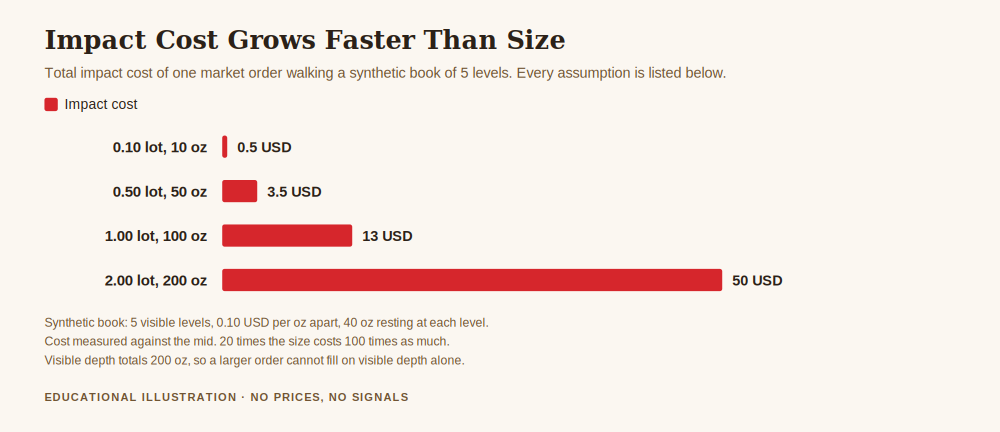
Assume a standard gold contract where 1.00 lot is 100 troy ounces. Assume a visible order book with five levels on the side you are buying. Assume the first level sits 0.05 US dollars per ounce above the mid, and each level after that is 0.10 dollars further away, so 0.05, 0.15, 0.25, 0.35 and 0.45. Assume 40 ounces resting at each level. Total visible depth is therefore 200 ounces, which is 2.00 lot.
No gold price appears in any of this. Every figure is a distance from the mid, not a level, which is why the conclusion holds whatever gold is doing on the day.
Now walk a market order through that book.
At 0.10 lot, 10 ounces, you fill entirely at the first level. Cost is 10 times 0.05, so 0.50 dollars, and your average cost is 0.05 dollars per ounce.
At 0.50 lot, 50 ounces, you clear the 40 at the first level and take 10 from the second. That is 2.00 plus 1.50, so 3.50 dollars, and your average is 0.07 dollars per ounce.
At 1.00 lot, 100 ounces, you take 40 at 0.05, 40 at 0.15 and 20 at 0.25. That is 2.00 plus 6.00 plus 5.00, so 13.00 dollars, and your average is 0.13 dollars per ounce.
At 2.00 lot, 200 ounces, you consume the entire visible book. That is 2.00 plus 6.00 plus 10.00 plus 14.00 plus 18.00, so 50.00 dollars, and your average is 0.25 dollars per ounce.
The Number a Business Owner Should Take From That Table
Here is the finding, and it is the reason I wrote this.
Going from 0.10 lot to 2.00 lot multiplies your size by 20. It multiplies your total impact cost by 100. The extra factor of 5 is the average cost per ounce rising from 0.05 to 0.25, and that factor is pure penalty. You did not get anything for it.
Compare that with the costs you already track. Commission at a fixed rate per lot multiplies by 20 when your size multiplies by 20, because that is what a per unit cost does. Impact cost multiplied by 100. If your cost model treats trading costs as linear in size, then at 2.00 lot your model is understating this component by a factor of five.
Even the modest step from 0.10 to 1.00 lot, a ten times increase, costs 26 times as much in impact. That is not an exotic size. That is an ordinary trader having a good year and scaling up the way everybody tells them to.
This is why I keep saying that a strategy is not a thing on its own, it is a thing at a size. A rule set that clears its costs comfortably at 0.10 lot can be underwater at 2.00 lot without a single thing about the rules having changed, and without the trader doing anything wrong. Their cost base moved under them. If you want the fuller version of that argument, it is the same logic as fixed and variable costs of a trading business, with one cost that refuses to stay variable.
What Happens When the Book Runs Out
In my model, visible depth totals 200 ounces. Order 2.00 lot and you have consumed all of it. Order more and there is nothing left to fill against at any visible price.
What happens next is not a mystery, and it is documented. Your platform has a fill policy, and MetaTrader defines three of them in its order properties reference.
Fill or kill means "an order can be executed in the specified volume only. If the necessary amount of a financial instrument is currently unavailable in the market, the order will not be executed." Immediate or cancel means "a trader agrees to execute a deal with the volume maximally available in the market within that indicated in the order. If the request cannot be filled completely, an order with the available volume will be executed, and the remaining volume will be canceled." Return means "in case of partial filling, an order with remaining volume is not canceled but processed further."
Read those as three different business outcomes, because that is what they are. Under fill or kill you get nothing and your plan is intact. Under immediate or cancel you get a smaller position than you intended and you need to know that, because your risk calculation assumed the full size. Under return you get a partial fill now and a live order still working, which means your position can keep growing after you have stopped paying attention.
None of those is wrong. What is wrong is not knowing which one your account uses, and finding out during the trade that revealed it.
The One Control You Already Have
There is a setting for this and most people leave it on the default without ever reading what it does.
In MetaTrader's trade request structure, the field is called deviation, and the documentation defines it as "the maximal price deviation, specified in points." In plain terms it is the worst fill you are willing to accept, expressed as a distance.
That field is your impact cost ceiling. Set it tight and you refuse expensive fills, at the price of sometimes not trading. Set it wide and you will always get filled, at whatever the book charges you. There is no setting that gives you both, and anyone who tells you otherwise is selling something.
A business decides this deliberately rather than by default. My own view, and it is a view rather than a recommendation, is that a deviation you never hit is too wide to be doing any work, and a deviation you hit constantly is telling you your size is wrong for the hours you trade.
Get the free REX one page business plan, the sheet where your costs and your size limits get written down before the market picks them for you. One email, no spam, unsubscribe anytime.
Get the free business plan →How to Put This in Your Books
You do not need a model of the order book to manage this. You need a measurement, and you already have the raw material.
For each fill, record the price you got and the price on screen when you sent the order. The difference, times the size, is your impact cost for that trade. Sum it monthly and put it beside your commission line. It belongs in the same table as the costs you already respect, which is the argument I make in key metrics every trading business should track.
Then watch one ratio: impact cost per ounce traded, month over month. If your size is growing and that ratio is flat, your market is absorbing you and you have room. If the ratio is climbing, you have found the edge of your liquidity, and no amount of conviction about the strategy changes that. That is a capacity constraint, and every real business has one. Knowing yours before it finds you is the entire difference between operating and improvising.
It also reframes a question people ask badly. The broker's volume ceiling and your own are two different things, which I worked through in maximum lot size forex. Impact cost adds a third ceiling that nobody publishes: the size at which the market itself starts charging you a premium for existing. That one is yours to measure, because nobody will tell you what it is.
Frequently Asked Questions
What is impact cost in trading, in one sentence?
The difference between the price an infinitely small order would have got and the price your actual order got, measured against the mid at the moment you sent it, times the volume you traded.
Is impact cost the same as slippage?
No. Slippage as most people use it includes the market moving on its own between your click and your fill, which would have happened without you. Impact cost is only the part your own order caused by consuming depth.
Does impact cost matter at retail sizes?
At genuinely small size relative to available depth, it is close to negligible, and that is the honest answer. It stops being negligible in two situations that retail traders hit constantly: when they scale up, and when they trade in thin conditions, where the same order is suddenly large relative to what is resting. The size did not change. The depth did.
How do I reduce it?
Trade smaller relative to depth, trade when depth is better, use limit orders where your strategy tolerates not being filled, and set your deviation deliberately. Each of those has a cost of its own, which is why this is a business decision and not a trick.
Where did the figures in this article come from?
The three fill policies and the definition of the deviation field are quoted from the MetaQuotes references linked above. Every cost figure is my own arithmetic on the synthetic order book described in the text, being five levels at 0.05, 0.15, 0.25, 0.35 and 0.45 dollars per ounce above the mid with 40 ounces at each, and a 100 ounce standard lot. It is a model chosen to show the behaviour clearly, not a measurement of any real book.
Why is there no gold price anywhere in this article?
Because none is needed. Every number here is a distance or a difference, so the arithmetic works at any price level, and quoting a level would add nothing except the false impression that I was telling you something about where gold is going.
Where REX Fits
REX Trading Signal is free to follow, with daily XAUUSD analysis and the reasoning stated before the trade, and an optional Kit for people who want the operating side written down properly. Nothing here is a promise of profit, and a channel that made one would be telling you something about itself rather than about the market.
The operating side is the whole point. The one page trading business plan template is the pillar this sits under, because a cost you have not written down is a cost you are not managing. Fixed and variable costs of a trading business is where the rest of the cost base lives, and the break-even point of your trading business is what all of it finally adds up to.
About the author. Rex writes REX Trading Signal. He is interested in the unglamorous half of this business, the costs, the controls and the review dates, on the view that the interesting half takes care of itself once the dull half is written down.
Disclaimer: This article is general educational content about execution costs in a trading business. It is not financial advice, not investment advice, and not a recommendation to open, hold or close any position, or to use any particular broker, platform, order type or setting. The three fill policies and the definition of the deviation field are quoted from the MetaQuotes order properties reference and the MetaQuotes trade request reference. Every cost figure, average and ratio is my own arithmetic on the synthetic order book and the 100 ounce standard lot described in the text, and is a model built to illustrate a behaviour rather than a measurement of any real market, any real broker or anyone's results. No gold price level is quoted anywhere in this article. Trading leveraged products carries a high risk of losing money rapidly, and no entry, stop or target discussed should be treated as a signal. Consider your own circumstances and speak to a licensed professional in your jurisdiction before making decisions about your money.