

Most trading journals die in the same way. Somebody starts one after a bad week, fills it in beautifully for eleven days, misses a day, misses three, and then quietly stops. Two months later the spreadsheet is still there with 14 rows in it, and those 14 rows cannot answer a single useful question about the business.
The failure is almost never discipline. It is design. A journal that asks you for a paragraph of feelings after every trade will be abandoned, and it should be. So the real question is not whether to keep one, it is how to keep a trading journal like a professional keeps a set of books: quickly, on a schedule, in fields that are decided in advance, for the specific purpose of answering questions you will actually ask later.
This is an operations article rather than a trading one. The journal is the accounting function of a trading business, and like every accounting function it is boring, it is unpopular, and it is the only reason anyone can tell you whether the business works.
How to Keep a Trading Journal Like a Professional Firm Would
Start with an observation about regulated firms, because it reframes what a journal is for.
In the United States, the rules the Commodity Futures Trading Commission published for retail foreign currency transactions, effective 18 October 2010, do not just require dealers to keep records. They require the dealer to disclose the number of non discretionary retail forex accounts it holds and the percentage of those accounts that were profitable, for each of the four most recent quarters. A firm in that business has to publish its own scoreboard, on a fixed cycle, whether the quarter went well or badly.
The same rules set a minimum capital requirement of 20 million dollars for the firms acting as counterparty, plus 5 percent of the amount by which their liabilities to retail forex customers exceed 10 million dollars. The point of citing that is not the number. It is the posture. A serious operation is required to know its own position continuously and to state it on a schedule, and it is not allowed to decide after the fact which quarters count.
That is the standard a personal journal should copy. Not the volume of writing. The obligation to record the same fields every time, and to look at them on a date chosen before you know what they say.
Why Fourteen Rows Cannot Tell You Anything
Here is the argument that changed how I keep records, and it is worth working through with actual figures rather than assertions.
Suppose your true win rate is 45 percent. Not what you hope, what it genuinely is, over a long run. If you log a sample of trades and calculate the win rate from that sample, how close is your number to the truth? Treating trades as independent draws and using the standard interval of plus or minus 1.96 standard errors, I calculated the following for this article.
After 20 trades, your measured win rate is accurate to plus or minus 21.8 percentage points. That interval runs from 23 percent to 67 percent. After 30 trades it is plus or minus 17.8 points. After 100 trades it is plus or minus 9.8 points. After 400 trades it is plus or minus 4.9 points. To pin the number down to plus or minus 5 percentage points takes 381 trades, and to reach plus or minus 3 points takes 1,057.
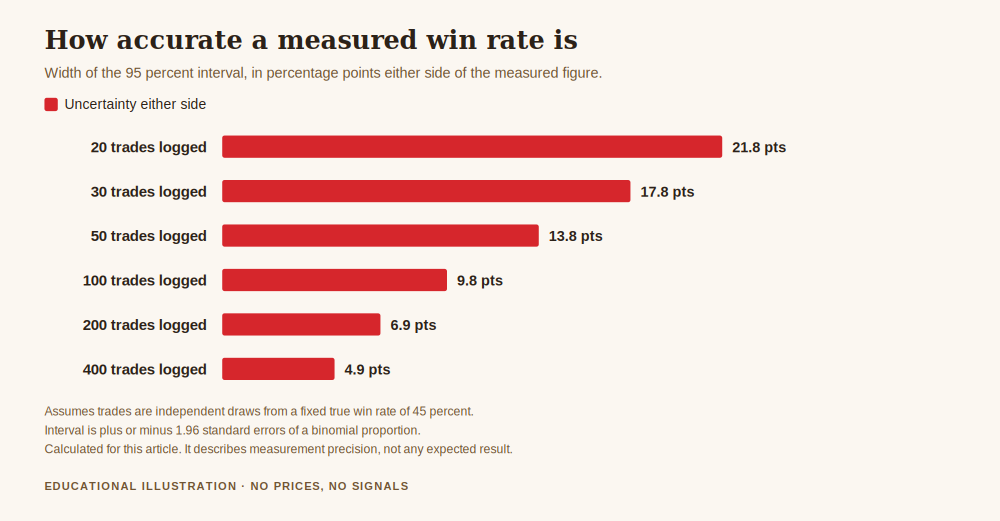
Put that on a calendar. At five trades a week across 48 working weeks, that is 240 trades a year, so 381 trades is a little over eighteen months of records. Eighteen months of unbroken logging to be able to say your win rate is 45 percent give or take five points.
Two conclusions follow, and they pull in the same direction.
The first is that a journal with 14 rows in it is not a small journal. It is an empty one. Anything you conclude from it about your win rate is noise wearing a number's clothes, and the confidence people take from a short winning sample is the most expensive thing a partial journal produces.
The second is that continuity matters far more than depth. A one line record kept for 400 trades is worth enormously more than a beautifully annotated record kept for 30. This is the entire case for designing the journal to be fast. Every field you add that takes thought is a field that will eventually cost you the habit, and the habit is the asset.
The Fields, and Why Each One Earns Its Place
A professional record is narrow and complete rather than wide and patchy. These are the fields I would defend, and the test for each is whether a question you will genuinely ask in six months becomes unanswerable without it.
Date and instrument. Obvious, and the thing that lets you slice results by session or by market later.
Planned risk, in currency and as a percentage. Not the lot size. The lot size is an output. What you need on the record is what you decided to put at stake, because that is the decision you are auditing.
Planned stop distance and target distance. Recorded before the outcome, which is the only time they are honest.
Outcome in R. R is the unit of one planned risk. A trade that lost exactly what you planned is minus 1R. One that made twice the planned risk is plus 2R. Recording in R rather than in money is what lets you compare a trade from when the account was 3,000 dollars with a trade from when it was 30,000.
Setup label, chosen from a fixed list. A closed list of five or six names, decided in advance. Free text here is what destroys the ability to group anything, because the same setup gets four spellings across a year.
Whether you followed your own rule, as a yes or no. One character. This is the most valuable field in the journal and the one people leave out, because it is the only field that separates a losing trade from a broken process. A strategy can survive losing trades. It cannot be evaluated at all if you do not know which results came from following it.
Notice what is not on that list. No paragraph about how you felt. No screenshot ritual. Those are not worthless, but they belong in a weekly note, not in a per trade record, because they are exactly the fields that make the daily habit collapse.
The Cost of a Sloppy Row
One more calculation, because it explains why accuracy of the record matters more than the volume of it.
Take 100 logged trades with a true expectancy of plus 0.10R, which is a modest but real edge. Now suppose a single trade was logged as plus 2.0R when it was actually minus 1.0R, because it was recorded from memory a week later. That one row shifts the average by 3.0R spread over 100 trades, which is 0.03R. Your journal now reports plus 0.13R instead of plus 0.10R, an overstatement of 30 percent, from one mistyped row in a hundred.
Thirty percent is not a rounding error. It is the difference between a strategy you scale and a strategy you retire. And the failure mode here is not dishonesty, it is delay: rows written from memory drift toward the story you remember rather than the result you had. Which is why the operational rule is not accuracy in the abstract, it is log at the close of the trade, or accept that the row is an estimate.
The Routine That Makes It Survive
Rules like this are useless as theory and useful as a schedule, so here is the schedule.
Log at close, in under 60 seconds. If it takes longer than that, the journal is too wide. Cut a field.
Review weekly, on a fixed day, whether or not it was a good week. The regulated firm publishes every quarter regardless. You review every week regardless. The whole value of a fixed date is that it removes the choice, and the choice is what always gets exercised in favour of not looking after a bad run.
Do not compute your edge monthly. By the arithmetic above, a month of trading is roughly 20 rows, and 20 rows carry an interval of plus or minus 22 points. Monthly numbers should be checked for process compliance, meaning the yes or no column, not for performance conclusions. Performance conclusions belong to the quarter and the year.
Keep it outside the platform. A record that lives only inside your broker's web portal is not your record. Export it. This is the same argument as the record retention piece makes for the tax side, and the same discipline covers both.
Separate the trade record from the money record. The journal proves what you did. Deposits, withdrawals and what you paid yourself are a different ledger and belong with the business side of the accounts.
Get the free REX one page business plan, the sheet where the journal fields, the review day and the person responsible for the paperwork get written down before the habit is tested. One email, no spam, unsubscribe anytime.
Get the free business plan →Frequently Asked Questions
How to keep a trading journal like a professional, in one line?
Narrow fixed fields logged at the close of every trade in under a minute, results recorded in R rather than money, a yes or no column for whether you followed your own rule, and a review on a fixed day regardless of how the week went.
How many trades before my journal tells me anything?
By the calculation in this article, roughly 100 trades before a measured win rate is accurate to plus or minus 10 percentage points and roughly 381 before it is accurate to plus or minus 5. Below about 50 rows, treat the numbers as a description of what happened rather than as evidence about your edge.
Should I write down how I felt?
Not in the per trade row. Emotional notes are worth keeping weekly, where there is time for them, but putting them in the trade record is the most common reason a journal is abandoned inside a month.
Spreadsheet, notebook or an app?
Whichever one you will still be using in a year, since continuity is what creates the value. The one property that matters is that you can export the whole history yourself without asking anyone's permission.
What if I have already broken the habit?
Start a new record today rather than reconstructing the missing weeks from memory. Rows written from memory are the ones that introduce the kind of error described above, and a clean short record is more useful than a long invented one.
Where did the numbers in this article come from?
The 18 October 2010 effective date, the quarterly disclosure of the percentage of profitable non discretionary retail forex accounts, and the 20 million dollar minimum capital requirement plus 5 percent of customer liabilities above 10 million dollars are quoted from the CFTC page linked above and its published fact sheet. The sample size intervals, the 381 and 1,057 trade figures and the expectancy distortion example were calculated for this article, treating trades as independent draws from a fixed win rate and using a 95 percent interval, with all assumptions stated in the text.
Where REX Fits
REX Trading Signal is free to follow. Daily XAUUSD setups with a stop loss, a reason and a rule, posted live on Telegram, wins and losses both left up. There is a free one page business plan for anyone who wants the operations side written down, and an optional kit for people who want the full system. Nothing here promises a profit, because nobody can.
The journal belongs on the operations shelf with the rest of the business. The one page trading business plan template is where the review day gets committed to, the trading journal template is the sheet itself, key metrics every trading business should track covers what to compute once the rows exist, and the about page explains who writes this and why.
About the author. Rex writes REX Trading Signal. He is interested in the unglamorous half of this job, the records, the schedule and the review that nobody posts about, on the view that a trading account is a business and a business without books is a hobby with a balance. Nothing here is a recommendation, and no entry, stop or target discussed should be treated as a signal.
Disclaimer: This article is general educational content about record keeping for people trading their own accounts. It is not financial advice, not tax advice, not legal advice and not a recommendation to buy or sell anything. The regulatory figures quoted describe requirements placed on registered firms in the United States and are included to illustrate a standard of record keeping, not to suggest that an individual trader is subject to them; requirements differ by jurisdiction and by the legal entity holding your account. The statistical figures were calculated for this article from the assumptions stated in the text, and they describe the precision of a measurement rather than predicting any result. Leveraged trading carries a high risk of losing money rapidly, and a majority of retail accounts lose money. Past behaviour of any market or any strategy does not indicate future behaviour. No entry, stop or target discussed should be treated as a signal, and you should consider taking independent professional advice before making any financial decision.