
How many hours a week should I trade is a question I get in two very different tones. One is hopeful, from someone with a job, wondering whether two hours a night is enough to be taken seriously. The other is exhausted, from someone who has been at the screen all day for months and cannot work out why the account has not moved. They are the same question, and almost nobody answers it the way a business would, which is by costing the hours instead of counting them.
A business knows what an hour of its own time costs, which hours produce anything, and which ones are simply open for business with nobody coming through the door. A trading account is a business with exactly one employee, and that employee usually has no idea which of those categories his week falls into. So let us do the accounting.
Everything numerical below is my own calculation from assumptions I state as I go, apart from one piece of research which I have linked and quoted precisely. There are no profit figures in this article, because I do not know what your account will do and neither does anyone else.
How many hours a week should I trade, broken into the six jobs
The first mistake is treating "trading hours" as one thing. It is at least six, and only one of them involves watching price.
Here is a week split into those six jobs, at three operating levels. I want to be blunt that these hour splits are illustrative assumptions, not measured data. They are a starting shape for your own timesheet, nothing more.
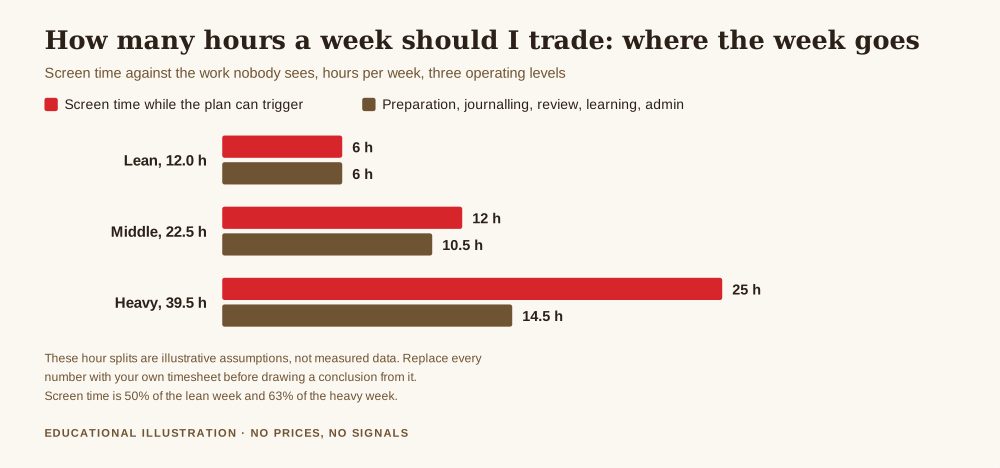
The lean week is 12.0 hours: 6 at the screen while the plan can actually trigger, 2.5 preparing, 1 journalling, 1 reviewing the numbers, 1 learning one thing properly, and half an hour on admin. The middle week is 22.5 hours and the heavy week is 39.5.
Now the number almost nobody computes. In the lean week, screen time is 50 per cent of the total. In the middle week it is 53 per cent. Even in the heavy week, where someone is sitting at a chart for 25 hours, screen time is only 63 per cent of the business's actual workload. Between 37 and 50 per cent of running a trading account is work that produces no trades at all, and it is the half that gets dropped first when someone is busy.
That is the first useful answer. If you are doing 10 hours a week and all 10 are at the screen, you are not running a 10 hour business. You are running a 20 hour business and skipping half of it.
What one hour of your business actually costs
Businesses know their cost per hour. Traders almost never do, so here is the arithmetic.
Assume a fixed monthly cost base of 100 units of currency: 40 for data and charting, 20 for a VPS, 15 for the share of your internet that belongs to the business, and 25 for platform and tools. The unit is deliberately neutral, and the point survives whatever currency and whatever figures you substitute.
Using 4.33 weeks to the month, the lean week is 52 hours a month, the middle week 98, the heavy week 171. Divide the cost base by those and each hour carries 1.92 units in the lean week, 1.03 in the middle week, and 0.58 in the heavy week. That is the burden every hour has to clear before the business has made anything at all.
Read that table too quickly and you reach exactly the wrong conclusion. It looks as though working more hours makes the business cheaper to run. It does not. The total bill is 100 units either way. All the extra hours have done is slice the same invoice into thinner pieces, so each slice looks smaller while the business pays precisely the same amount. Cost per hour falls, cost does not. This is the same accounting trap I wrote about in the fixed and variable costs of a trading business, and it catches people in both directions.
The honest version of the cost question is not "what does an hour cost" but "what is this hour for". Which brings us to the part that is genuinely uncomfortable.
The hours when your plan cannot do anything
Most strategies only trigger inside a window. If your plan is built around one session, or one setup that needs a particular condition, then the hours outside that window are not trading hours. They are waiting hours, and they carry risk without carrying opportunity, because a bored operator with an open platform is the most expensive asset in the business.
Work it through. Suppose your plan can only trigger in one three hour window a day, five days a week. That is 15 hours a week in which the business can actually transact. The lean week's 6 hours of screen time fits inside it comfortably. The middle week's 12 hours fits too. The heavy week's 25 hours does not: it exceeds the useful window by 10 hours every week, which is 520 hours a year sitting in front of a chart at times when the written plan cannot legally, by its own rules, do anything.
Five hundred and twenty hours is thirteen working weeks. That is a quarter of a year spent on premises that are open while the business is closed. Nothing in that time is forbidden, which is the problem. The platform still works. The orders still go through. The only thing stopping a trade is a document, and documents lose arguments to boredom.
Get the free REX one page business plan, the sheet I use to run an account like a business, including the operating hours section where the timesheet in this article belongs. One email, no spam, unsubscribe anytime.
Get the free business plan →Does working more hours actually buy a better result?
This is where I have to be careful, because the honest answer is that nobody has measured it for retail gold traders, and anyone who tells you otherwise is selling something.
What does exist is a large and famous study of a neighbouring question. Barber and Odean's Trading Is Hazardous to Your Wealth, published in The Journal of Finance in 2000 and verified through Crossref at DOI 10.1111/0022-1082.00226, looked at 66,465 households at a large discount broker between 1991 and 1996. The households that traded most earned an annual return of 11.4 per cent while the market returned 17.9 per cent. The average household earned 16.4 per cent and turned over 75 per cent of its portfolio a year. The authors' explanation was overconfidence.
That is a 6.5 percentage point gap between the busiest traders and the market they were trading in, and a 5.0 point gap between the busiest households and the merely average ones.
Now the limitation, stated plainly, because it matters more than the headline. That study is about United States common stocks between 1991 and 1996. It is not about gold, it is not about CFDs, it is not about 2026, and it measures trading frequency rather than hours at a desk. You cannot carry the 11.4 per cent across to your own account and you should distrust anyone who does. What it does establish is that in one very large dataset, more activity went with worse outcomes rather than better ones, and that the burden of proof sits with the person claiming that more hours help.
What this article is not saying
It is not saying that fewer hours are automatically better. A business that is never open does not trade either, and the lean week only works if the 6 hours land on the window where the plan can trigger. Six badly placed hours are worse than twelve well placed ones.
It is not saying that screen time is wasted. It is saying that screen time is roughly half the job, and the half that gets skipped is the half that tells you whether any of it is working.
And it is not giving you a number. I cannot tell you how many hours a week you should trade, because the answer depends on when your plan can trigger, what your costs are, and what else your life is obliged to contain. What I can do is give you the four lines that produce your own number.
The operating hours policy, in four lines
Put these in the operating section of your plan, next to the risk limits.
One. Write down the window in which your plan can trigger, in UTC, as a number of hours a week. That is your maximum useful screen time. Anything beyond it is waiting, and waiting goes in a different column.
Two. Budget the other five jobs explicitly: preparation, journalling, weekly review, learning, admin. If they do not have hours assigned they will not happen, and they are between 37 and 50 per cent of the business.
Three. Keep a timesheet for one month. Not forever, just one month. Most people discover their real split is nothing like the one they imagined, and you cannot manage a number you have never measured.
Four. Review hours alongside results in your weekly review, and treat a rising hour count with a flat result as a cost problem rather than an effort problem. The fix for that is usually fewer hours pointed better, not more hours pointed the same way.
Frequently asked questions
How many hours a week should I trade, if I want one number?
There is no honest single number. The useful version is your plan's trigger window, which caps meaningful screen time, plus a budget for preparation, journalling, review, learning and admin, which together run 37 to 50 per cent of the total in the worked examples above.
Is ten hours a week enough to trade seriously?
It can be, if the hours land where your plan can actually trigger and you still budget for the work away from the screen. Ten hours all spent watching price is a half built business, not a small one.
Does trading full time give better results than part time?
No evidence here says so. The closest large study, Barber and Odean 2000, found the most active traders underperformed the market by 6.5 percentage points, though that was United States stocks in the 1990s and does not transfer directly to gold.
Why does my cost per hour fall when I work more?
Because you are dividing the same fixed bill by more hours. The cost base does not change. In the worked example it is 100 units a month whether you work 52 hours or 171, so a falling cost per hour tells you nothing about whether the extra hours were worth having.
What counts as a trading hour?
Any hour the business consumes: screen time inside the trigger window, preparation, journalling, the weekly review, deliberate learning, and admin. If you only count the first one you will consistently underestimate the job by about half.
How do I know if I am overtrading on hours?
Compare screen time against your plan's trigger window. In the heavy week example, 25 hours of screen time against a 15 hour window leaves 10 hours a week, 520 hours a year, when the plan cannot act but the platform still can. That gap is where unplanned trades come from, and the companion piece is how to not over trade.
Where REX fits
REX Trading Signal is a free journal about running a trading account the way you would run a business, with books, costs, policies and an operating manual. Everything here is free to read. The one optional piece is the one page business plan above. I do not promise profits, I do not sell a method, and I do not think anyone can tell you what your account will do. The piece this one hangs off is the one page trading business plan, and the nearest neighbours are the fixed and variable costs of a trading business and how much to spend on your trading setup.
About the author. Rex kept a timesheet for one month on a dare and found that a third of his screen hours sat outside the window his own plan allowed him to trade in. He would rather show you the arithmetic than the anecdote. Nothing in this article is financial advice, and no entry, stop or target discussed should be treated as a signal.