
Somebody asks this question about once a month, and it usually arrives phrased as a milestone. They have been trading for a while, it is going reasonably, and it feels like the moment to make it official.
So here is how to open a trading company, and more usefully, how to work out whether you should. The registration itself is administrative and takes an afternoon. The decision underneath it is a business decision, and most of the people asking have not yet been shown the two facts that decide it: what a company actually changes, and what it costs against the size of the account it sits on top of.
There is one thing to get straight before any of that, because it is the only part of this subject with genuine legal weight.
The Line That Actually Matters
Trading your own money is not a regulated activity. Trading other people's money is.
That sentence is the whole regulatory landscape in miniature, and everything else is detail. If the capital in the account is yours, you are a person doing something with your own property, and no licence is required to do it in any major jurisdiction. The moment somebody else's money is involved, or you are advising others for compensation, you have crossed into an activity that is registered, supervised and enforced.
The United States definitions are a useful place to see the line drawn, because they are written plainly. The Commodity Futures Trading Commission defines a Commodity Trading Advisor as "any person who, for compensation or profit, engages in the business of advising others, either directly or indirectly, as to the value of or the advisability of trading in any contract of sale of a commodity for future delivery." A Commodity Pool Operator is "any person engaged in a business who solicits, accepts, or receives from others, funds, securities, or property for the purpose of trading in commodity interests."
Read what triggers each one. Advising others for compensation. Accepting funds from others. Neither describes somebody trading their own account, however large it is and whatever it is called.
This matters because of a fairly common misunderstanding, which is that forming a company is a step towards being allowed to do something you are not currently allowed to do. It is not. A company does not authorise you to manage anybody's money, and if you started doing that, the company would not be the thing that made it lawful. Those are separate registrations with their own requirements, and setting up a limited company is not a first step towards them.
So the company is not a permission. What is it?
How to Open a Trading Company, and What You Actually Get
Mechanically it is unremarkable. In the United Kingdom, you file an incorporation with Companies House, name the company, name its directors and shareholders, state a registered address and a share structure, and it exists. Most jurisdictions have an equivalent process, and in almost all of them it is measured in hours rather than weeks.
What you receive is a separate legal person. That is the entire product. Everything people expect a company to do follows from that one property, or does not follow from it at all.
Things that genuinely follow:
- Separation of assets. The company's money and your money are legally distinct, provided you keep them distinct in practice.
- Limited liability in the ordinary sense, which matters if the business can generate obligations to third parties.
- A different tax treatment of profits, which is usually the real reason anybody does this.
- Continuity and structure, which matter if there is ever more than one person involved.
Things that do not follow, and that people expect anyway:
- It does not reduce trading risk by one unit. The market has no idea what legal form you have taken.
- It does not get you institutional pricing, better spreads or different execution. Retail terms are about volume and venue, not about whether you have a company number.
- It does not make you more disciplined. Nobody has ever been saved from a bad habit by a certificate of incorporation.
- It does not let you manage anybody else's capital, as above.
- It frequently does not simplify your broker relationship. A corporate account is a different onboarding process, usually a slower one with more documents, and not every retail broker offers one.
Strip that list down and what remains is a tax and liability structure. Which is fine. It is just a much narrower thing than the milestone people have in mind when they ask.
What It Costs, With Published Numbers
This is where the decision usually resolves itself, and it resolves fast once the numbers are on the table.
Companies House publishes its fees, and the guidance was last updated on 2 July 2026. Incorporating online costs one hundred pounds. Incorporating on paper costs one hundred and twenty four. The annual confirmation statement, which every company files whether or not it traded, costs fifty pounds digitally and one hundred and ten on paper.
Those are the published figures. They are also the small half of the bill. The larger half is accountancy, because a company files accounts, and company accounts are not something most people do themselves. I am going to assume nine hundred pounds a year for that, and I want to be explicit that this is an assumption rather than a published figure. Quotes vary widely. Substitute your own.
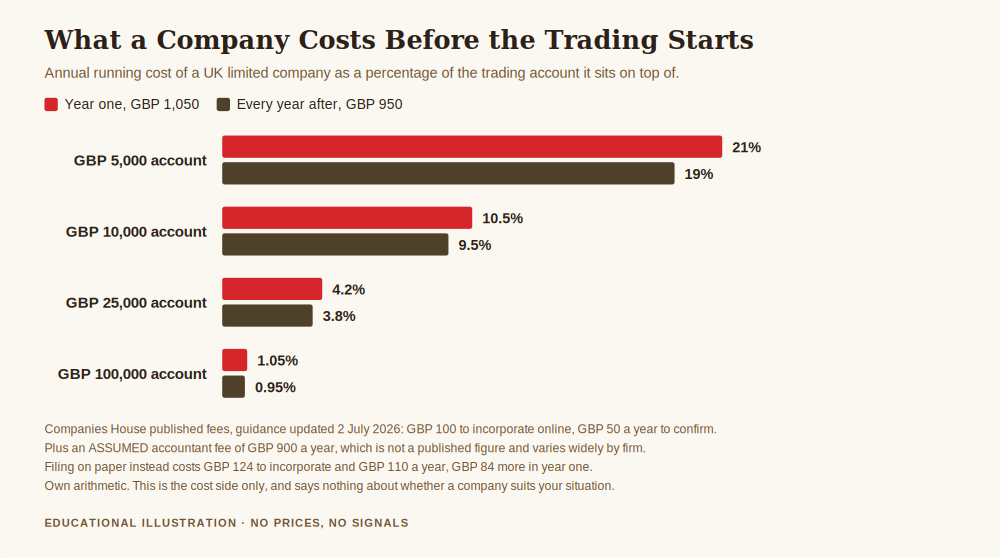
Under those assumptions the arithmetic is simple. Year one costs one hundred to incorporate, fifty to confirm and nine hundred to account for, which is one thousand and fifty pounds. Every year after that is nine hundred and fifty. Filing on paper rather than online adds eighty four pounds in the first year.
Now the only comparison that matters. Set that running cost against the account it is sitting on top of:
- On a five thousand pound account, the company costs twenty one percent of the account in year one and nineteen percent every year after.
- On a ten thousand pound account, ten and a half percent, then nine and a half.
- On a twenty five thousand pound account, four point two percent, then three point eight.
- On a one hundred thousand pound account, one point zero five percent, then zero point nine five.
Read the first two rows again. A trader with ten thousand pounds who incorporates has to earn nine and a half percent every year before they are level with where they would have been without the company. That is not a small hurdle. It is a larger annual return than many people actually achieve, spent entirely on paperwork, to obtain a tax structure whose benefit on a ten thousand pound account is close to nothing.
The Break Even, and Why It Points One Way
Push it one step further, because the cost is only half the calculation. What would the company have to save to justify itself?
Assume the only benefit is a difference of some number of percentage points between the rate the company pays on profit and the rate the same profit would have paid in your hands. Call that difference d. The company pays for itself when your annual trading profit multiplied by d exceeds nine hundred and fifty pounds. So the break even profit is nine hundred and fifty divided by d.
- At a three point advantage, you need thirty one thousand six hundred and sixty seven pounds of annual trading profit before the company is worth having.
- At five points, nineteen thousand.
- At ten points, nine thousand five hundred.
- At nineteen points, which is a large advantage, five thousand.
Notice what those numbers are. They are annual profits, not account sizes. To make thirty one thousand pounds of trading profit a year you need a substantially larger account than thirty one thousand pounds behind it, and you need to be doing this consistently rather than once.
Which gives the honest general answer. For most people asking how to open a trading company, the answer is that it is a real thing they will probably want eventually, and today is early. Not because of ambition, and not as discouragement. Because nine hundred and fifty pounds a year buys nothing at all until there is enough profit for the tax difference to bite, and until then it is a fixed cost that the trading has to carry.
The tax rates themselves I am deliberately not giving you. They depend on your country, your residency, your other income, how the profit is characterised where you live, and how you take money out of the company. That last one alone can eliminate the advantage entirely. It is genuinely a question for an accountant in your jurisdiction, and it is worth an hour of one's time before it is worth a hundred pounds of Companies House's.
The Things That Actually Change, Day to Day
Suppose the numbers do work for you. Three practical consequences are worth knowing in advance, because they surprise people.
You have created filing obligations that do not care how the year went. A confirmation statement and a set of accounts are due whether the company made money, lost money or did nothing at all. A dormant company still files. Deadlines carry penalties. This is the part that catches traders who set one up in a good year and then have a quiet one.
Some of it is public. Company registers are public records in most jurisdictions. Your name as a director, the registered address, and depending on size some financial information, are visible to anyone who looks. People who assumed a company was a privacy measure usually have it backwards.
The separation has to be real to be worth anything. The reason the assets are legally distinct is that they are actually distinct. Money moving casually between the company account and your own, expenses paid from whichever card is nearest, no records of which is which, and you have the cost of a company with a weakened version of its main benefit. Which brings this back to where every REX article ends up: the structure is only as good as the bookkeeping under it.
Three Questions Before You File Anything
If you want a decision procedure rather than an essay, this is it.
Is the capital yours? If yes, no licence question arises and this is purely a tax and structure decision. If anyone else's money is involved, stop, because that is a different subject with a different rulebook and it is not one to improvise on.
Is the annual profit above the break even? Take your own advantage in percentage points, divide your own running cost by it, and compare that number against what you have actually made in the last twelve months. Actually made, from the record, not the good months annualised.
Can you carry the fixed cost through a bad year? The cost does not scale down when the trading does. A structure that makes sense at last year's numbers and becomes a nine and a half percent drag at this year's is a structure that was sized to a hope.
None of that is exciting, and it is not meant to be. A trading account run as a business gets the same treatment as any other business, which is that you cost the thing out before you buy it. Most of the people who ask this question are asking a version of a better question, which is whether they are running this seriously. You can answer that one today, for nothing, with a set of books and a review day. The company, if it ever makes sense, will still be there when the numbers say so.
Get the free REX one page business plan, the sheet where the fixed costs, the review day and the person responsible for the paperwork get written down before any of it is tested. One email, no spam, unsubscribe anytime.
Get the free business plan →Frequently Asked Questions
Do I need a company or a licence to trade my own money?
No. Trading your own capital is not a regulated activity in any major jurisdiction, and no company is required for it. Registration requirements attach to advising others for compensation or accepting funds from others, which are different activities with their own rulebooks.
Will a company get me better spreads or execution?
No. Retail pricing is a function of volume and venue, not legal form. A corporate account is usually a slower onboarding process with more documents, and not every retail broker offers one at all.
At what profit does a company start to make sense?
By the arithmetic in this article, break even annual profit is your running cost divided by your tax advantage in percentage points. At an assumed cost of 950 pounds a year, that is about 19,000 pounds of annual profit at a five point advantage and about 9,500 at a ten point advantage. Your own figures will differ and an accountant in your jurisdiction is the right person to supply them.
What happens if I set one up and then have a quiet year?
The filing obligations continue regardless. A dormant company still files a confirmation statement and accounts, deadlines carry penalties, and the running cost does not scale down when the trading does. This is the single most common reason people regret incorporating early.
Can I use a company to manage money for friends or family?
Treat that as a separate question with a different answer, because accepting other people's funds is the activity that triggers registration. A company does not authorise it, and this article is not the place to work out what does. Speak to a regulated professional before accepting a single pound from anyone, and no entry, stop or target discussed should be treated as a signal.
Where did the numbers in this article come from?
The definitions of a Commodity Trading Advisor and a Commodity Pool Operator are quoted from the CFTC intermediaries page linked above. The incorporation fees of 100 pounds online and 124 on paper, and the confirmation statement fees of 50 pounds digital and 110 on paper, are the published Companies House fees from the guidance updated on 2 July 2026, also linked. The accountancy figure of 900 pounds a year is my own assumption and is not a published figure. Every derived number, the 1,050 and 950 annual totals, the percentages of account size, and the break even profits of 31,667, 19,000, 9,500 and 5,000 pounds, is my own arithmetic under the assumptions written out in the text.
Where REX Fits
REX Trading Signal is free to follow. Daily XAUUSD setups with a stop loss, a reason and a rule, posted live on Telegram, wins and losses both left up. There is a free one page business plan for anyone who wants the operations side written down, and an optional kit for people who want the full system. Nothing here promises a profit, because nobody can.
Structure is the last thing you build, not the first. The one page trading business plan template is the pillar this sits under and the place the fixed costs get written down, fixed and variable costs of a trading business covers the category a company fee belongs to, how to pay yourself from your trading business covers the decision that usually follows this one, and the about page explains who writes this and why. The regulatory definitions come from the CFTC and the fees from Companies House.
About the author. Rex writes REX Trading Signal. He is interested in the unglamorous half of this job, the records, the schedule and the review that nobody posts about, on the view that a trading account is a business and a business without books is a hobby with a balance. Nothing here is a recommendation, and no entry, stop or target discussed should be treated as a signal.
Disclaimer: This article is general educational content about business structure for people trading their own accounts. It is not legal advice, not tax advice, not accountancy advice, not financial advice and not a recommendation to form or not to form a company. It is a summary written for general readers and is not a statement of the law. Company law, registration requirements, tax rates and the treatment of trading profits differ by country, by residency, by your other income and by how money is taken out of a company, and only a licensed professional in your own jurisdiction can tell you what applies to you. The Companies House fees and the CFTC definitions are quoted from the sources linked in the text, which were checked and reachable at the time of writing; the accountancy figure is an assumption of mine and not a published or quoted price. Every other figure is my own arithmetic under the assumptions stated in the text and is an illustration of proportion rather than a projection of anyone's results. Leveraged trading carries a high risk of losing money rapidly, and a majority of retail accounts lose money. Past behaviour of any market or any strategy does not indicate future behaviour. No entry, stop or target discussed should be treated as a signal, and you should consider taking independent professional advice before making any financial decision.