
Ask is a sep ira traditional or roth and the tax authority answers it in one sentence on its own guidance page: a SEP-IRA account is a traditional IRA and follows the same investment, distribution and rollover rules as traditional IRAs. That is the answer, and for most of the time this account type has existed it was the whole answer. Congress then added a narrow exception in 2022 that let these accounts be designated as Roth, which is why you now see conflicting answers online written at different times. Both are right about their own year. Below is what the documents actually say, what the 2026 numbers are, and why an operator running a trading account as a business should care about which column the money lands in.
Is a sep ira traditional or roth, according to the rulebook
The default is traditional, and the reason is structural rather than a matter of election. A SEP is not an account type. It is an arrangement under which an employer makes contributions into an IRA set up for each participant, and that IRA is a traditional IRA. The guidance is explicit that it follows the same investment, distribution and rollover rules as any other traditional IRA, which means the contribution goes in before tax, the balance grows untaxed, and withdrawals are taxable income.
That has a second consequence people miss. Because the account is a traditional IRA, it can also receive your own regular annual IRA contributions if the plan document permits non-SEP contributions. The guidance notes that any dollars you contribute yourself to the SEP-IRA reduce what you can put into other IRAs, including Roth IRAs, for that year. Employer contributions under the SEP do not, which is the point worth separating: the employer side and the personal side have different ceilings and only the personal side competes with your Roth.
Now the exception. The SECURE 2.0 Act of 2022 included a provision listed in official guidance under the heading of SIMPLE and SEP Roth IRAs. Section 601(a) of that Act struck a subsection of the tax code which had previously provided that a SEP or SIMPLE IRA account could not be designated as a Roth IRA, and that contributions to such an account would not count toward the Roth IRA contribution limit. Section 601(b)(1) then added a new paragraph allowing a Roth IRA to serve as the account under a SEP arrangement. In plain terms: before 2023 the answer was traditional with no option, and after it the answer is traditional unless the arrangement is specifically set up and documented otherwise.
So the honest answer to the question has three parts. By default, traditional. By definition of the underlying account, traditional. By election, Roth is now legally possible, but only if the plan has been established that way and the provider supports it, which many do not. If nobody told you a Roth election was made, no Roth election was made.
The numbers that actually decide the question
For a one person trading business the Roth versus traditional argument is usually less consequential than the ceiling, because the ceiling is what makes this account type interesting in the first place. The 2026 figures, from the official publication and the annual adjustment release, are these.
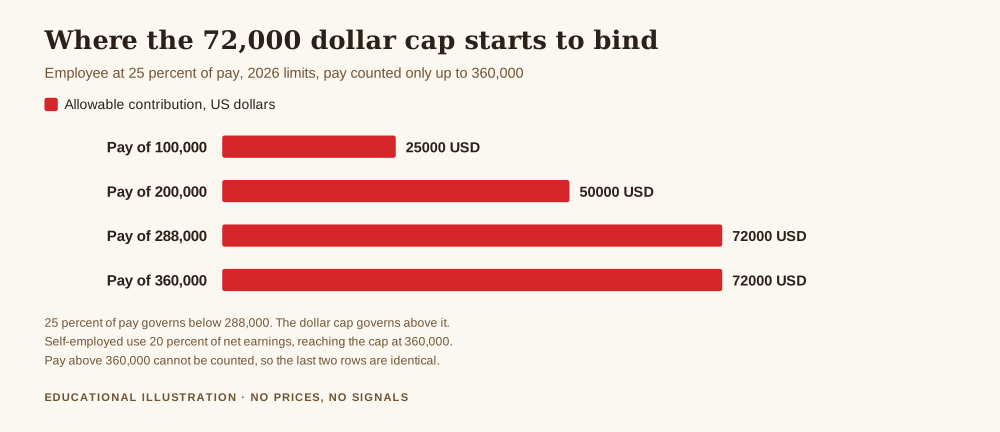
A contribution for a common-law employee cannot exceed the lesser of 25 percent of that employee's compensation or the annual dollar cap. For 2025 the cap was 70,000 dollars. For 2026 it rises to 72,000 dollars. The compensation that may be counted in the calculation is itself capped: 350,000 dollars for 2025, rising to 360,000 dollars for 2026. If you are self-employed rather than an employee of your own corporation, the publication directs you to use 20 percent of your net earnings from self-employment rather than 25 percent, and net earnings are computed after subtracting one half of self-employment tax and the contribution itself.
Two things fall out of those numbers once you divide them, and both are useful to know before you plan a contribution. First, the dollar cap and the compensation cap were indexed by the same amount this year: 2,000 on 70,000 and 10,000 on 350,000 are each an increase of 2.857 percent. Second, the two ceilings cross at a specific income. Twenty five percent of compensation reaches the 72,000 dollar cap at 288,000 dollars of compensation, so below that figure the percentage governs and above it the dollar cap governs. For the self-employed at 20 percent, the crossing point is 360,000 dollars of net earnings, which is exactly the compensation cap, so the two constraints bind together.
Set that beside the personal side. The regular IRA limit rises to 7,500 dollars for 2026 from 7,000, an increase of 7.14 percent, and the catch-up for those aged 50 and over rises to 1,100 dollars from 1,000. The employer ceiling of 72,000 dollars is 9.6 times the regular IRA limit. That ratio is the reason this structure exists for profitable sole operators, and it is also why the traditional versus Roth question gets a different weight here than it does on a 7,500 dollar contribution.
What the deferral is actually worth, with the assumptions on the table
The usual argument for a traditional contribution is that you defer tax now and pay it later at a lower rate. That is a claim about two tax rates, not about the account, and it is worth doing the arithmetic rather than accepting the slogan.
Assume 20,000 dollars contributed, a 24 percent marginal rate today, a 22 percent marginal rate when the money comes out, 7 percent nominal growth for 20 years, no state tax, and no change in the law. On those assumptions the traditional route puts 20,000 to work, which grows to 77,394 dollars, and after 22 percent tax leaves 60,367 dollars. The Roth-style route pays the 24 percent first, so 15,200 dollars goes to work and grows to 58,819 dollars, kept whole. The deferral wins by 1,548 dollars, which is 2.63 percent.
Twenty years, a 20,000 dollar contribution, and the entire advantage is 2.63 percent. That is the number that should calibrate how much energy this decision deserves. And it flips sign completely if your rate in retirement is higher than your rate today, because the break-even is simply the point where the two marginal rates are equal. Every dollar of that result comes from the gap between two rates, one of which you are guessing about, and neither of which you control.
Which is why I would put the decision in its proper place in the operating order. The contribution ceiling is a fact. The account's default tax treatment is a fact. The relative advantage of one tax treatment over the other is a forecast about tax policy and your own future income, dressed up in compound interest notation. Operators should spend their attention on the facts and hand the forecast to somebody qualified to make it.
Where this sits in the books of a trading business
There is a bookkeeping point here that matters more than the tax question, and it is the reason this article is on this site at all.
A retirement contribution is the first line item most one person operations encounter that is neither a cost of trading nor a withdrawal for living expenses. It is a transfer from the business to a separate legal container that you cannot easily reverse. If your chart of accounts has no place for it, it will get recorded as either an expense or an owner draw, and both are wrong in ways that distort the figures you use to judge the operation. Treated as an expense, it makes a profitable year look marginal. Treated as a draw, it disappears from the record of what the business actually produced.
The sequence that keeps this straight is the ordinary one. Close the period first, so you know what the net figure is. Compute the ceiling from that figure using the correct percentage for your structure, 25 percent for an employee of your own entity and 20 percent of net earnings if self-employed. Decide the contribution. Record it in its own account, not inside expenses and not inside draws. Then, and only then, worry about which tax column it belongs in.
Note the ordering constraint, because it is the practical trap. The contribution is computed from a number that does not exist until the books are closed, and the publication ties the deduction to making the contribution by the due date of your return including extensions. A business that closes its books in March cannot plan a contribution in December. That is an argument for a monthly close rather than an argument about tax treatment, and it is the kind of thing that only shows up once you have tried to do it in the wrong order.
Get the free REX one page trading business plan, the template for running an account with limits, a close and a review instead of a hunch. One email, no spam, unsubscribe anytime.
Get the free business plan →Frequently asked questions
Can I convert a SEP-IRA to a Roth IRA?
A conversion from a traditional IRA to a Roth IRA is a recognised transaction in the tax code, and a SEP-IRA is a traditional IRA, so the same route exists. The consequence is that the converted amount is generally taxable income in the year of conversion, which is the whole trade: you pay now to stop owing later. Whether that is sensible depends on your rate this year against your expected rate later, and on having cash outside the account to pay the bill. This is exactly the decision to take to a tax professional with your actual figures rather than settle from an article.
Is a SEP contribution deductible?
Yes, within limits, and that is the practical meaning of traditional treatment. The publication states that the most you may deduct is the lesser of your contributions or 25 percent of the compensation paid to participants, with compensation limited per participant to 360,000 dollars in 2026 and the deduction not to exceed 72,000 dollars per participant. Self-employed individuals follow a separate calculation using net earnings. Deadlines and extension rules apply, so confirm them for your own filing situation.
Can I have a SEP-IRA and a Roth IRA at the same time?
Yes. The guidance says plainly that you can receive employer contributions to a SEP-IRA and also make regular annual contributions to a traditional or Roth IRA, and that employer SEP contributions do not reduce what you may contribute to an IRA on your own behalf. The one interaction to watch is that if you make your own regular contributions into the SEP-IRA itself, those dollars do reduce what you can put into other IRAs, Roth included, for that year.
How much can a self-employed trader contribute for 2026?
The ceiling is the lesser of the dollar cap, 72,000 dollars for 2026, or 20 percent of net earnings from self-employment for someone who is self-employed rather than an employee of their own entity. Net earnings are computed after one half of self-employment tax and after the contribution itself, which makes the figure circular and worth computing carefully. Note also that trading profits are not automatically self-employment income; how your activity is characterised for tax is a separate question with real consequences, and it is one to settle with a professional before relying on any of these ceilings.
Does any of this depend on how my trading is taxed?
Yes, and this is the caveat I would put above all the arithmetic. Every ceiling above is computed from compensation or from net earnings from self-employment. Whether your trading produces either of those, and in what amount, depends on your structure and on how your activity is characterised, which varies by situation and by jurisdiction. The numbers in this article are quoted accurately from the published sources. Whether they apply to you is not something an article can determine.
Where this leaves you
REX Trading Signal is free to follow and stays free. The daily record goes up including the quiet days and the losing days, there is a free one page business plan for anyone who wants the operating structure in one place, and there is an optional kit for people who want the longer version. Nothing here promises a return, and nothing here is a recommendation to use or avoid any provider, custodian or product.
The foundation under this article is the one page trading business plan. Beside it, the account structure that gives a contribution somewhere to live is in what a chart of accounts looks like, the timing question of which year a transaction belongs to is in cash basis versus accrual accounting, the statement that shows what the business is actually worth after a transfer out is in what a balance sheet equity line is, and the record keeping that makes any of this computable is in how to keep track of day trading for taxes.
Outside sources used here: the statement that a SEP-IRA account is a traditional IRA following the same investment, distribution and rollover rules, and the interaction between your own IRA contributions and the SEP, are from the IRS frequently asked questions on SEPs. The contribution and deduction limits, the 25 percent and 20 percent figures, the 70,000 and 72,000 dollar caps and the 350,000 and 360,000 dollar compensation limits are from IRS Publication 560. The 2026 regular IRA limit of 7,500 dollars and the 1,100 dollar catch-up are from the IRS annual limit adjustment release. That section 601 of the SECURE 2.0 Act struck the provision barring a SEP or SIMPLE IRA from being designated as a Roth IRA, and added a paragraph permitting it, is from IRS Notice 2024-02. Every ratio, crossover point and growth figure in this article is computed from the assumptions stated in the text, so you can reproduce all of it with your own numbers.
About the author. Rex writes REX Trading Signal and treats an account the way an operator treats a business, with limits set before the week starts and a review that happens whether the month was good or bad. He is less interested in what a trader thinks will happen next than in what the records say already happened. The limits here are quoted from the publications linked above and the arithmetic is computed from the stated assumptions so you can repeat it with your own numbers, tax treatment depends on your structure, your jurisdiction and how your activity is characterised, this article is educational and is not tax, accounting, legal or investment advice and should not be relied on in place of a qualified professional who has seen your figures, nothing here is a recommendation to use or avoid any firm, custodian or product, and no entry, stop or target discussed should be treated as a signal.