
Most traders who ask how to create a business budget spreadsheet are really asking a different question: where is the money going. The profit and loss statement answers that after the fact. A budget answers it in advance, which is the only time the answer is useful. The build takes about twenty minutes and the number it produces, the amount your account has to make before the business keeps anything, is one most traders have never actually calculated.
How to create a business budget spreadsheet, the five columns that do the work
You do not need accounting software for this and you do not need a template from anybody. Five columns:
- Item. The plain name of the cost.
- Type. Fixed, variable, or annual. Three words only, and it is the column that makes the sheet useful.
- Amount. What one unit of it costs.
- Frequency. Per month, per year, or per round trip.
- Annual total. Amount multiplied out to twelve months. This is the only column you add up.
That is the entire structure. The discipline is not in the spreadsheet, it is in refusing to leave anything out because it felt small at the time.
Fixed, variable and annual, the classification that pays for itself
The Type column is doing more than tidying. It separates costs you owe whether or not you trade from costs you only incur by trading, and that distinction is what turns a list into a decision tool.
Fixed costs arrive on the same date whatever you do. Charting subscription, server, bookkeeping software, the share of your internet bill that belongs to the business. Variable costs scale with activity: commission, the spread you pay getting in and out, financing on positions held overnight. Annual costs are real but easy to forget because they arrive once: the accountant, a registration renewal, a training budget.
Traders consistently underestimate the fixed block, because each line is individually trivial and the subscriptions renew quietly. Adding them up once a year is uncomfortable and that is precisely the value of doing it.
A worked year, with the assumptions stated
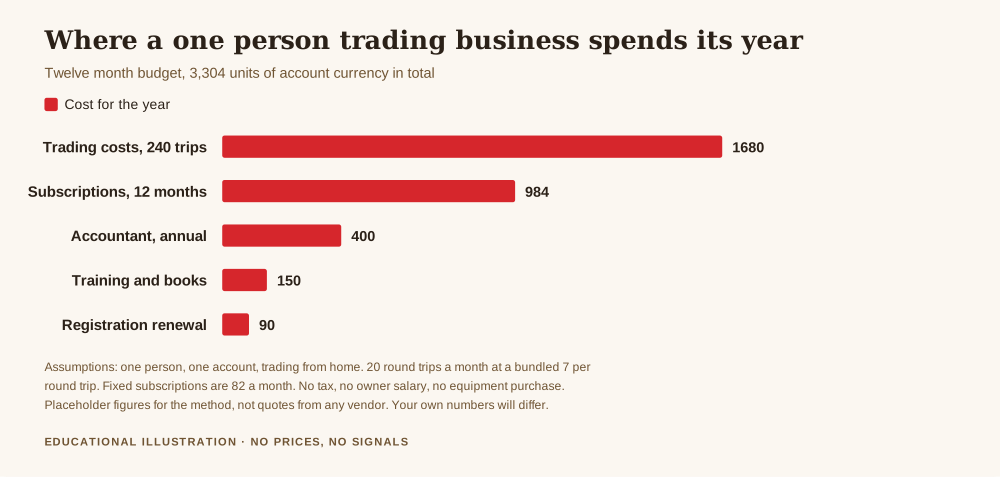
Here is a complete budget for a one person operation, so the method has something concrete underneath it. Assumptions: one person, one account, trading from home, no tax, no salary to the owner and no equipment purchase. The figures are placeholders chosen to demonstrate the method, not quotes from any vendor, and your own numbers will differ.
Fixed, per month: charting and data 30, virtual private server 12, bookkeeping software 15, share of internet and phone 20, cloud backup of records 5. That is 82 a month, 984 for the year.
Annual: accountant for the annual return 400, training and books 150, business registration or renewal 90. That is 640.
Variable: 20 round trips a month at a bundled 7 per round trip, which covers commission both ways plus the spread you cross. That is 140 a month, 1,680 for the year.
Add them: 3,304 for the year, an average of 275.33 a month.
Now the two figures that only exist because you built the sheet.
First, the real cost of a trade is 13.77, not 7. Divide the full 3,304 by the 240 round trips in the year and the subscriptions you were treating as background noise are revealed as part of the cost of each trade. Half of what a trade costs you has nothing to do with the broker.
Second, fixed and annual costs are 49.2 per cent of the budget, owed whether you place 240 trades or none. Test what that means: cut your trading in half, to 10 round trips a month, and the annual cost falls from 3,304 to 2,464. A 50 per cent reduction in activity produces a 25.4 per cent reduction in cost. Trading less is not the lever people assume it is, because half the budget does not care what you do.
What the budget tells you that the profit and loss does not
A profit and loss statement is a report on a period that has finished. A budget is a claim about a period that has not started, and it produces one number worth putting somewhere you will see it: the account has to produce 3,304 gross across the year before the business keeps a single unit. That is 275.33 a month of gross trading result just to stand still.
This reframes decisions that otherwise get made on feel. A new data subscription at 40 a month is not 40 a month, it is 480 a year, which is roughly 35 additional round trips that now exist purely to pay for it. Maybe that is worth it. The point is that you can now ask the question in units you understand, instead of asking whether 40 sounds like a lot.
It also sets a floor on account size, without anybody having to give you a rule about minimum capital. If the business costs 3,304 a year to run, and you would not want running costs to exceed a modest fraction of equity, the budget tells you what size account makes the structure sensible. The arithmetic is yours and the conclusion is yours. That is better than a number somebody asserted at you.
The line most people leave out
Start-up costs. The expenses incurred before the business begins operating sit in their own category and are not simply deducted like ordinary running costs.
The Internal Revenue Service sets out the treatment in Publication 583, Starting a Business and Keeping Records, which states that you can elect to deduct up to 5,000 dollars of business start-up costs and up to 5,000 dollars of organizational costs. The allowance is reduced by the amount your start-up or organizational costs exceed 50,000 dollars, and any remaining costs must be amortized.
Two practical consequences for the sheet. Give start-up costs their own small block rather than mixing them into the running budget, because they are treated differently and because mixing them makes your first year look permanently expensive. And keep the records that support them: the same publication is blunt that your books must show gross income, deductions and credits, that supporting documents include sales slips, paid bills, invoices, receipts, deposit slips and cancelled checks, and that you must keep business records available at all times for inspection.
Those thresholds are United States federal guidance. The principle that pre-trading costs are handled separately is close to universal, but the figures are not, so check your own tax authority and put your own position to a qualified professional.
What this looks like from the other side
Roughly 151 messages in my inbox mention trading with a small account. That is a keyword count across my own Telegram messages rather than a survey, so take it as a sense of how often the subject arrives, not a statistic about traders generally. The recurring note is affordability, and it is almost always expressed about the deposit rather than about the running costs.
One reader wrote: "I can't start with that much, I'm new to this and I can't afford it yet." Another: "can't afford for now bro i will just message you if im ready." And a third, describing the plan most people actually have: "I have entered the market with only 100 trying to level it up slowly to control and learn."
Every one of those is a budgeting statement made without a budget. The question being asked is whether the business is affordable, and the answer is being guessed. A sheet that takes twenty minutes converts the guess into a number. Sometimes the number says wait, which is an unwelcome answer and a much cheaper one than finding out across a year.
One more, which belongs here because it is the correct instinct: "Oké bro but I want you to know, I cant afford to lose all again." A budget does not stop losses. It does mean the running costs of the business are a decision you made rather than a drip you never measured.
Build it in twenty minutes
Open a blank sheet. Put the five columns across the top. Then:
- Read twelve months of bank and broker statements and write down every outgoing that touched the business. Do not do this from memory. The forgotten subscription is the entire reason this exercise works.
- Tag each line fixed, variable or annual.
- Convert everything to an annual figure in the last column, and total it.
- Divide the total by your realistic round trip count for the year. That is your true cost per trade. Compare it with what you believed it was.
- Add a start-up block if the business is new, kept separate from the running lines.
- Put the monthly break-even figure at the top of the sheet in bold, and look at it during your monthly review.
Then leave it alone for a quarter, and update it when something changes rather than continuously. A budget that gets edited every week stops being a plan and becomes a second journal.
Get the free REX one page trading business plan, with the risk limit, the review cadence and the record keeping on a single sheet, so the budget you just built has something to sit inside. One email, no spam, unsubscribe anytime.
Get the free business plan →Frequently asked questions
How to create a business budget spreadsheet if the business is brand new?
Build it from quotes rather than from statements, since you have no history yet. Price every subscription you intend to hold, take the broker's published commission and a realistic spread for the instrument you will trade, and estimate your round trip count conservatively. Mark it as an estimate, then replace each line with the real figure as the first statements arrive. An estimated budget beats no budget, provided you label it honestly.
Should trading losses go in the budget?
No, and keeping them out is what makes the sheet useful. A budget covers the cost of operating, which you control and can forecast. Trading results are the output, which you do not control and should not forecast. Mixing the two produces a document that is neither a plan nor a record. Losses belong in the profit and loss review.
How often should the budget be updated?
Once a quarter as a habit, and immediately when a cost changes, such as a new subscription or a change in commission. Rebuilding it continuously turns a planning document into busywork. The annual total is the figure that matters, and it does not move much between quarters.
What counts as a round trip?
One complete trade, in and out. It is the right unit for budgeting because costs are incurred on both legs. If you scale into positions, count each entry and exit as its own leg and divide accordingly, otherwise the cost per trade figure will flatter you.
Does a small account need this?
A small account needs it more, not less. On the worked example, running costs of 3,304 a year are a different proposition on a large account than on a small one, and the only way to know which situation you are in is to have the number. That is a question the sheet answers for you rather than one anybody should answer for you.
Where REX Trading Signal fits
REX Trading Signal is free to follow. The daily record on Telegram includes losing days, because a record that only shows winners is not a record. There is a free one page trading business plan for anyone who wants the limits and the review cadence in one place, and an optional Kit for people who want the full operating method. Nothing here promises a profit and nothing here is a signal service. The foundation this article sits on is the one page trading business plan template, the cost classification used in the Type column is set out in fixed and variable costs of a trading business, the break-even figure this budget produces is handled in the break-even point of your trading business, the review the budget feeds is your monthly profit and loss review, and the question of which year a cost lands in is covered in cash basis vs accrual accounting.
Outside sources used here: Internal Revenue Service Publication 583, Starting a Business and Keeping Records for the start-up and organizational cost election, the 50,000 dollar reduction threshold and the recordkeeping requirements, with background on business expense categories in the IRS guide to business expense resources. Every budget figure in this article is computed from the assumptions stated beside it and can be reproduced with your own numbers.
About the author. Rex writes REX Trading Signal and treats an account the way an operator treats a business, with limits set before the week starts and a review that happens whether the month was good or bad. He is less interested in what a trader thinks will happen next than in what the records say already happened. The figures here are quoted from the source linked above or computed from the stated assumptions so you can repeat them with your own numbers, this article is educational and is not tax, accounting or investment advice, your own position should be put to a qualified professional, nothing here is a recommendation to use or avoid any firm, platform or arrangement, and no entry, stop or target discussed should be treated as a signal.