
Ask what is a balance sheet equity line and you will get an accounting answer, which is that equity is assets minus liabilities. True, and almost useless on its own. The useful version is this: equity is the only number on the statement that nobody types in. Every other line is a fact you can point at, a bank balance, a card balance, a machine on the desk. Equity is whatever is left when those facts have finished arguing. For a trading business that distinction matters more than it does almost anywhere else, because the number your platform calls equity and the number your balance sheet calls equity are rarely the same, and the gap is where people lose track of how they are actually doing.
What is a balance sheet equity line, in plain words
A balance sheet is a photograph of one instant. It has three parts. Assets are what the business holds. Liabilities are what it owes to somebody else. Equity is the part that belongs to you once the owing is settled. The three are locked together by an identity that cannot be broken:
Assets = Liabilities + Equity
Read it the other way round and it becomes the definition worth remembering. Equity = Assets minus Liabilities. You do not decide equity. You measure assets, you measure liabilities, and equity falls out. This is why accountants call it a residual, and why a balance sheet that does not balance means you have mismeasured something, not that equity is wrong.
A profit and loss statement covers a period, a month or a year, and answers whether the business made money. A balance sheet covers a moment and answers whether the business is solvent and what it is worth to its owner. A trading business needs both, and most solo traders keep neither, because the platform shows a number that feels like it has already done the job.
The official form gives equity one line out of twenty six
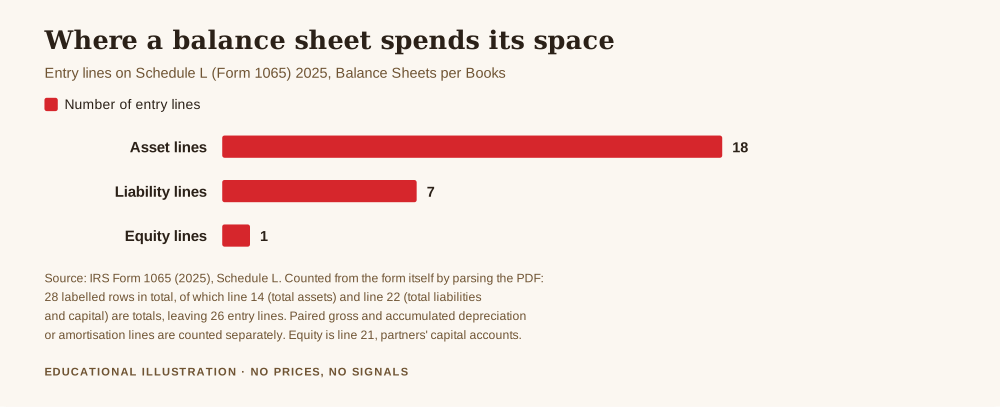
Here is a concrete way to see how little of a balance sheet is about equity. Partnerships filing in the United States report a balance sheet on Schedule L of Form 1065, published as a PDF on irs.gov. I parsed the 2025 form and counted the labelled rows rather than estimating them. Schedule L has 28 labelled rows. Two of those are totals, line 14 for total assets and line 22 for total liabilities and capital. That leaves 26 rows you actually enter a figure on, split like this:
- 18 asset lines, from cash on line 1 through other assets on line 13, including the paired lines where a gross figure sits above an accumulated depreciation or amortisation figure.
- 7 liability lines, lines 15 to 20, covering payables, loans of various maturities and other liabilities.
- 1 equity line, line 21, partners' capital accounts.
Eighteen lines for what you hold. Seven for what you owe. One for what it is all worth to you. Equity gets 3.8 percent of the entry lines on the form, and assets get eighteen times as many lines as equity does.
That ratio is not an oversight, it is the whole logic of the document. The form spends its space on the things that have to be measured, because those are the things that can be got wrong. Equity needs one line because once the other twenty five are honest, equity is arithmetic. If you remember nothing else here, remember that the effort belongs on the asset and liability side, and the equity figure will take care of itself.
Why your platform's equity is a different number
Every trading platform shows a field called equity. It means balance plus or minus the running profit on open positions. It is a real number and it is useful, but it is the equity of an account, not of a business. Those differ for two reasons. The account does not know about anything you hold outside it, and it does not know about anything you owe.
Take a worked example. The figures below are chosen to be round, they are not anybody's real books, and the costs are kept on a cash basis with one open position marked to market. Suppose at month end a one person trading business holds:
| Line | Amount |
|---|---|
| Bank account, business | 18,400.00 |
| Cash at broker | 6,250.00 |
| Open position, unrealised gain | 1,150.00 |
| Equipment at cost | 2,300.00 |
| Total assets | 28,100.00 |
| Card balance outstanding | 640.00 |
| Tax set aside, not yet paid | 3,900.00 |
| Total liabilities | 4,540.00 |
| Equity, the residual | 23,560.00 |
The platform, looking only at the account, reports equity of 7,400.00, which is the 6,250 of cash at broker plus the 1,150 of unrealised gain. The balance sheet reports 23,560.00. The platform number is 31.4 percent of the real one, and the difference of 16,160 is made up of money sitting in the bank, a machine, a card balance and a tax bill that has not arrived yet.
Neither number is lying. They answer different questions. The platform answers what can be traded right now. The balance sheet answers what the business is worth. Traders who only ever see the first number tend to make two specific mistakes: they treat the bank balance as spare because it is not in the account, and they treat the tax set aside as their own money because nobody has invoiced it yet. Both mistakes are invisible until the year end.
What actually moves equity
Four things change an owner's equity, and it is worth being strict about them, because three of the four get confused with each other constantly.
- You put money in. A deposit from personal savings into the business increases equity. It is a contribution, not income. Nothing was earned.
- You take money out. A withdrawal to pay yourself reduces equity. It is a drawing, not an expense. Nothing was consumed by the business.
- The business earns or loses. Profit increases equity, a loss reduces it. This is the only one of the four that says anything about how the business is performing.
- A holding is revalued. Marking an open position to market moves equity before any cash has moved.
The first two are the ones that flatter and frighten people wrongly. An account that grows because you funded it has not performed. An account that shrinks because you paid yourself has not failed. If deposits and withdrawals are mixed into the same figure as trading results, the equity line stops answering the only question you wanted it for. Keep contributions and drawings in their own accounts and the performance story survives.
The fourth deserves its own caution. Unrealised gains are genuinely part of equity under accrual thinking, and they are also the softest figure on the statement, because they can reverse before they are ever realised. Including them is defensible. Pretending they are the same quality of number as cash in the bank is not. Many solo operators keep two equity figures, one including open positions and one excluding them, and read the second when deciding what they can afford to take out.
What a balance sheet tells you that a profit and loss cannot
A profitable month and a solvent business are different claims. These are the questions only the balance sheet answers.
Could you absorb a bad run without borrowing. Liquid assets minus liabilities, ignoring equipment, is the honest version of a cushion. A business with a healthy equity figure made mostly of unrealised gains and a machine has far less cushion than the headline suggests.
How much of what you hold is really yours. Tax set aside is the line people resist writing down. Once it is a liability, the equity figure stops including money that was always going to leave.
Whether growth came from performance or from funding. Compare this month's equity to last month's, then subtract contributions and add back drawings. What remains is the trading result, and it often differs sharply from the impression the account balance gave.
Whether the books are internally consistent. The identity either holds or it does not. A balance sheet that fails to balance is the cheapest error detector in a small business, which is the practical reason it is worth producing even when nobody is asking for it.
Build one in twenty minutes
You do not need software. A sheet with three blocks will do, and it will take longer to find the figures the first time than it will ever take again.
- List what you hold. Bank balance, cash at each broker, open position value, equipment at what you paid. Use statement figures dated the same day, not figures from whenever you last looked.
- List what you owe. Card balances, anything financed, tax set aside, money lent to the business by you personally if you want to track it as a loan rather than as equity.
- Subtract. That is equity. Write it down and date it.
- Keep the dated figure. One row per month. After six months the sequence is more informative than any single snapshot, because the direction of travel and the source of the change are both visible.
Do it on the same day each month, directly after the monthly review of results, and use closing figures for that date throughout. A balance sheet assembled from numbers taken on four different days is not a photograph of anything.
Get the free REX one page trading business plan, the limits, the review cadence and the records to keep, on a single sheet. One email, no spam, unsubscribe anytime.
Get the free business plan →Frequently asked questions
What is a balance sheet equity figure for a one person trading business?
It is everything the business holds minus everything it owes, measured on one date. For most solo traders that means bank balance plus cash at the broker plus the value of open positions plus equipment, minus card balances, anything financed and tax set aside. It is normally a larger number than the platform shows, because the platform can only see the account.
Is equity the same as my account balance?
No, and conflating them is the common error. Balance is cash in the account. Platform equity is that balance adjusted for open position value. Balance sheet equity is the whole business, including assets held outside the account and net of liabilities. In the worked example above the platform figure was under a third of the balance sheet figure.
Should unrealised profit on open positions count in equity?
Under accrual thinking yes, and it is the standard treatment. Just remember it is the least certain figure on the statement, since it can reverse before it is realised. Keeping a second equity figure that excludes open positions gives you a conservative number to use when deciding what you can take out of the business.
Do I need a balance sheet if I am a sole trader rather than a partnership or a company?
You may not be required to file one. Sole proprietors in the United States report profit on Schedule C and are not asked for Schedule L. That is a filing question rather than a management question. The reasons to keep one, seeing your real cushion, separating funding from performance and catching bookkeeping errors, apply regardless of what the return asks for. Whether any of this changes your filing obligations is a matter for a qualified professional in your jurisdiction.
Why does my balance sheet not balance?
Because something on the asset or liability side is wrong, not because equity is wrong. Equity is derived, so it cannot be the cause. The usual culprits are a transfer counted twice or not at all, figures taken on different dates, a withdrawal recorded as an expense, or an opening balance that was never reconciled. Work through the measured lines and the identity will close.
Where REX Trading Signal fits
REX Trading Signal is free to follow. The daily record on Telegram includes losing days, because a record that only shows winners is not a record. There is a free one page trading business plan for anyone who wants the limits and the review cadence in one place, and an optional Kit for people who want the full operating method. Nothing here promises a profit and nothing here is a signal service. The foundation this article sits on is the one page trading business plan template. Beside it, the account labels this statement is assembled from are in what does a chart of accounts look like, the timing rule that decides when a cost or a gain lands on it is in cash basis vs accrual accounting, the monthly habit this snapshot belongs beside is in your monthly profit and loss review, and the check that makes the broker figures trustworthy in the first place is in how to reconcile your broker statement.
About the author. Rex writes REX Trading Signal and treats an account the way an operator treats a business, with limits set before the week starts and a review that happens whether the month was good or bad. He is less interested in what a trader thinks will happen next than in what the records say already happened. The line counts here were parsed from the official form linked above and the worked example is computed from the stated assumptions so you can repeat it with your own numbers, this article is educational and is not tax, accounting or investment advice, your own position should be put to a qualified professional, nothing here is a recommendation to use or avoid any firm, platform or arrangement, and no entry, stop or target discussed should be treated as a signal.