
The choice between cash basis vs accrual accounting sounds like something to hand to an accountant and forget. It is not, and the reason is simple: the method does not change how much your trading business made or lost over its lifetime. It changes which year each number lands in. That decides which year looks profitable, which year carries the costs, and what your own records tell you when you sit down to review them. An operator who does not know which method their books are on is reading a report without knowing the units.
Cash basis vs accrual accounting, the one line difference
The United States Internal Revenue Service sets out both in Publication 538, Accounting Periods and Methods. Under the cash method you "generally report income in the tax year you receive it, and deduct expenses in the tax year in which you pay the expenses". Under the accrual method you report income in the year you earn it, whether or not you have been paid, and deduct expenses in the year you incur them, whether or not you have paid them.
That is the whole distinction. Cash follows the money. Accrual follows the obligation. Everything else is detail about where the edges are, and the edges are where the money moves between years.
A worked example on a trading desk's books
Abstractions do not settle this, so here are four ordinary costs for a one person trading business. These are bookkeeping figures for an illustration, not trading results and not a forecast of anything.
- A platform and market data subscription, twelve months, 1,200 dollars, paid on 15 December 2026 and covering 2027.
- An accountant's invoice for 450 dollars, received in December 2026, paid in January 2027.
- A commission rebate of 300 dollars earned in December 2026, credited to the account in January 2027.
- A desk and chair, 600 dollars, bought and paid for in November 2026.
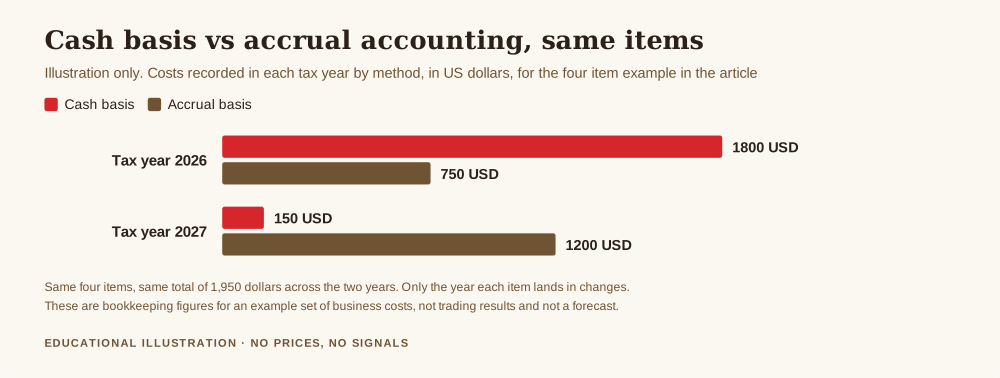
On the cash basis, 2026 records the subscription and the furniture, 1,800 dollars out. 2027 records the accountant's fee paid and the rebate received, a net 150 dollars out.
On the accrual basis, 2026 records the accountant's fee incurred and the rebate earned along with the furniture, a net 750 dollars out. 2027 records the subscription that the year actually consumed, 1,200 dollars out.
Both methods total 1,950 dollars across the two years. Every year, the gap between them is 1,050 dollars. Same business, same four pieces of paper, two legitimate sets of books that disagree by more than half the total in each individual year.
If you were judging whether 2026 was an expensive year to run the business, the method alone would move your answer by a factor of more than two.
Who is allowed to use the cash method
Most individuals and many small businesses use the cash method, and Publication 538 says so plainly. The restrictions are aimed at larger entities. Generally excluded are a corporation other than an S corporation, a partnership with a non S corporation partner, and a tax shelter as defined in section 448(d)(3).
There are exceptions back the other way. A corporation or partnership that is not a tax shelter may use the cash method if it meets the gross receipts test, which the publication states as average annual gross receipts for the three prior tax years of "$26 million or less (indexed for inflation)". The publication does not print the indexed figure for any particular year, so the number you need is the one for your own filing year rather than the headline in the text.
For a sole trader running their own account, none of this is usually in doubt. The cash method is available and it is what most people are already on without having consciously chosen it.
The two tests that make accrual stricter
Accrual is not simply "write it down when the invoice arrives". Two tests have to be satisfied before a cost counts.
The first is the all events test. For income, the events fixing your right to it must have occurred and the amount must be determinable with reasonable accuracy. For a liability, the same logic applies to the obligation.
The second is economic performance. Publication 538 is blunt about it: "Generally, you cannot deduct or capitalize a business expense until economic performance occurs." For property or services provided to you, that happens as they are provided or used, not when you sign the contract.
Apply that to the subscription in the example. You paid in December 2026 and you have an invoice. But the service is delivered across 2027, so under accrual that is when it is consumed, and that is why it sits in the 2027 column.
The recurring item exception, and the eight and a half month window
There is a relief valve. The recurring item exception lets you treat an item as incurred in the earlier year even though economic performance happens later, provided a set of conditions all hold: the all events test is met, economic performance occurs within 8½ months after the end of the tax year or by the timely filed return date including extensions, the item is recurring and is treated consistently, and it is either immaterial or accruing it gives a better match against income.
The operator's reading of that is the phrase "treated consistently". You do not get to apply the exception in years where it flatters the books and ignore it in years where it does not. A method you switch opportunistically is not a method.
Prepaid costs and the twelve month rule
The cash method has its own boundary, and people assume it is looser than it is. Publication 538 notes that expenses paid in advance are deductible only in the year to which they apply, unless the twelve month rule applies.
So the annual subscription paid in December is not automatically a December deduction just because the money left in December. There is a specific rule that may permit it, and that rule has a shape. This is the most common place where somebody assumes the cash method means "whenever the card was charged" and is wrong.
The related trap on the income side is constructive receipt. Income counts as received when it is credited to your account or made available to you without restriction. Leaving a rebate sitting in a broker account you could withdraw from does not postpone it.
Which one a one person trading business usually runs
Most sole traders are on the cash method, because it is permitted, because it needs one ledger rather than two, and because it matches the bank statement, which means errors are visible rather than buried.
The argument for accrual is matching. If you want to know what a quarter genuinely cost to operate, accrual answers that and cash does not, because cash tells you when the money moved. A twelve month tool bought in December distorts a cash view of December and tells you nothing about the year that actually used it.
There is a practical middle path that needs no election at all: file on whichever method applies to you, and keep an internal management view on an accrual basis purely for your own review. The tax return is a compliance document. Your monthly review is a decision making document. They do not have to use the same lens, and the second one is the one that changes behaviour.
What this does not decide
Three limits worth stating clearly, because the subject attracts overreach.
It does not change your trading results. The lifetime total was 1,950 dollars either way. Nobody has ever improved a method by changing how it is recorded.
It does not settle how your trading gains themselves are treated. Whether a person is a trader or an investor for tax purposes, and what elections are available to them, is a separate question with its own rules and its own consequences, and it is not answered by your bookkeeping method.
It is jurisdiction specific. Everything above describes the United States federal position as published by the IRS. If you file somewhere else, the principles usually rhyme and the thresholds and the tests will not be the same. Take the structure from this article and the figures from your own tax authority, and put the actual decision in front of a qualified professional who can see your full position.
Get the free REX one page trading business plan, with the risk limit, the review cadence and the record keeping on a single sheet, so the books you review each month were set up on purpose rather than by accident. One email, no spam, unsubscribe anytime.
Get the free business plan →Frequently asked questions
What is the main difference between cash basis vs accrual accounting?
Timing, and only timing. Cash records income when it is received and expenses when they are paid. Accrual records income when it is earned and expenses when they are incurred. Over the life of the business the totals are identical. In any single year they can differ substantially, as the 1,050 dollar gap in the example above shows.
Which method should a small trading business use?
Most sole traders are eligible for the cash method and use it, because it is simpler and it reconciles directly against the bank statement. That is a general observation and not advice for your situation. Eligibility, and whether a different method would suit you better, depends on your entity type, your receipts and your jurisdiction, so it is a question for a qualified professional.
Can I change from cash to accrual later?
A change of accounting method is a formal process rather than something you simply start doing, and it generally requires permission from the tax authority. Publication 538 covers the procedure. The point to take away is that the method is not a setting you can flip between years to suit the result.
Does the accounting method change how much tax I pay?
Not over the lifetime of the business, because the same items are counted either way. It changes which year they fall in, which can change the tax due in any individual year depending on your rates and circumstances in that year. That is a timing effect, not a reduction.
Does this apply outside the United States?
The cash and accrual distinction exists in most systems and the underlying logic travels well. The specific thresholds, tests and elections described here are from United States federal guidance and should not be assumed to hold elsewhere. Check your own tax authority's published guidance.
Where REX Trading Signal fits
REX Trading Signal is free to follow. The daily record on Telegram includes losing days, because a record that only shows winners is not a record. There is a free one page trading business plan for anyone who wants the limits and the review cadence in one place, and an optional Kit for people who want the full operating method. Nothing here promises a profit and nothing here is a signal service. The foundation this article sits on is the one page trading business plan template, the review that these books feed into is in your monthly profit and loss review, the record keeping side is covered in how to keep track of day trading for taxes and how long to keep tax records as a sole trader, and the question of what counts as a cost at all is handled in whether a losing trade is a business expense.
Outside sources used here: Internal Revenue Service Publication 538, Accounting Periods and Methods for the definitions of both methods, the gross receipts test, the all events test, economic performance, the recurring item exception and constructive receipt. The two year worked example is computed from the four stated items, and the calculation with its assumptions is reproducible from the figures given in the article.
About the author. Rex writes REX Trading Signal and treats an account the way an operator treats a business, with limits set before the week starts and a review that happens whether the month was good or bad. He is less interested in what a trader thinks will happen next than in what the records say already happened. The figures here are quoted from the source linked above or computed from the stated assumptions so you can repeat them with your own numbers, this article is educational and is not tax, accounting or investment advice, your own position should be put to a qualified professional, nothing here is a recommendation to use or avoid any firm, platform or arrangement, and no entry, stop or target discussed should be treated as a signal.