
Every operator eventually finds out what happens if your broker platform goes down, and almost nobody finds out on a quiet afternoon with nothing open. It happens on the one morning you are carrying size, and the discovery arrives as a spinning icon and a login screen that will not accept a password you know is correct. The question I want to answer is not whether this will occur, because over a long enough run it will. The question is which parts of your business keep running while you are locked out, and which parts were only ever running because you were sitting there.
That distinction is the whole of it. A trading business has processes that live on somebody else's servers and processes that live in your hands. An outage does not pause the market, it just removes your hands.
What Happens If Your Broker Platform Goes Down, Line by Line
Start with what does not stop. The market does not stop. Your position continues to be marked against a price you cannot see. Any order already resting on the broker's servers, a stop or a limit you placed and confirmed, continues to sit there waiting to be triggered, because it is held on their infrastructure rather than on your machine. Financing or swap on an overnight position continues to accrue on the schedule it always does.
The broker's own risk engine also continues to run, and this is the part people underestimate. Under the measures the European Securities and Markets Authority agreed for retail contracts for difference, the package includes leverage limits on opening positions, a margin close out rule on a per account basis, and negative balance protection on a per account basis. You can read the ESMA announcement in full. A margin close out rule is an automated process that closes positions when account equity falls past a threshold. It does not ask whether you are logged in. During an outage it is, in a real sense, the only member of staff still at the desk, and it has exactly one instruction.
Now the list of what does stop. Anything requiring a click stops. Moving a stop stops. Taking partial profit stops. Opening the hedge you had planned as your contingency stops. Cancelling a pending order before news stops. In other words, every piece of discretion you were relying on is gone, and everything mechanical continues. That asymmetry is the argument for putting more of your plan into resting orders and less of it into intentions.
How Often This Actually Lands, With Numbers Instead of Anecdotes
Operators usually treat outages as freak events. They are not freak events, they are low frequency events, which is a different thing and easy to price. Suppose your business experiences six disruptions a year across all causes: the broker's platform, your home connection, your machine, your power. Six is an assumption, and a fairly gentle one once you count everything rather than only the ones that made the news. Suppose those disruptions arrive at random times, independent of whether you happen to be holding a position.
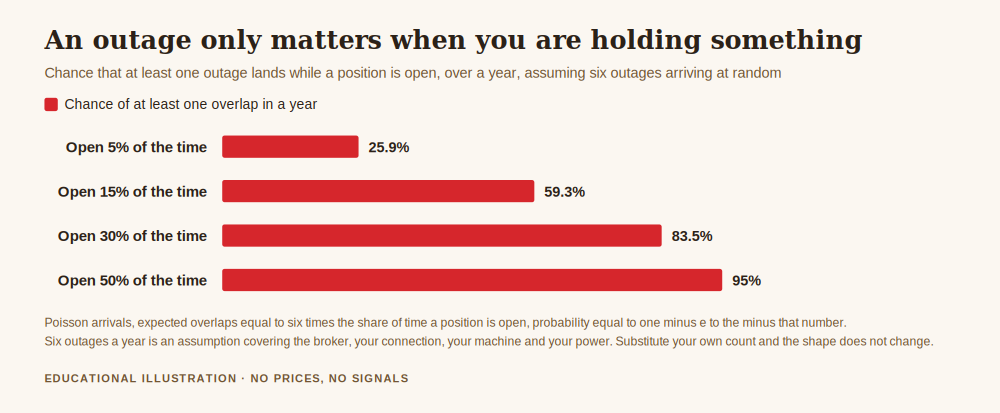
Then the expected number that land while you are exposed is simply six multiplied by the share of the year during which you have a position open, and the chance of at least one landing is one minus e to the minus that number. If you hold positions 5 per cent of the time, the chance that at least one outage overlaps an open position during the year is 25.9 per cent. At 15 per cent of the time it is 59.3 per cent. At 30 per cent it is 83.5 per cent. At 50 per cent it is 95.0 per cent.
Read those as a business owner rather than as a trader. A swing operator who holds positions through most of the week is not looking at a rare event, they are looking at something closer to a certainty over a twelve month horizon. A day trader who is flat overnight and flat most of the session faces roughly one chance in four. Same broker, same connection, same world, and the exposure differs by a factor of nearly four purely because of how the business is run.
The duration matters too, and it multiplies straightforwardly. At 15 per cent time in market with six disruptions a year, an average outage of 15 minutes gives you 13.5 expected minutes of blind exposure a year. At 45 minutes it is 40.5 minutes. At two hours it is 108 minutes. Nobody is going to change their life over 108 minutes a year, until you notice that the minutes are not drawn uniformly from the calendar. Platforms strain when volume spikes, and volume spikes on the days your position is moving fastest. The minutes you lose are the expensive ones.
What a Stop That Lives in Your Head Actually Costs
Here is the specific failure this article exists to prevent. Suppose you intended to risk one unit of risk on a trade, one R. If your stop was placed and confirmed on the broker's servers, the outage is an inconvenience. The instruction executes without you, and you find out afterwards.
If your stop was a mental stop, a level you were watching and intending to act on, then during the outage there is no instruction anywhere in the system. Price keeps moving. If it travels twice the distance you had allowed before you regain access, you lose 2R instead of 1R, which is 100 per cent more than planned. Three times the distance costs 3R, which is 200 per cent more. Five times costs 5R.
Translate that into recovery work, which is the honest way to look at any loss in a business. A 3R loss requires three 1R wins simply to return to the line you were on before the outage. A 5R loss requires five. That is not a statement about how often you win, it is division. The point is that a single infrastructure event converted a planned expense into an unplanned one, and the difference is paid for out of future production.
The fix is unglamorous and takes about four seconds per trade: place the protective order at the same moment you open the position, and confirm it is showing as resting rather than pending on your screen. Mental stops have a number of drawbacks, and the fact that they evaporate entirely when your connection does is the one nobody lists.
The One Page Continuity Plan
Every other kind of business writes this down, and a trading business should too. It does not need to be long. It needs to exist before it is required, because the whole point is that you will be writing nothing during the event itself.
The first item is a second route to your account. Most brokers offer a mobile application on a completely different network path from your desktop terminal, and many offer a web terminal as well. If your home connection is the failure, mobile data is your redundancy, and it costs nothing to verify it works while everything is fine. Log in on it once a month so that you discover a forgotten password on a calm day rather than an expensive one.
The second item is the broker's dealing desk telephone number, stored in your phone rather than on the website you cannot currently load. Most regulated brokers accept instructions to close positions by telephone precisely because platform failure is a known operational risk. Find out today whether yours does, what the number is, and what they will ask you for. A business that cannot reach its counterparty has no plan, it has a hope.
The third item is a written position policy for the outage itself. Decide, in advance and in ordinary words, what you will do: close everything at market as soon as access returns, hold according to the original plan, or act only if a specific condition is true. Any of those can be a defensible policy. What is not defensible is deciding in the moment, at speed, with adrenaline and an account balance you have not seen for forty minutes. The decision you make under those conditions is not really a decision.
The fourth item is the record. Note the time, the duration, the positions open and what it cost you, and keep it with your other business records. Three of those entries over a year tell you whether the problem is your broker, your infrastructure or your habits, and each of those has a different and obvious fix. Without the record you will remember only the worst one, and you will fix the wrong thing.
What This Does Not Say
It does not say your broker is negligent. Platforms fail for the same reasons all systems fail, and a well run firm publishes a status page and a post mortem. It does not say you can sue your way out of a loss: your client agreement almost certainly addresses platform availability, and it is worth reading the section before you need it rather than after.
Above all, it does not say the outage caused the loss. The outage exposed a plan that depended on your continuous presence. A business that can only operate while the owner watches the screen is not a business, it is a job with worse hours, and this is simply the day that gets demonstrated.
Where REX Fits
REX is free to follow. The daily record goes out with the reasoning stated before the outcome is known, losing days included, because a business plan that only shows the good weeks is marketing. There is a free one page business plan template for anyone who wants their operating rules in one place, and an optional Kit for people who want the full operating system. Nothing here promises a profit and nothing here is a signal service. If you want the foundation, start with the one page trading business plan template, then read how to use a VPS for forex trading and how your trading business survives a market shock.
Get the free REX one page business plan, including the continuity checklist described in this article. One email, no spam, unsubscribe anytime.
Get the free business plan →Frequently Asked Questions
Do my stop orders still work if the platform is down?
An order that is resting on the broker's servers, placed and confirmed, is held on their infrastructure and continues to work without your terminal. A stop that exists only as a level in your head does nothing at all. That is the entire difference, and it is worth four seconds per trade to be on the right side of it.
Can my account be closed out while I cannot log in?
Yes. Automated risk processes run independently of your session, and under the ESMA measures linked above a margin close out rule operates on a per account basis. It does not check whether you are available.
Should I just close everything when I get back in?
That is a legitimate policy, and so is holding to the original plan. Whichever you choose, choose it in advance and write it down. The problem is not which option you pick, it is picking one at speed while your heart rate is elevated and the balance in front of you is unfamiliar.
Is a VPS the answer?
It removes your machine and your home connection from the failure list, which is a genuine improvement if you run automated strategies. It does not remove the broker's platform from that list, and it introduces a provider of its own. Redundancy moves the risk, it rarely deletes it.
Where did the numbers in this article come from?
The overlap probabilities assume outages arrive at random, independently of your positions, with expected overlaps equal to six a year multiplied by the share of time a position is open, and a probability of one minus e to the minus that figure. Six outages a year is an assumption covering all causes and you should substitute your own count. The R figures are division applied to a stated one unit risk. The regulatory points come from the linked ESMA announcement.
Put the protective order on their servers, keep a second route to your account, write the outage policy while nothing is wrong, and log the event afterwards like any other operating cost.
About the author. Rex writes REX Trading. He came to this from running an actual business with actual inventory, where a supplier failure was a planning problem rather than a personal betrayal, and he has never understood why traders treat their own infrastructure any differently. Nothing in this article is a recommendation to trade, and no entry, stop or target discussed should be treated as a signal.