
Every business plan I have ever read for a one person operation has a section on market risk, a section on cost control and nothing at all on key person risk in your trading business, which is strange, because in a business with exactly one employee it is the largest single-point failure on the books. A real company writes it down. It buys insurance against it, names a deputy, documents the procedures. A trading business usually pretends the operator will simply be there, every session, for the rest of their working life.
They will not. People get ill, take holidays, have a week of family emergency, move house, work late at the job that currently pays for all this. The question is not whether you will be away. It is what the business loses while you are, and whether that number is large enough to plan around. So I went and measured it.
Key person risk in your trading business is the line item nobody writes down
Let me define it before measuring it, because the term gets used loosely.
Key person risk is the exposure a business carries to the loss of one individual whose absence it cannot absorb. In a normal firm it is managed by documentation, cross training and cover. In a trading business, the operator is the method, the risk committee, the execution desk and the bookkeeping, and there is nobody to hand it to.
It splits into two quite different exposures, and conflating them is why the subject gets waved away. The first is the opportunity you do not take because you were not at the desk. The second is the position that was already open when you walked away from it. They behave differently, they need different controls, and only one of them can hurt you badly.
How concentrated a year actually is
Start with the opportunity side, because that is where people assume the loss is biggest.
I used the afternoon gold auction published by the London Bullion Market Association, in US dollars, and took every complete year from 1969 to 2025. That is 57 years averaging 251.1 sessions each, ranging from 248 to 254. For each year I ranked the sessions by how far the price moved, ignoring direction, and asked what share of the year's total movement the biggest sessions carried.
The ten largest sessions of a year carry a median 15.9 per cent of everything that year moved. Across the 57 years that figure ranges from 12.9 per cent to 23.8 per cent. The twenty largest carry 26.8 per cent.
That is concentrated, and it is worth pausing on the direction of the surprise. Ten sessions out of 251 is 4 per cent of the year delivering 16 per cent of the movement, so the big days are roughly four times as productive as an average one. But it is a long way from the story you sometimes hear, where a handful of days are everything and missing them ruins the year. Eighty four per cent of the movement happens on the other 241 sessions. A business that is present most of the time captures most of what there is.
The arithmetic of being away
Now put an operator's absence against that. Assume 252 sessions in a year, ten of them the big ones, and assume your absence is unrelated to when the market decides to move, which is the honest assumption since illness and school holidays do not consult the calendar.
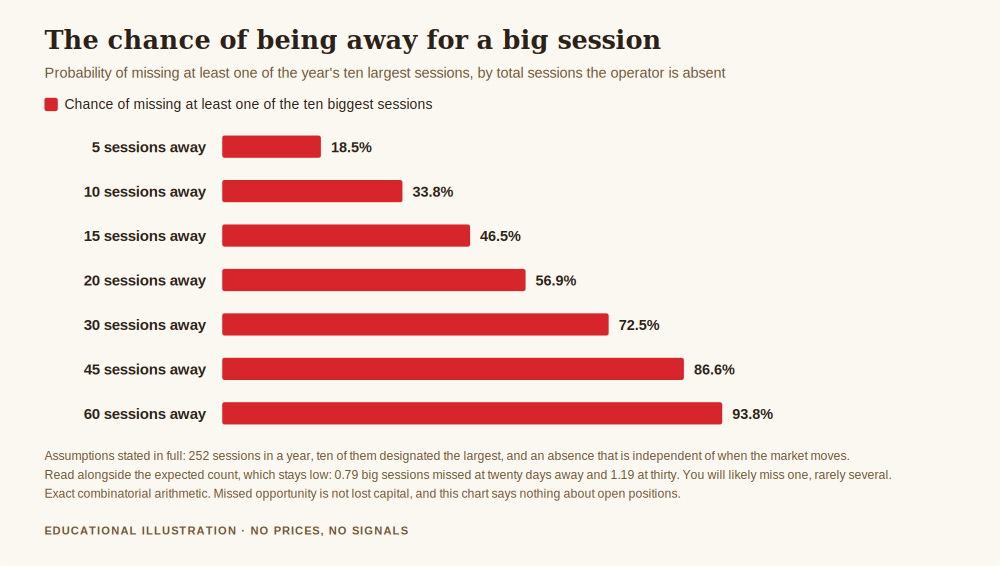
Five sessions away, a single week, and you miss at least one of the year's ten biggest sessions 18.5 per cent of the time. Ten sessions, 33.8 per cent. Fifteen, 46.5 per cent. Twenty sessions, which is four working weeks and less holiday than most employed people take, and it is 56.9 per cent. Thirty sessions, 72.5 per cent. Forty five, 86.6 per cent. Sixty sessions away and the probability is 93.8 per cent.
Those numbers look alarming until you read the second column. The expected number of big sessions missed at twenty days away is 0.79, and the chance of missing two or more is 18.3 per cent. At thirty days it is 1.19 expected and 33.9 per cent. You are very likely to miss one. You are unlikely to miss several.
That is the reassuring half of the finding and I want to state it plainly, because the panicked version of this subject leads operators to trade while ill, trade from airports, and trade on a phone in a hotel lobby, which is a reliable way to convert a manageable absence into an expensive one. Four weeks off costs you, in expectation, most of one good day out of ten. Set against the cost of trading badly for twenty sessions, that is a bargain, and any plan that has you at the desk unwell is optimising the wrong variable.
Block leave or scattered days, and the answer that surprised me
I assumed a single long absence would be worse than the same number of days scattered through the year, on the theory that a block can land squarely on a busy stretch. I was wrong, and the simulation is unambiguous.
Twenty thousand simulated years, 252 sessions each, ten big sessions placed at random, fixed random seed 20260927. At ten sessions away, a continuous block misses an average of 0.399 big sessions against 0.395 for scattered days. At twenty sessions it is 0.791 against 0.793. At thirty, 1.190 against 1.195. The probability of missing at least one is 56.9 per cent for a block of twenty against 57.0 per cent scattered.
They are the same to within simulation noise, and on reflection they have to be. If the big sessions are scattered at random, then any twenty sessions you remove from the year are as likely to contain them as any other twenty. Clustering your absence does not concentrate your bad luck.
The practical conclusion is the useful bit. There is no operational reason to break a holiday into fragments to reduce this risk, and the fragmented version is worse for the operator, who never fully stops. Take the block. The arithmetic does not care and you will come back sharper.
The other half, which is the one that can actually hurt
Everything above is about opportunity, and opportunity you did not take costs you nothing you already had. The open position is a different matter entirely, because that one can take money off the table while you are unreachable.
Across the full LBMA record, 1968 to 2026, which is 14,690 session to session changes, 8.03 per cent of sessions moved 2 per cent or more, and 3.01 per cent moved 3 per cent or more. Compound that over an unattended stretch. Leave a position running for three sessions and the chance of meeting at least one move of 2 per cent or more is 22.2 per cent. Over five sessions, 34.2 per cent. Over ten sessions, 56.7 per cent. Over fifteen, 71.5 per cent.
So the operator who goes away for three weeks with positions open is not facing a remote tail event. They are facing better than even odds of a 2 per cent session arriving with nobody watching, and a one in four chance of a 3 per cent one over ten sessions. Whether that matters depends entirely on whether the protective orders were set correctly before the laptop closed, which is a decision made at the desk, in advance, and not one that can be fixed from a phone with two bars of signal.
This is the same structure as what happens if your broker platform goes down. In both cases the exposure is not the event, it is the combination of an open position and an operator who cannot act. The platform failing and you being on a plane are operationally identical from the account's point of view.
What an operator actually does about it
Four things, none of which require being at the desk more.
Write the absence policy before you need it. Decide now, in writing, what happens to open positions when you will be unreachable for more than a set number of sessions. Flat before you go is the simplest rule and the one most small operations should probably adopt, because it converts an unmanaged exposure into a known, small cost, which is one spread.
Separate the two exposures in your own head. Missed opportunity is a cost of doing business at human scale and should not drive any decision. Unmanaged open risk is a genuine hazard and should drive several.
Document the business so a three week absence does not restart it. Where the records are, which accounts exist, what the platform passwords are and who can reach them, what the method actually is in writing. This is the part that looks like bureaucracy and is genuinely key person risk management, and it sits naturally inside the one page trading business plan rather than in a separate document nobody opens.
Size so that absence is survivable. A position that must be watched is a position that has been sized for an operator who never sleeps. That is the same lesson as concentration risk in your trading business, arriving from a different direction: the exposure is only dangerous because it is large relative to the account, and the fix in both cases is upstream of the trade.
None of this is glamorous, and none of it improves a single entry. It is the difference between a business that can absorb its owner having flu and one that cannot, which is the distinction surviving a market shock makes about the market and this one makes about you.
Get the free REX one page trading business plan, the document where the absence policy, the risk ceiling and the records all live in one place instead of in your head. One email, no spam, unsubscribe anytime.
Get the free business plan →Frequently asked questions
How many sessions can I take off before key person risk in your trading business becomes serious?
On the opportunity side it never becomes serious in the way people fear. Even sixty sessions away, a full quarter of the year, costs an expected 2.4 of the year's ten biggest sessions, and the other 241 sessions still hold 84 per cent of the movement. On the open position side it becomes serious immediately, because a single unattended session carries an 8.03 per cent chance of a 2 per cent move. The answer is that the length of the absence matters far less than whether you left anything running.
Should I break my holiday into short trips to miss less?
No. Twenty thousand simulated years say a continuous block and the same number of scattered days miss the same amount, 0.791 big sessions against 0.793 at twenty days away. Since the arithmetic is indifferent and fragmented time off does not rest anyone, take the block.
Is closing everything before I travel not just giving up profit?
It gives up the remainder of whatever those positions would have done, in both directions, and it costs one spread to re-enter. What it buys is the removal of an exposure you cannot manage. Whether that trade is worth it is your call and depends on your position sizes, but it should be a decided policy rather than a decision you make in a taxi.
Can I not just leave protective orders and go?
You can, and it is better than leaving nothing, which is why the policy should specify it. Understand what it does and does not cover. A resting order handles the ordinary case. It does not handle a platform outage, a gap through the level, or a change in circumstances that would have made you exit for a reason unrelated to price. Those are the situations where being reachable mattered, and they are exactly the ones a resting order cannot see.
Does this apply if I only trade part time anyway?
More so, not less. A part time operator is already absent for most sessions by design, which is fine and priced in. The risk is the unplanned absence on top of the planned one, arriving in a week when positions happen to be open. A part time business needs the absence policy written down more urgently than a full time one, because it has less slack to absorb the surprise.
Where did these numbers come from?
The concentration figures and the session move frequencies are my own arithmetic on the LBMA afternoon gold auction in US dollars, linked above. Concentration uses the 57 complete years from 1969 to 2025, averaging 251.1 sessions; the move frequencies use all 14,690 session to session changes from 1968 to 25 September 2026. The probabilities of missing the biggest sessions are exact combinatorial arithmetic on a stated assumption, 252 sessions a year with ten designated as the largest and an absence that is independent of when the market moves. The block against scattered comparison is a simulation of 20,000 years with random seed 20260927. The unattended position probabilities compound the observed session frequency and assume sessions are independent, which slightly understates the risk because large moves cluster. No gold price level appears anywhere in this article.
About the author. Rex writes REX Trading Signal, where the account is treated as an operating business rather than a hobby with money in it. He takes the view that a business which collapses when its only employee gets flu was never a business, and that the fix is written down long before the flu arrives. Nothing in this article is a recommendation to trade, and no entry, stop or target discussed should be treated as a signal.