
Do I need business insurance as a sole trader is a question that turns up early for anyone who has started treating their trading account as a business rather than a hobby. It usually arrives alongside the first spreadsheet of costs, and it deserves a straight answer rather than a sales page.
The straight answer has two halves. There is exactly one insurance a sole trader in the United Kingdom is legally required to carry, and it almost certainly does not apply to you. And the risk that will actually end your trading business is not insurable by anybody, at any price.
What follows is the legal position as published by the government, then the arithmetic of what fixed costs do to a one person operation, computed with the assumptions written out. This is general information about how business costs and obligations work, not legal or insurance advice, and the rules below are the ones that apply in England, Scotland and Wales.
Do I need business insurance as a sole trader? The legal answer first
Only one class of business insurance is compulsory, and it is tied to employing people rather than to trading itself.
The government's guidance on employers' liability insurance states that you must get it as soon as you become an employer, and that the policy must cover you for at least £5 million. The penalty for going without is published in the same place: you can be fined £2,500 for every day you are not properly insured. You must also display the certificate where employees can see it, and failing to do that carries a fine of £1,000.
Then comes the exemption that covers most people reading this. You do not need the policy if the only people you employ are close family members, a spouse or civil partner, parent, grandparent, child, sibling, or a step or half relative, or if the person is based outside England, Scotland and Wales. The Health and Safety Executive publishes its own guide to the Act if you want the detail.
A sole trader who trades their own capital, alone, with no staff, is in the clear. Nobody is legally obliged to insure anything. That is the whole compulsory list.
The fine is worth a moment anyway, because of what it demonstrates about fixed obligations. At £2,500 a day, a week uninsured is £17,500, a month is £75,000, and a year is £912,500, which is 18.2 per cent of the minimum cover the law asks you to buy in the first place. That is my arithmetic on the published daily figure. A business cost that accrues per day while you are not looking is the shape of problem worth noticing, and in trading it usually shows up as swap rather than as a fine.
What the optional policies actually cover
Everything else a broker will sell a sole trader is voluntary, and each one answers a specific question. It is worth knowing which question, because the answer for a trading business is usually "not mine".
Public liability covers injury or damage you cause to a third party. It matters if clients or the public come to your premises. If your business is one person at a desk, there is no third party in the room.
Professional indemnity covers claims that your professional advice or service caused a client a loss. It matters the moment you advise, manage money, or publish research for payment, which is a different business from trading your own account, and one with its own regulatory requirements.
Contents and equipment covers the hardware. For most traders this is already inside a home contents policy, often with a condition about business use that is worth reading before assuming it.
Business interruption covers lost income when an insured event stops you trading. Read the trigger carefully. These policies pay out on physical damage and named perils, not on a broker outage, not on a platform failure, and not on a market that moved while you were watching.
Notice what is missing from all four. None of them covers a losing trade. There is no policy anywhere that reimburses market loss, for the obvious reason that an insurer cannot price a risk the insured party chooses to take and can take again tomorrow.
Every fixed cost sets a hurdle
Here is the part that belongs in a business journal rather than an insurance brochure. A premium is a fixed cost, and fixed costs in a small trading business do something specific: they set the return you must make before you have made anything at all.
Assume the fixed costs come out of the trading account, there are no withdrawals and no new deposits. The hurdle is twelve months of fixed costs divided by account equity.
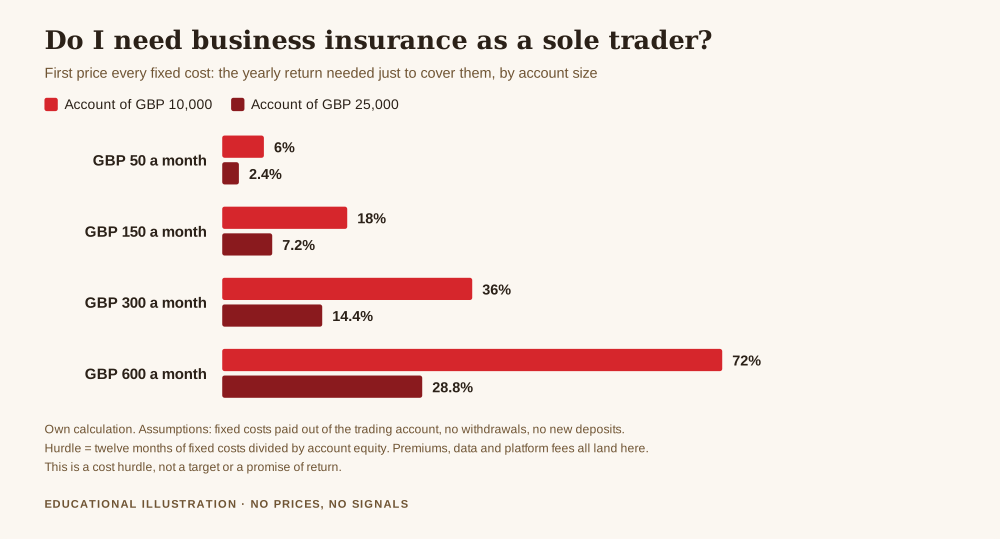
On a £10,000 account, £50 a month of fixed costs is a 6 per cent annual hurdle. At £150 a month it is 18 per cent. At £300 a month it is 36 per cent, and at £600 a month it is 72 per cent, which is a number no strategy should be asked to clear. On a £25,000 account the same costs are 2.4, 7.2, 14.4 and 28.8 per cent.
Two conclusions fall out of that table, and neither is about insurance specifically.
The first is that the hurdle depends far more on the size of the account than on the size of the cost. The same £150 a month is a 90 per cent hurdle on a £2,000 account and a 3.6 per cent hurdle on £50,000. Subscriptions that are trivial for a funded business are ruinous for a small one, which is the real reason a new trader should be ruthless about the monthly list. I went through the full cost structure in fixed and variable costs of a trading business.
The second is that a premium has to be judged like any other fixed cost: against the loss it actually prevents. A policy that costs 6 per cent a year of the account and covers an event that cannot happen to you is not cheap insurance, it is an expensive subscription.
What a one person trading business should actually be protecting
Insurance exists to transfer a risk that is rare, expensive and outside your control. Run the real risks of a one person trading operation through that filter and the list comes out short.
You stop working. Illness or injury stops the business instantly, because the business is you. This is the one genuine insurable exposure a sole trader has, and the products that address it are personal rather than commercial, income protection and critical illness cover. The business version of the same problem is in key person risk in your trading business.
The infrastructure fails. Power, internet, platform or broker. No insurer covers these in a retail setting, and the mitigation is redundancy rather than a policy, which I worked through in what happens if your broker platform goes down.
The account is compromised. Cyber policies exist, they are written for businesses holding customer data, and a personal trading account is not that. Two factor authentication does more here than any premium, as in protecting your account from hackers.
The market moves against you. Uninsurable, by definition, and the largest risk on the list.
For three of those four, the instrument that does the work of insurance is a cash reserve held outside the trading account. It is not a premium, it is your own money, and it pays out on any event at all.
The arithmetic is simple. A reserve of £3,000 against fixed costs of £150 a month covers 20 months of zero income. The same reserve against £300 a month covers 10 months, and against £600 a month, 5 months. Assumptions: no income from trading, costs unchanged, no new deposits. How to build one is in how to build a cash reserve for your trading business.
The arithmetic no policy changes
There is one more number worth having in front of you, because it is the reason risk control sits above everything else in this business.
Lose 10 per cent of the account and you need 11.1 per cent on the smaller balance to get back to flat. Lose 20 per cent and you need 25 per cent. Lose 30 per cent and you need 42.9 per cent. Lose 50 per cent and you need 100 per cent, a doubling, just to return to where you started.
That asymmetry is arithmetic, not opinion, and no insurer will sell you a way out of it. Position sizing and a written risk ceiling are the only instruments that act on it, which is why they belong on the first page of the one page trading business plan rather than somewhere in an appendix.
So, what would I actually buy?
Judged purely as a business decision, and as a general framework rather than advice for your situation, the order of priority for a sole trader whose business is a trading account looks like this.
First, the reserve. It covers every scenario, costs nothing in premiums, and remains your money.
Second, cover for yourself if other people depend on your income, since you stopping is the one rare, expensive, outside-your-control risk on the list.
Third, employers' liability, immediately, if you ever employ anyone outside the family exemption, because that one is not optional and the penalty accrues daily.
Fourth, public liability or professional indemnity only when the business genuinely changes shape, meaning clients, premises, or paid advice. Taking money to advise or manage for others is a different business with its own authorisation requirements, and how to open a trading company is the place that question starts.
And if you are now wondering what you can put through the books, which is the usual next question, is a losing trade a business expense and how long to keep tax records as a sole trader cover the record keeping side.
What this article does not say
It does not tell you that you do not need insurance. It says the compulsory list has one item on it, employers' liability, and that the rest is a cost to be judged against a risk you have actually identified.
It is not legal or insurance advice, and it does not replace asking an insurer or an accountant about your own circumstances. Business structure, where you live and what you actually do all change the answer.
And the figures above are the published UK rules plus my own arithmetic from them. The fines, the minimum cover and the exemptions are quoted from the government guidance linked in the text. The hurdles, the reserve months and the recovery percentages are calculations on stated assumptions, not quotes from any insurer.
Get the free REX one page business plan, the sheet where the cost base, the risk ceiling and the reserve get written down before any capital is committed. One email, no spam, unsubscribe anytime.
Get the free business plan →Frequently asked questions
Do I need business insurance as a sole trader if I trade alone?
Not as a legal requirement. Employers' liability insurance is the only compulsory business insurance, and it applies when you employ someone. A sole trader with no employees, trading their own capital, has no mandatory cover to buy.
What happens if I employ someone and skip employers' liability?
The published penalty is £2,500 for each day you are not properly insured, plus £1,000 for failing to display the certificate when asked. Cover must be at least £5 million.
Does any insurance cover my trading losses?
No. Market loss is not insurable. An insurer cannot price a risk the insured chooses to take and can choose to take again the next day, which is why no product exists.
Is business interruption cover useful if my broker goes offline?
Almost never. These policies are generally triggered by physical damage or named perils at your premises, not by a third party's platform failing. Read the trigger clause before assuming otherwise.
What about employing my husband, wife or child in the business?
The guidance exempts close family members, including a spouse or civil partner, parent, grandparent, child, sibling, and step or half relatives. If they are your only employees, the policy is not required.
What should a small trading business spend on instead?
A cash reserve outside the trading account, held in proportion to fixed monthly costs, does the job insurance would do across almost every scenario a one person operation faces, and it stays your money if nothing goes wrong.
Where REX Trading Signal fits
REX Trading Signal is a free journal about running a trading account like a business, which mostly means pricing things honestly before committing money to them. Nothing here is sold on a promise of returns and there is no signal service to subscribe to. The free one page business plan is where the cost base, the risk ceiling and the reserve get written down in one place. The piece underneath all of it is the one page trading business plan, and the cost side is in fixed and variable costs of a trading business.
About the author. Rex writes REX Trading Signal. He once spent an afternoon pricing four insurance policies for a business that consisted of himself, a laptop and a trading account, worked out that three of them covered risks he did not have, and put the money in a reserve account instead. He has needed the reserve twice and the policies never.
This article is educational and is not financial, legal or insurance advice. Trading gold and other leveraged products carries a high risk of losing money rapidly, and no entry, stop or target discussed should be treated as a signal. The compulsory employers' liability requirement, the £5 million minimum cover, the £2,500 daily fine, the £1,000 certificate fine and the family member exemption are quoted from the UK government's published guidance and the Health and Safety Executive, as linked above, and apply in England, Scotland and Wales. The annual cost hurdles, the reserve durations, the cumulative fine figures and the recovery percentages are my own arithmetic on the assumptions stated in the text. Your own circumstances govern what you need. Decide your own risk, and never trade money you cannot afford to lose.