
Every so often somebody clears out a drawer, finds three years of broker statements, and asks the reasonable question: how long to keep tax records sole trader rules actually demand before this stuff can go in the bin. The answer they usually already have in their head is three years. Three years is the number that circulates, and for a lot of people it is genuinely correct.
It is also, for most people trading their own account, the wrong number. Not because the rule is different, but because a trader routinely lands in two of the exceptions to it, and the exceptions run to six and seven years. Working from the headline figure means shredding the records that cover exactly the situations where someone might later ask you to produce them.
This is a bookkeeping article rather than a trading one, which is the point. The administrative side of this business is where accounts get into trouble long after the trading has settled down.
How Long to Keep Tax Records Sole Trader Rules Set Out
Start with the actual text rather than the folklore. The United States position is published by the IRS under the heading how long should I keep records, and it is organised around what it calls the period of limitations, which the page defines as "the period of time in which you can amend your tax return to claim a credit or refund, or the IRS can assess additional tax."
That framing is the whole logic. You are not keeping paperwork because a filing cabinet demands it. You are keeping it for exactly as long as somebody is still entitled to reopen the question. When the window closes, the records stop being load bearing.
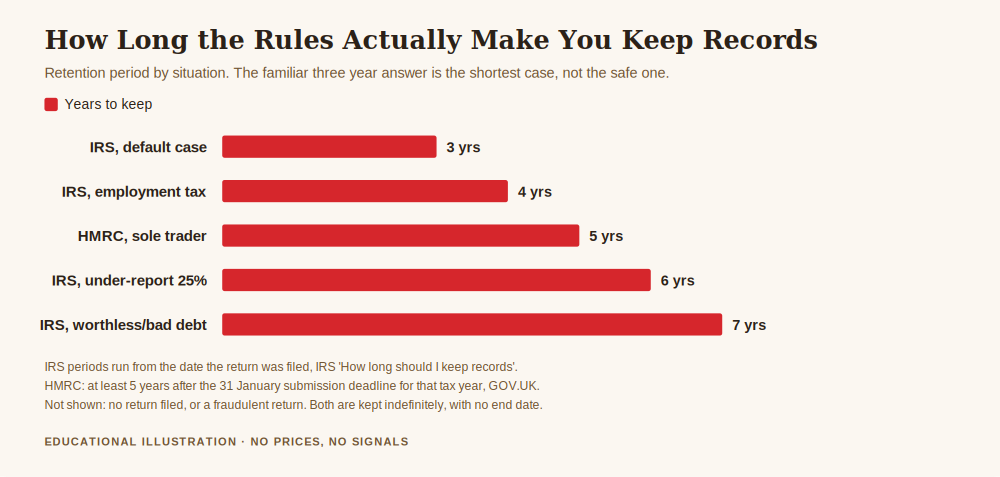
The periods themselves, quoted from that page, run like this. Keep records for three years if the other situations do not apply. Keep them for seven years "if you file a claim for a loss from worthless securities or bad debt deduction." Keep them for six years "if you do not report income that you should report, and it is more than 25% of the gross income shown on your return." Keep employment tax records "for at least 4 years after the date that the tax becomes due or is paid, whichever is later." And two with no end at all: keep records indefinitely if you do not file a return, and indefinitely if you file a fraudulent return. Unless stated otherwise, the years run from the date the return was filed, and a return filed early counts as filed on the due date.
The United Kingdom answers the same question with a single figure and a different shape. GOV.UK states that a self employed person "must keep your records for at least 5 years after the 31 January submission deadline of the relevant tax year," and gives its own worked example: a 2022 to 2023 return filed online by 31 January 2024 means keeping the records until at least the end of January 2029. There is a separate rule for very late filing, where a return sent more than four years after the deadline requires keeping records for fifteen months after you send it.
Note what the UK version does that the US version does not. Because the clock starts at the filing deadline rather than the end of the tax year, five years is really closer to six from the point the income was earned. In that worked example the tax year ended in April 2023 and the records live until January 2029, which is a shade under six years of actual shelf life.
Why a Trader Lands in the Long Cases
Here is the part that turns a general bookkeeping question into a specific one for anyone running an account.
Take the six year rule first. It applies when unreported income exceeds 25 percent of the gross income shown on the return. Most people picture that as deliberate concealment, and it can be. But consider the ordinary shape of a trading year: an account at one broker, a second account opened mid year and half forgotten, an interest credit, a rebate programme, a small amount of income from a platform that reports separately or does not report at all. Gross income on a trading return is often a modest number, which means the 25 percent threshold is a modest number too. One overlooked account can clear it without anybody intending anything.
Then the seven year rule, which is the one that catches people. It covers a claim for a loss from worthless securities or a bad debt deduction. A trader whose broker fails, or who holds an instrument that goes to zero, or who is owed a balance that never arrives, is squarely in that territory. It is not an exotic circumstance in this business. It is one of the ordinary bad outcomes, and the year you claim it is precisely the year you most need the paperwork that proves the position existed and what it cost.
Put the two together and the practical retention floor for someone trading their own account is the longest of the three cases rather than the shortest. Three, six and seven years, take the maximum, and you get seven. That is four years longer than the number most people are working from.
Four years is not an abstraction when you count what sits inside it. At a modest five trades a week, four years is 1,040 trade records, plus the statements, contract notes and transfer confirmations that go with them. That is the volume of evidence someone destroys when they act on the headline figure and it turns out an exception applied.
The Operator's Version of the Rule
Rules like this are useless as trivia and useful as a routine, so here is the routine.
Keep everything for seven years, and stop making case by case decisions. The storage cost of a decade of trading records is effectively zero. The cost of guessing wrong once is producing an argument without evidence. When one branch of a decision tree is free and the other is expensive, you do not need a decision tree. Set the retention period at seven years, apply it to everything, and spend the attention somewhere it earns more.
Export at the source, on a schedule. Broker access to historical statements is a courtesy, not an entitlement, and it disappears when an account is closed, when a platform is retired, or when a firm fails. That last one is worth dwelling on, because the scenario that triggers the seven year rule, a broker failure, is the same scenario that destroys your ability to retrieve the records afterwards. Pull statements down quarterly while everything is calm.
Keep the trade record and the money record separately. Trade history proves what you did. Deposits, withdrawals and transfer confirmations prove what moved and when. They answer different questions, and the second set is usually the one nobody has kept.
Store it somewhere that outlives the platform. Records that exist only inside a broker's web portal are not records you have. A dated folder per tax year, exported as files you hold, is the whole system.
Date the folder by tax year, and note the filing date on it. Both the IRS and HMRC clocks start from filing rather than from earning, so the filing date is the piece of information that tells you when the folder is actually safe to delete. Without it you cannot compute the answer even when you know the rule.
Get the free REX one page business plan, the sheet where the review date, the record keeping routine and the person responsible for the paperwork get written down before they are needed. One email, no spam, unsubscribe anytime.
Get the free business plan →Frequently Asked Questions
How long to keep tax records sole trader rules require, in one line?
Three years is the default in the United States and five years after the 31 January deadline in the United Kingdom, but a trader frequently falls under the six or seven year exceptions, so seven is the practical figure to operate on.
Does the clock start when I earned the money or when I filed?
When you filed, in both systems. The IRS periods run from the date the return was filed, with an early return treated as filed on the due date. HMRC counts from the 31 January submission deadline for that tax year. This is why recording the filing date alongside each year's folder matters.
Are digital copies acceptable?
Both authorities accept records kept digitally, and HMRC explicitly allows it for self employed record keeping. The requirement is that the records are complete and readable, not that they are paper. Check the current guidance for your own jurisdiction, since formats and expectations change.
What if my records are lost or destroyed?
GOV.UK addresses this directly: if you cannot replace them you must do your best to provide figures, and tell HMRC when you file whether you are using estimated figures, meaning your best guess, or provisional figures, meaning temporary estimates you will replace with actual ones later. It is a recoverable situation, but it is a much worse position than having the records.
Is there ever a case with no time limit at all?
Yes. The IRS says to keep records indefinitely if you did not file a return, and indefinitely if you filed a fraudulent one. In both cases the period of limitations never starts running, so nothing ever expires.
Where did the numbers in this article come from?
The three, four, six and seven year periods and the two indefinite cases are quoted from the IRS page "How long should I keep records". The five year period, the 31 January starting point, the 2022 to 2023 worked example and the fifteen month late filing rule are quoted from GOV.UK. The seven year practical floor, and the 1,040 trade records in four years at five trades a week, are my own arithmetic on those published rules under the assumptions written out in the text.
Where REX Fits
REX Trading Signal is free to follow. Daily XAUUSD setups with a stop loss, a reason and a rule, posted live, wins and losses alike, plus an optional Kit for people who want the operating side written down. Nothing here promises a return, because nobody honest can.
This belongs on the administration shelf with the rest of it. The one page trading business plan template is the pillar, and a retention period is one of the lines that belongs on that sheet. How to keep track of day trading for taxes covers what to record during the year, where this article covers how long the finished record has to survive afterwards, and the trading journal template is the habit that makes both of them produce something worth keeping.
About the author. Rex writes REX Trading Signal. He is interested in the unglamorous half of this business, the ledger, the controls and the review date, on the view that an account survives on its administration long before it survives on its ideas.
Disclaimer: This article is general educational content about record retention for self employed people and is not tax advice, not legal advice, not accounting advice, not financial advice, and not a solicitation to trade. It is not a substitute for a qualified accountant or tax adviser in your own country. The United States retention periods are quoted from the IRS page How long should I keep records, and the United Kingdom periods from GOV.UK self employed records. Both are summarised here rather than reproduced in full, both are amended from time to time, and both apply only in their own jurisdiction. Rules differ substantially by country, by legal structure and by individual circumstance, including how trading income is characterised for tax, which is itself a question for a professional rather than an article. Every derived figure, including the seven year practical floor and the trade record count, is my own arithmetic on those published rules under the assumptions written out in the text. Trading gold, CFDs and leveraged products carries a high risk of losing money rapidly, and no entry, stop or target discussed should be treated as a signal. Readers should consider their own circumstances and speak to a licensed professional in their jurisdiction.