
The question where to backtest for free is almost always asked as a software question, and it is really a budget question wearing a software costume. Somebody has a method they half believe in, no money to spend proving it, and a reasonable suspicion that paying for a tool before the method works is the wrong order. That instinct is correct. About 79 messages in my inbox touch whether somebody else's results are worth paying for, counted by keyword rather than by any survey, and the money involved is not trivial. One person wrote: "I didn't pay for tuition, I have paid a lot to enter different signal groups but I have wasted over 3000$ in the cause of this 5 months trying to get things right." Another asked simply: "Do you have free signal channel where I can join and raise some money for the subscription?" A third described the outcome: "I've been copying some of my trades from your public channel for a while now, but my portfolio isn't doing well at all."
So the honest version of the answer is in two parts. Free backtesting is genuinely available and you should use it. And the money was never the expensive part, which is what the rest of this is about.
Where to backtest for free, and what you are actually buying
Strip the vendor names away and there are only four free routes, and they differ in what they take from you rather than in price.
The tester built into the platform you already use. Most charting and execution platforms ship a strategy tester at no extra cost. It is the fastest route, and its weakness is that it reports a result without reporting how many versions of the idea you ran to get there.
Manual replay by hand. Bar by bar through historical data, writing each decision down before moving forward. It is slow, which people treat as the drawback and which is actually the feature. A business that can only run forty trades a week through a manual process is a business that cannot accidentally test two hundred variants.
Open source libraries with public data. Free in money, expensive in setup time, and the only route that makes your assumptions explicit, because you have to write the cost model yourself instead of inheriting one you never read.
Your broker's demo environment. Forward testing rather than backtesting, which answers a different and often more useful question, since it includes your own execution behaviour and the delays you actually face.
Any of those four will do. The choice between them matters far less than what you do with the output, and that is where the real bill arrives.
The regulator already has an opinion about your backtest
This is the part most free backtesting guides leave out, and it is the most useful single fact in the subject. United States commodity regulation does not treat simulated results as ordinary evidence. Rule 4.41 requires that any presentation of simulated or hypothetical performance carries a prescribed warning, and the wording of that warning is an unusually honest piece of drafting.
It states that hypothetical results "do not represent actual trading", that because the trades were not executed they "may have under or over compensated for the impact, if any, of certain market factors, such as lack of liquidity", and, most pointedly, that simulated programs "in general are also subject to the fact that they are designed with the benefit of hindsight". It closes by saying no representation is being made that any account will or is likely to achieve similar results.
Two details make this more than legal decoration. The rule applies whether or not the person presenting the results is registered or exempt from registration. And the warning is not aimed at dishonest operators, it is aimed at the method itself. The regulator's position is that a backtest is designed with hindsight as a structural matter, not as an accusation. If the people who write the rules will not let a professional show you a simulated track record without that sentence attached, your own simulated track record does not deserve a gentler reading just because you produced it yourself.
The expensive part: testing a lot is not the same as testing well
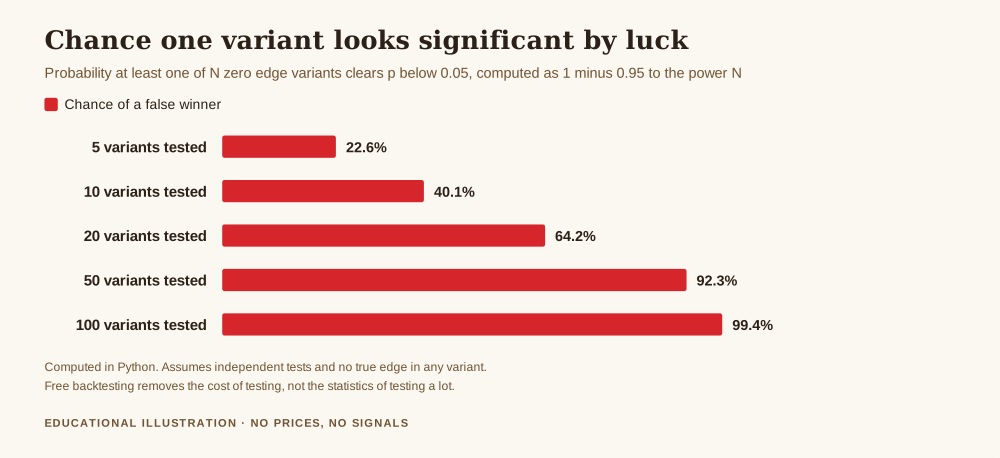
Here is the arithmetic that free access quietly changes. Suppose you test variants of an idea, each with no real edge at all, and you treat a result as promising if it clears the conventional significance threshold of five per cent. The chance that at least one variant looks promising by luck alone is one minus 0.95 raised to the number of variants.
Five variants gives 22.6 per cent. Ten gives 40.1 per cent. Twenty gives 64.2 per cent. Fifty gives 92.3 per cent, and a hundred gives 99.4 per cent. Those are computed in Python on the assumption that the tests are independent and that none of them has a true edge, and I am stating the assumptions so you can argue with them.
Read the hundred variant figure again. If you sit down with a free tester and a free afternoon and try a hundred combinations of parameters, you are not likely to find a winner, you are almost certain to. The finding carries no information about the market. It is a report on how many times you asked.
This is not a fringe concern. Harvey, Liu and Zhu examined the problem for the published finance literature in "… and the Cross-Section of Expected Returns", and argued that because so many factors have been tested, a newly claimed one should have to clear a substantially higher statistical hurdle than the conventional one, on the order of a t-statistic near 3 rather than 2. Bailey and López de Prado make the same argument for trading strategies specifically in "The Deflated Sharpe Ratio", doi:10.3905/jpm.2014.40.5.094, which adjusts a reported Sharpe ratio for the number of configurations tried.
Paid software does not fix this and never claimed to. Free software does not cause it either. What free access changes is the number of attempts, by removing the only thing that used to limit them.
How many trades before the number means anything
The other half of the bill is sample size, and it is worth computing once because the answer tends to settle arguments.
Take the average result per trade and divide it by the standard deviation of results per trade. Call that ratio r. To get a t-statistic of 2 you need roughly 2 divided by r, squared, trades. For a modest edge where r is 0.05, that is 1,600 trades. At five trades a week it takes about 6.2 years to accumulate them. If you accept the higher hurdle argued above and ask for a t-statistic of 3, the requirement rises to 3,600 trades, close to 13.8 years at the same rate.
Those figures assume independent trades and a stable edge, neither of which strictly holds, and they are mine rather than anyone's published result. Change r and they move sharply: at r equal to 0.10 the t of 2 requirement falls to 400 trades, and at 0.03 it rises to about 4,444.
The operational point survives all of that. A backtest covering 60 trades has not measured an edge. It has produced a number with an enormous error bar around it, and the fact that the number was free to produce does not shrink the error bar.
The record that makes a free backtest worth something
All of which points at the one discipline that converts free testing from a hazard into an asset, and it costs nothing either.
Keep a log of every variant you test, written before you see the result. Date, the rule, the parameters, the window, and the reason you thought it would work. Then record what happened, including the ones you abandoned.
That log is the denominator. Without it, you cannot apply any of the arithmetic above, because you genuinely do not know whether this month's promising result came out of three attempts or ninety. Most people do not know, and the not knowing is not an accident, because abandoned tests are forgettable in a way successful ones are not.
A business would not accept this anywhere else. No operator would judge a supplier on one good delivery while declining to count the failed ones. The backtest log is the same instrument as the trade journal, applied one step earlier, and it is the difference between a free tool that informs the business and a free tool that flatters it.
What an operator does with this
Decide the test before you run it. Write down the rule, the window and what result would make you abandon the idea, then run it once. A test with a pre-committed abandon condition is evidence. A test you keep adjusting until it looks good is a search.
Cap the number of variants per idea. Pick a number, five or ten, and treat exceeding it as a decision requiring a reason. This is a risk limit on a different axis, and it belongs in the plan next to the loss limits.
Hold back a window you have not looked at. Reserve a period of data, do the searching on the rest, and test the survivor once on the untouched window. Free data makes this easy, and most people spend the reserve early.
Put the sample size on the report. Any strategy result that circulates in your own records should carry its trade count beside it, for the same reason a financial statement carries its period. A number without its sample size is not a measurement.
Get the free REX one page trading business plan, with the risk limit, the review cadence and the record keeping on a single sheet, so a promising test is judged by a rule written in advance rather than by how good it looks on the day. One email, no spam, unsubscribe anytime.
Get the free business plan →Frequently asked questions
Is free backtesting software good enough to rely on?
For the statistics, yes. The limits that matter are sample size and the number of variants you tried, and neither improves when you pay. Paid tools buy convenience, data depth and support. They do not buy a smaller error bar on a 60 trade result.
Where to backtest for free without writing code?
The strategy tester inside the platform you already trade on, or manual replay with a spreadsheet beside you. Manual replay is slower and that is a genuine advantage, because the rate at which you can test variants is the rate at which you can accidentally manufacture a false winner.
How many trades does a backtest need?
It depends on the size of the edge relative to its variability, and the arithmetic above gives roughly 1,600 trades for a modest edge at the conventional threshold, rising to about 3,600 at the stricter hurdle. Those use stated assumptions, so recompute them with your own ratio rather than adopting the figure.
Why does a backtest need a disclaimer at all?
Because the method is built with hindsight, which is the regulator's own description rather than a criticism of any particular test. The prescribed United States warning notes that hypothetical results do not represent actual trading and may have under or over compensated for factors such as lack of liquidity. That applies to yours too.
What is the single cheapest improvement to a free backtest?
A written log of every variant tested, recorded before the result is known. It costs nothing, takes a minute per test, and it is the only thing that lets you tell a real finding from the twentieth attempt at one.
Where REX Trading Signal fits
REX Trading Signal is free to follow. The daily record on Telegram includes losing days, because a record that only shows winners is not a record. There is a free one page trading business plan for anyone who wants the limits and the review cadence in one place, and an optional Kit for people who want the full operating method. Nothing here promises a profit and nothing here is a signal service. The foundation this article sits on is the one page trading business plan template, the question of how to judge any tool is handled in the best software for backtesting trading strategies, the sample size argument is developed in how many trades you need to judge a strategy, and the two failure modes that quietly inflate a result are covered in what overfitting is and what look ahead bias is.
Outside sources used here: 17 CFR 4.41 for the prescribed hypothetical performance statement and its scope, and Harvey, Liu and Zhu, "… and the Cross-Section of Expected Returns", Review of Financial Studies, volume 29 issue 1, pages 5 to 68, doi:10.1093/rfs/hhv059, for the multiple testing hurdle. The deflated Sharpe ratio argument referenced above is Bailey and López de Prado, The Journal of Portfolio Management, volume 40 issue 5, pages 94 to 107, doi:10.3905/jpm.2014.40.5.094. Both papers were checked against the Crossref record before citing.
About the author. Rex writes REX Trading Signal and treats an account the way an operator treats a business, with limits set before the week starts and a review that happens whether the month was good or bad. He is less interested in what a trader thinks will happen next than in what the records say already happened. The figures here are quoted from the sources linked above or computed from the stated assumptions so you can repeat them with your own numbers, the sources were checked before publication, the reader quotations are real messages used with identifying details removed, nothing here is investment advice or a recommendation to use or avoid any firm, platform or arrangement, and no entry, stop or target discussed should be treated as a signal.