
A reader wrote to me after a storm took his street out for four hours. He had a position open. He spent the first twenty minutes trying to get a hotspot working, the next hour watching a phone screen he could not place an order from, and the rest of the afternoon learning what had happened without him. His question was what happens if my internet goes out while trading, and underneath it was the real one: whose fault was that, and what was he supposed to have done?
The answer is that it was an operating failure rather than a trading failure, and operating failures have a literature. Every business that depends on a machine being switched on has already solved this, and they did not solve it with better luck. They solved it by deciding in advance what happens when the power goes, writing it down, and testing it. A trading account is that kind of business.
So this article does the thing nobody does with this question, which is put a number on it. Everything below is my own calculation from assumptions I state as I go, apart from the reliability figures, which come from the United States Energy Information Administration.
What happens if my internet goes out while trading, stated as a probability
Start with how often the lights actually go out, because most people assume it is rare and the data says otherwise.
The EIA publishes reliability metrics for the US distribution system in its Electric Power Annual, and you can read the figures yourself in Table 11.1, reliability metrics of the US distribution system. The 2024 figures, measured the standard IEEE way, are that the average customer experienced 662.6 minutes of interruption, which is just over eleven hours, across 1.531 separate interruptions in the year. Strip out major event days, meaning the storms, heatwaves and wildfires, and it is still 131.6 minutes across 1.065 interruptions.
Those two versions matter because they describe different risks. About 80 per cent of all the minutes come from major events, which is to say most of your outage time arrives in a few large, newsworthy chunks. But even on a quiet year with no disasters, the typical customer still loses power roughly once, for about two hours.
Now the part that applies to you. Assume you trade a three hour session, five days a week, 46 weeks a year. That is 690 hours out of the 8,760 in a year, so your session covers 7.88 per cent of the clock. If interruptions arrive at random through the year, the expected number landing inside your session is 1.531 times 0.0788, which is 0.121 a year, or about one every eight years.
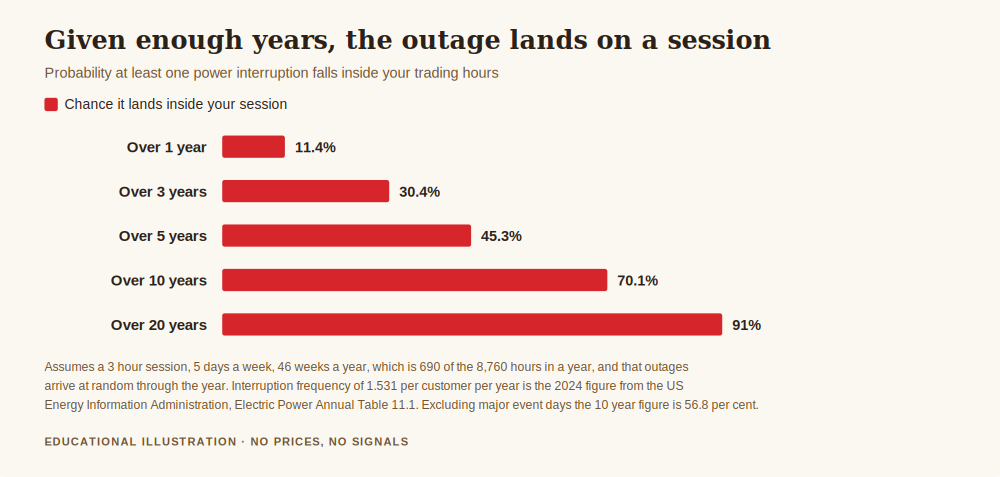
Convert that into the probability of it happening at least once, and the shape of the problem appears. Over one year it is 11.4 per cent. Over five years, 45.3 per cent. Over ten years, 70.1 per cent. Over twenty, 91.0 per cent. Excluding major event days entirely, the ten year figure is still 56.8 per cent.
That is the whole argument in one line. In any given year this is a low probability event, which is exactly why nobody plans for it. Across the length of time you intend to do this, it is more likely than not. Businesses plan on the second horizon. Hobbies plan on the first.
And it is getting worse, not better
I expected the eleven year series to show improvement, because grids get maintained and reporting gets better. It does not.
In 2014 the average customer lost 236.2 minutes with major events included. In 2024 it was 662.6, the worst year in the series and 3.17 times the best year, 2015. The headline number swings a lot because it is dominated by storms, so the fairer comparison is the figure with major events stripped out, and that went from 114.2 minutes in 2014 to 131.6 in 2024, an increase of about 15 per cent. Interruption frequency rose over the same period, from 1.257 to 1.531 a year.
So the baseline is drifting the wrong way on both measures. Whatever number you would have used to justify ignoring this ten years ago, the current one is larger.
What it costs when it lands
Frequency is only half of a risk. The other half is what it costs, and that depends entirely on what you had open.
A single interruption lasts a median of around 124 minutes on a normal day, and averages 433 minutes once major events are included. Those are long enough that waiting it out is not a plan. If you have no position open, the cost is zero and some irritation. If you have a position open with a stop order resting at the broker, the cost is whatever that stop costs you, which is a risk you had already accepted and sized. If you have a position open with the stop in your head, you have an uncapped exposure for two to seven hours.
Put that in R terms, where 1R is the amount you risk on one trade. Suppose an unmanaged position in an outage costs you an extra 0.5R, 1R or 2R beyond what a resting stop would have cost. At 0.121 expected occurrences a year, the expected annual cost is 0.06R, 0.12R or 0.24R respectively, and over ten years 0.6R, 1.2R or 2.4R.
Read that correctly, because it is the number most likely to be misread. Those are expectations, not instalments. Nothing charges you 0.12R a year. What happens is that nothing happens for eight years and then one afternoon costs you the whole amount at once, and it does not politely choose a day when your exposure was small.
The control that actually survives the outage
Here is the part that makes the arithmetic actionable, and it is not a gadget.
A stop order placed with your broker lives on the broker's server. It does not care whether your machine is on, whether your router has power, or whether you are in the room. A stop you are holding in your head requires a human with electricity to execute it. Those are not two versions of the same risk control. One of them is a control and the other is an intention.
I am stating that qualitatively on purpose, because I have no data on fill quality during outages and will not invent any. But the logic does not need data. One mechanism has a dependency on your household power and the other does not, and the outage is precisely the event that removes your household power.
The same reasoning applies to anything else you rely on. If your risk management requires you to be watching, then your risk management has an uptime requirement, and you now know roughly what that uptime is worth.
Redundancy, and the mistake that makes it fake
The standard answer is a backup connection, usually tethering to a phone on a mobile network. The arithmetic supports it, with one condition that is easy to get wrong.
If your backup fails independently of your main route, with roughly the same probability, then the chance of both failing at once is the product rather than the sum. An 11.4 per cent annual chance becomes 1.29 per cent, which is a reduction of about 8.8 times, or from once every nine years to once every seventy seven.
The condition is the word independently. A desktop machine and a router plugged into the same wall lose power together, so a second internet connection into the same building is not a second route, it is the same route with extra steps. What makes a phone genuinely independent is that it has its own battery and its own radio network. If you have ever tested your backup by unplugging the router rather than by killing the power, you have tested the wrong failure.
Which leads to the only unglamorous instruction in this article. Test it. Pull the plug, deliberately, on a quiet afternoon with nothing open, and find out whether you can actually reach your account from the phone in your pocket before you find out during a storm. A continuity plan you have never executed is a document, not a capability.
What this article is not saying
The EIA figures are for the United States, and they describe power, not connectivity. I used them because they are the best measured proxy I can link to: power outages are counted rigorously by a government agency, as the EIA's own summary of annual interruption data sets out, while broadband outages are not reported on a comparable national basis. If your supply is less reliable than the American average, which is true in much of the world, every probability here is an underestimate.
The random arrival assumption is also convenient rather than correct. Outages cluster in storms and heatwaves, so they are not uniformly spread across the calendar. Clustering makes the tail worse, not better, which again means these numbers are a floor.
And none of this tells you how to trade. There is no position size that makes an outage harmless and no setup that makes you immune. What the arithmetic supports is narrower: this is a scheduled sized risk rather than an act of God, and it belongs in your operating plan next to the other ones. The groundwork sits in the one page trading business plan, and the neighbouring failures are covered in what happens when your broker platform goes down and how your trading business survives a market shock. If the fix you are considering is a virtual private server, the cost side of that decision is in using a VPS for forex trading.
The policy, in four lines
This is what I would write into the operating manual, and none of it is a trade.
First, every position carries a stop order resting at the broker, for the single reason that it is the only part of your risk management that works while you are not there. Second, keep an independent backup route, meaning a phone on mobile data with its own battery, and know your account credentials well enough to use it under pressure. Third, test the backup by cutting the power rather than by unplugging a cable, at least once, on a day when nothing is open.
Fourth, and most important, write down what you will do when it happens, before it happens. In an outage you will be making decisions on a small screen, with partial information, under time pressure, which is the worst condition anyone makes decisions in. The decision you make calmly in advance is the one worth having.
So that is the honest answer to what happens if my internet goes out while trading. Over a career it is more likely than not, the typical interruption is long enough that waiting is not a plan, the resting stop order is the control that survives it, and an independent backup cuts the odds by roughly nine times. None of that is dramatic. It is just the sort of boring continuity planning that separates a business from a hobby with a chart on it.
Get the free REX one page business plan, the sheet I use to run an account like a business, including the continuity section where the outage policy in this article belongs. One email, no spam, unsubscribe anytime.
Get the free business plan →Frequently asked questions
What happens if my internet goes out while trading and I have a position open?
Any order already resting with your broker, including a stop, continues to work, because it lives on the broker's server rather than on your machine. Anything you were planning to do manually does not happen until you are back online, and the typical interruption runs about two hours on a normal day.
How likely is this, really?
Using the 2024 US figure of 1.531 interruptions per customer per year and a three hour session five days a week, there is an 11.4 per cent chance in any given year that one lands inside your trading hours. Over ten years it is 70.1 per cent and over twenty it is 91.0 per cent.
Will my broker close my trade if I disconnect?
No. Disconnecting does not close anything. Your position stays open with whatever orders you left attached to it, which is exactly why the stop needs to have been placed rather than remembered. Margin rules continue to apply whether or not you are watching.
Is a mobile hotspot enough of a backup?
It is, provided it fails independently of your main connection. A phone on a mobile network with its own battery qualifies. A second service entering the same building, or anything plugged into the same power, does not. Independent redundancy takes the annual probability from 11.4 per cent to about 1.29 per cent.
Does a VPS solve this?
It solves the part where your machine must stay on, which helps most if you run automation. It does not help with a decision you intended to make by hand, and it is a recurring cost to weigh against a failure that happens roughly once every eight years.
Are power cuts not getting rarer?
Not according to the data. Excluding major storms, the average US customer's annual interruption time rose from 114.2 minutes in 2014 to 131.6 minutes in 2024, and frequency rose from 1.257 to 1.531 interruptions a year. Including major events, 2024 was the worst year in the eleven year series.
Where REX fits
REX Trading Signal is a free journal about running a trading account the way you would run a business, with books, costs, policies and an operating manual. Everything here is free to read. The one optional piece is the one page business plan above. I do not promise profits, I do not sell a method, and I do not think anyone can tell you what your account will do. The piece this one hangs off is the one page trading business plan, and the rest of the continuity shelf is what happens when your broker platform goes down and key person risk in your trading business.
About the author. Rex runs his account from a written operating manual, and added the outage section to it the expensive way, during a storm, on a phone, with a position open. He would rather show you the arithmetic than the anecdote. Nothing in this article is financial advice, and no entry, stop or target discussed should be treated as a signal.