
How to use VPS for forex trading is usually answered with a shopping list: pick a provider, pick a plan, install the terminal, drag the robot onto the chart. That part is real and it takes about twenty minutes. It is also the least important part, because it answers "how" without ever asking "whether", and the whether is where the money is. A virtual private server is a piece of equipment with a monthly rent. Every other piece of equipment in this business gets asked what job it does and what happens if you do not buy it. This one usually does not, because it is sold with a number attached, and the number is speed.
Speed is almost never the reason a retail account needs one. Let me show you the arithmetic in the order a business owner would want it, and let me tell you the conclusion first so you can stop reading early if it applies to you: for most people asking this question, the honest expected value of a VPS is zero, and the reason is a feature they already have and do not know they have.
What a VPS Actually Is, in Business Terms
It is a computer in a data centre that you rent by the month, running your trading terminal instead of your own machine running it. That is the whole product. What you are renting is not computing power, since a terminal needs very little. You are renting two things: a machine that stays on, and a network connection that stays up.
So the business question is narrow and answerable. What work does this account do that stops when the lights go out, and what is that work worth per year.
Uptime, Translated Into Hours You Are Not There
Availability is quoted in nines because nines look small and reassuring. Convert them into hours and they stop being marketing. A year is 8,760 hours.
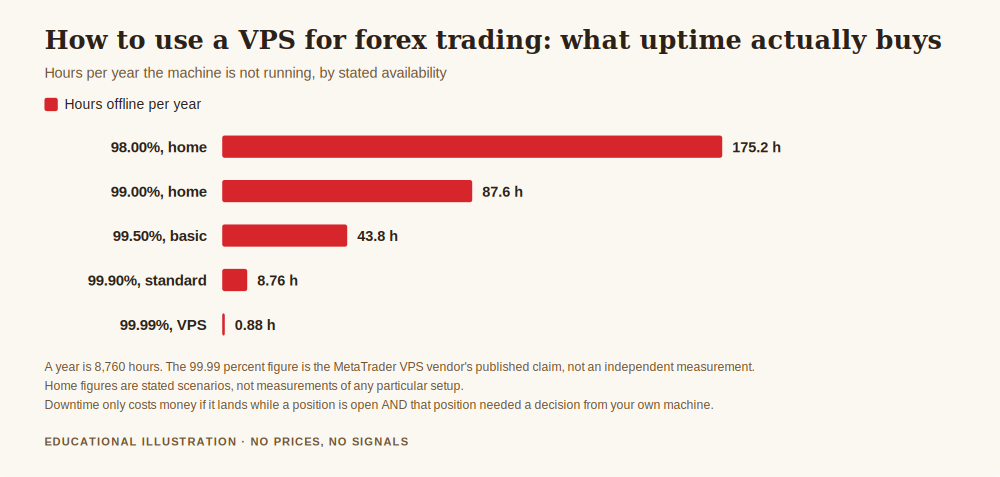
A home setup at a realistic 98% is offline 175.2 hours a year, which is 7.3 days. At an optimistic 99% it is 87.6 hours. MetaQuotes publishes a claim of "maximum uptime of 99.99%" for its own hosted service, which would be 52.6 minutes a year. Take the vendor's figure as a vendor's figure, but even discounted it is a different order of magnitude, and the gap between a realistic home setup and that claim is about 174 hours a year.
That sounds decisive until you ask the next question, which nobody selling a VPS is in a hurry for you to ask.
How to Use VPS for Forex Trading Without Fooling Yourself
Downtime costs you nothing unless two things are true at the same time. A position has to be open, and that position has to need a decision from your machine during the outage.
The second condition is where most readers fall out of the calculation, and here is why. A stop loss attached to a position does not live on your computer. It rests on the broker's server. If your house loses power, your internet dies, your laptop is stolen and your cat unplugs the router, that stop is still sitting on the broker's infrastructure and it will still execute. The same is true of a take profit and of any pending order you have already placed.
So if your working method is to enter a trade, attach a stop and a target, and let it resolve, then your downtime does not change the outcome of that position at all. Not partially. Not mostly. It does not change it. The expected cost of your outages on that axis is exactly zero dollars, at any account size, at any uptime figure, and the rent buys you nothing you did not already have for free.
I want to be blunt about this because it is the single most useful paragraph in the article and it argues against the thing I am describing how to use. If that is you, the answer to "should I rent a VPS" is no, and you can put the twelve dollars a month somewhere it does something.
When the Number Is Not Zero
It is not zero when the software has to be running to make its decisions. An expert advisor that watches for a condition and acts on it is not protected by a resting stop, because the decision it would have made was never sent to the broker. That decision only exists while the machine is on. Downtime deletes it.
Costing that needs three numbers, and two of them are yours rather than mine. Call them f, the share of the year a position is open, and N, the notional the system carries. The third comes from the market. Using the LBMA afternoon gold benchmark across 2,666 sessions from 4 January 2016 to 19 August 2026, daily volatility is 1.0111%, or 16.05% annualised. Scaled to an hour and taking the expected adverse move for a position you cannot touch, that is 0.0823% per hour of outage.
Multiply through and you get the notional at which the rent starts to pay for itself, against the cheapest published plan of $10 a month, so $120 a year.
| How much of the year a position is open | Exposed hours a year, at 99% | Break-even notional |
|---|---|---|
| 2 hours a day, weekdays | 5.0 | $28,918 |
| 6 hours a day, weekdays | 15.1 | $9,639 |
| 3 day holds, 40 a year | 28.8 | $5,061 |
| In the market most of the time | 65.7 | $2,218 |
Read the right hand column as a threshold, not a target. Below it, the rent costs more than the exposure it removes, and the correct business decision is to not buy it. At a realistic 98% rather than an optimistic 99%, every threshold halves, because the exposed hours double.
Notice what the table is actually saying. The longer you hold, the more a VPS is worth, which is the exact opposite of how these things are sold. The scalper who is told he needs one for speed has the highest break-even in the table, because he is barely in the market. The position trader nobody markets to has the lowest.
The Speed Claim, Checked
MetaQuotes states latency of "0-5 ms" against a home PC's "100 ms", and that "96% of broker servers can be accessed in less than 10 ms, while 84% in less than 3 ms". Take those at face value. The saving is about 95 milliseconds per order.
Ninety five milliseconds is roughly one millionth of a day. Using the same measured volatility, the expected size of the gold move inside that window is 0.00042296%. That is about one part in 1,181 of a median day's move. Against a modest 20 basis point round trip dealing cost, you would need roughly 473 orders before the milliseconds you saved add up to the cost of a single trade.
If you are not running a genuinely latency sensitive automated strategy, and almost nobody reading this is, the speed argument is not an argument. Buy uptime if you need uptime. Do not buy it for the milliseconds.
Get the free REX one page business plan, the sheet where the risk limits and the operating controls live in one place instead of in your memory. One email, no spam, unsubscribe anytime.
Get the free business plan →If You Do Buy One, Use It Like Equipment
The setup is the easy part, so treat it the way you would treat any other operating dependency rather than as a one off purchase.
Put it in the equipment line of your costs, not in a vague "tools" bucket, so that it shows up when you review the fixed and variable costs of a trading business. Twelve dollars a month is $120 to $180 a year and it is fixed, which means it is a cost you carry in the months you do not trade as well.
Test the failover before you rely on it, not after. Move the system across, then deliberately close your local terminal and confirm the next action happens without you. A VPS you have never tested being away from is a belief, not a control.
Keep the credentials in the same register as everything else that can lose you the account at once. A remote machine holding a live trading terminal is one more login worth stealing, which is the subject of how to protect your account from hackers.
And review it on a date. If the system it was rented for gets retired, the rent does not retire itself.
What This Does Not Say
It does not say hosting is a scam. It removes a real single point of failure, namely your own house, and there are people for whom that alone is worth the money. That is a judgement, and it should be made as one rather than dressed up as a return on investment.
It does not say the vendor's figures are wrong. It says they are the vendor's, they are used here as published claims rather than as independent measurements, and that the uptime number is the one worth paying attention to while the latency number is not.
The cost model assumes outages land independently and at random. Real outages cluster, often around exactly the storms and grid failures that also move markets, which makes a bad overlap rarer but worse when it happens. The model is a middle case, not a worst case.
And a VPS does nothing whatsoever about strategy risk. It makes a system run reliably. If the system loses money reliably, the VPS will help it do so with excellent uptime.
Frequently Asked Questions
How to use VPS for forex trading if I trade manually?
Generally you should not. Manual trading needs you at the machine, and a remote server you connect to in order to click a button has added a step rather than removed one. The exception is if you want pending orders and resting stops managed by a terminal that stays connected for reasons specific to your broker, which is worth confirming with them rather than assuming.
Will a VPS stop my stop loss from being missed?
Your stop is already on the broker's server and executes whether your machine is on or off. If you are relying on a script or an expert advisor to close positions rather than on a resting stop, the honest fix is to attach a real stop, which is free, rather than to rent a machine to keep the script alive.
What uptime is good enough?
The question is not the percentage, it is the exposed hours. Multiply your downtime hours by the share of the year you hold positions and you get the number that matters. A 99.9% service is 8.76 hours a year, and a swing trader in the market a third of the time is exposed for under three of them.
Is the free trial enough to decide?
It is enough to test the migration and the failover, which is the part worth testing. It is not enough to observe an outage, since the whole point is that outages are rare. Decide on the arithmetic, use the trial to check the mechanics.
Where did these figures come from?
The uptime conversions are arithmetic on 8,760 hours. The market figures are computed from the published LBMA afternoon gold benchmark, 2,666 sessions from 4 January 2016 to 19 August 2026. The service claims and prices are the vendor's published figures. The assumptions are listed in the disclaimer.
Where REX Fits
REX Trading Signal is free to follow. Daily XAUUSD setups with a stop loss, a reason and a rule, posted live, wins and losses alike, plus an optional Kit for people who want the operating side written down. Nothing here promises a profit and nothing here ever will.
This is an equipment decision, and equipment decisions belong in a written plan rather than in a browser tab at midnight. The one page trading business plan template is where the risk limits and the operating controls go. Fixed and variable costs of a trading business is where the rent lands once you have decided. Can I automate my trading strategy is the prior question, because a VPS only earns its keep once something is running unattended. And how your trading business survives a market shock covers the failures that a data centre cannot help you with.
About the author. Rex writes REX Trading Signal. He is interested in the unglamorous half of this business, the costs, the controls and the review dates, on the view that an account survives on its operating discipline long before it succeeds on its ideas.
Disclaimer: This article is general educational content about operating costs and infrastructure decisions. It is not financial advice, not a recommendation of any provider or product, and not a suggestion to open any particular position. Trading gold, CFDs and leveraged products carries a high risk of losing money rapidly. No entry, stop or target discussed should be treated as a signal. Availability, latency and price figures attributed to MetaTrader VPS are that vendor's own published claims and are reproduced here as claims, not as independently verified measurements; REX has no commercial relationship with any hosting provider and receives nothing if you buy one. Uptime scenarios labelled as home setups are stated scenarios, not measurements of any particular installation. Market figures were computed by me from the published LBMA gold benchmark, afternoon fix, across 2,666 published sessions from 4 January 2016 to 19 August 2026, using published benchmark values only and no intraday data. Movement over windows shorter than one day is scaled from measured daily volatility by the square root of time, which is a standard modelling assumption that understates extreme moves. Outages are modelled as independent one hour blocks landing uniformly across the year; real outages cluster, which makes a damaging overlap less likely and more severe than this model implies. Break-even notionals are the output of that model under the stated assumptions and are not a promise about any individual outcome. Whether a stop order rests on your broker's server is a matter for your broker's terms and should be confirmed with them rather than assumed. No gold price is quoted anywhere in this article and no trading results are represented. Past behaviour of a public benchmark is not a prediction.