
Ask what are allowable expenses for a sole trader and the honest answer has two halves. The first half is a list, and HMRC publishes it, so there is no need to guess. The second half is the part most people skip: an allowable expense is only worth something if it is recorded, and the amount it is worth depends on which tax band your profit lands in. Those two halves are the difference between knowing the rule and running a business. A trader who keeps a shoebox of receipts and never adds them up has the same list as everybody else and gets none of the benefit.
What are allowable expenses for a sole trader, as HMRC lists them
First, the definition, because it does the heavy lifting. If you are self employed, which for this purpose means a sole trader or an individual in a business partnership, your business has running costs, and you can deduct those costs to work out your taxable profit before paying Income Tax, as long as they are allowable expenses. HMRC adds one hard boundary in the same breath: allowable expenses do not include money taken from your business for personal use.
The categories HMRC sets out are these, and the list is short enough to keep on one page:
- Office costs, for example stationery or phone bills.
- Travel costs, for example fuel, parking, train or bus fares.
- Clothing expenses, for example uniforms.
- Staff costs, for example salaries or subcontractor costs.
- Things you buy to sell on, for example stock or raw materials.
- Legal and financial costs.
- Marketing and entertainment.
- Subscriptions.
- Training courses.
Read that list as a trader and the shape of your own expense sheet appears quickly. Data and platform subscriptions, the accountancy fee, bank charges on the business account, the proportion of your phone and internet that is business use, the desk and the second monitor, and courses that maintain the skills of the business you already run. Note the word proportion. A cost that is part business and part personal is claimable only to the extent it is business, which is why the phone bill is a line in the books and not a round number.
And this is UK specific. Sole trader is a UK term, the categories above are HMRC's, and the rates further down are the ones published for England, Wales and Northern Ireland. If you trade from elsewhere, the principle that costs reduce taxable profit travels; the list and the numbers do not.
What an unclaimed expense actually costs you
HMRC gives a worked example on its own page, and it is the cleanest starting point: if your turnover is 40,000 and you claim 10,000 in allowable expenses, you will pay Income Tax on the remaining 30,000, which is your taxable profit.
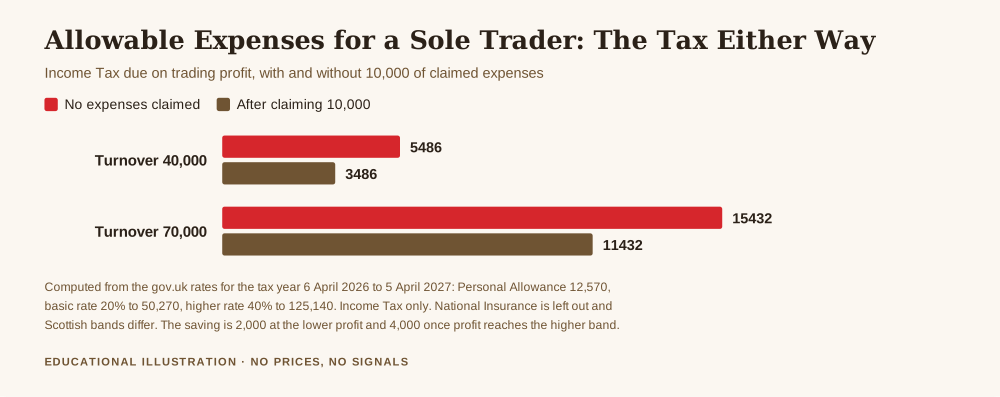
That tells you the profit figure. It does not tell you what the expenses saved, so here is that arithmetic, computed from the rates and bands gov.uk publishes for the tax year running 6 April 2026 to 5 April 2027: a Personal Allowance of 12,570, a basic rate of 20 per cent on taxable income from 12,571 to 50,270, and a higher rate of 40 per cent from 50,271 to 125,140. Income Tax only. National Insurance is left out, Scottish bands differ, and any other income you have would change the picture. That is the full list of assumptions.
- Income Tax on 40,000 of profit: 5,486.
- Income Tax on 30,000 of profit: 3,486.
- Difference from claiming the expenses: 2,000.
So at that profit level, every 100 of allowable expense you fail to claim costs you 20. Now run the same 10,000 of expenses for a trader whose profit reaches into the higher band, say 70,000 of turnover: tax of 15,432 against 11,432, a difference of 4,000, so each 100 unclaimed costs 40.
That is the first thing a business owner should take from this. The value of your bookkeeping is not fixed. It doubles when your profit crosses into the higher band, which means the year you have your best year is the year sloppy records cost you the most.
Why the small receipts are the ones that go missing
Nobody loses the accountancy invoice. The leak is always the small, frequent, boring costs, and it is worth seeing what they add to.
- 12 items a year at 35 each is 420 of deductions, worth 84 at the basic rate or 168 at the higher rate.
- 52 items a year at 8 each, roughly one small thing a week, is 416 of deductions, worth 83 or 166.
- 250 items a year at 2.50 each is 625 of deductions, worth 125 or 250.
Those are computed from the stated quantities at the published rates. None of the individual amounts feel worth recording, and that is precisely the trap. One small weekly cost, unrecorded for a year, is a number you would not leave on the table if somebody handed it to you in cash.
Which turns an accounting question into an operations question. The answer is not discipline, it is a system that makes recording the default: a separate business account so the business transactions are already separated when you look at the statement, a photograph of the receipt at the moment of purchase rather than at the end of the quarter, and a category list that matches HMRC's own so the year end is a sorting job instead of a reconstruction. The chart of accounts piece linked at the end is the version of this for a trading operation.
The 1,000 trading allowance, and when it beats the list
There is a second route, and it is the one most part time traders should at least check. HMRC's trading allowance is a tax exemption of up to 1,000 a year for individuals with trading income. If your annual gross trading income is 1,000 or less you may not have to tell HMRC at all, although gov.uk notes there are circumstances where you must still register for Self Assessment. If your gross trading income is more than 1,000, you can use the allowance instead of deducting any expenses or other allowances.
Read "instead of" carefully. It is one or the other, not both. Which makes the decision a single comparison:
- Real expenses of 300: the 1,000 allowance deducts more, so the allowance wins.
- Real expenses of 800: the allowance still wins.
- Real expenses of 1,000: the two routes tie exactly.
- Real expenses of 1,500 or 4,000: itemised expenses win, by 500 and 3,000 of extra deduction respectively.
The crossover is at 1,000 and there is no judgement involved, only addition. But notice what the comparison requires: you cannot tell which side of 1,000 you are on without having added up your expenses. Even the simple route needs the records.
What this looks like as a monthly routine
Expenses are a bookkeeping habit, and habits need a slot in the calendar rather than good intentions. The version I would run for a trading business:
Weekly, five minutes. Every business cost gets photographed and filed the day it happens. Platform fees, data, the subscription that renewed, the train fare to a meeting.
Monthly, half an hour. Reconcile the business account against the expense sheet, and fix the proportion lines while you can still remember them. If the phone was 60 per cent business use in a month when you travelled, write that down in the month, not in April.
Quarterly. Total the categories, compare against the same quarter last year, and check the running total against the 1,000 allowance threshold if you are near it.
Annually. Hand a clean, categorised set of records to whoever prepares the return. An accountant working from organised records is answering questions. An accountant working from a shoebox is doing archaeology, and charging for it.
One more piece of discipline that belongs here, because traders get it wrong in both directions: a trading loss is not an expense. The costs of running the operation are expenses. The money lost on a position is a different thing in the books entirely, and mixing the two produces a P and L that tells you nothing about either. There is a separate piece on that distinction linked below.
Get the free REX one page trading business plan, the sheet that puts your risk ceiling, your costs and your review routine on a single page you will actually use. One email, no spam, unsubscribe anytime.
Get the free business plan →Frequently asked questions
What are allowable expenses for a sole trader, in short?
The running costs of the business, which HMRC groups as office costs, travel, clothing such as uniforms, staff costs, things bought to sell on, legal and financial costs, marketing and entertainment, subscriptions and training courses. They are deducted to work out taxable profit, and money taken out of the business for personal use is explicitly not among them.
How much is claiming an expense actually worth?
It is worth your marginal rate. Computed from the gov.uk bands for the 2026 to 2027 tax year, Income Tax only, a trader with 40,000 of turnover who claims 10,000 of expenses pays 3,486 instead of 5,486, a saving of 2,000, so each 100 claimed is worth 20. For a trader whose profit reaches the higher band the same 10,000 saves 4,000, so each 100 is worth 40.
Can I claim part of my phone, internet or home costs?
Only the business proportion, which is why these are the lines that need a note in the month rather than an estimate at the year end. HMRC lists phone bills under office costs, and the general principle is that a mixed cost is claimable to the extent it is business use.
Should I use the 1,000 trading allowance instead?
Compare the two and take the larger deduction, because gov.uk makes clear you use the allowance instead of deducting expenses, not as well. Below 1,000 of real expenses the allowance deducts more, at exactly 1,000 they tie, and above that itemising wins. Either way you have to add up the expenses to know which applies.
Is a losing trade an allowable expense?
No, and keeping the two apart is what makes the accounts readable. Expenses are what it costs to run the operation. A loss on a position is a trading result. There is a separate article on that distinction linked below.
Do these figures apply outside the UK?
The categories and amounts here are HMRC's and the rates are those published for England, Wales and Northern Ireland, with Scottish bands differing. The underlying idea, that legitimate business costs reduce taxable profit and only recorded costs can be claimed, is general. The specifics are not, and none of this is tax advice. Check your own position with HMRC or an accountant.
Where this leaves you
REX Trading Signal is free to follow and stays free. The daily work on Telegram writes out the reasoning behind a level so you can judge it instead of copying it, there is a free one page business plan for anyone who wants their risk ceiling and their costs on a single sheet, and there is an optional kit for people who want the longer version. Nothing here promises a return, because nobody can promise you one, and nothing here is investment, legal or tax advice.
The foundation under this piece is the one page trading business plan template. Beside it, the distinction traders get wrong most often is in is a losing trade a business expense, how long to keep the paperwork is in how long to keep tax records as a sole trader, the record keeping itself is in how to keep track of day trading for taxes, the cover question is in do I need business insurance as a sole trader, and the category list that makes all of this a sorting job is in what a chart of accounts looks like.
Outside sources used here: the definition of self employed as a sole trader or individual in a business partnership, the statement that running costs can be deducted to work out taxable profit as long as they are allowable expenses, the exclusion of money taken from the business for personal use, the worked example of 40,000 turnover less 10,000 of expenses giving 30,000 of taxable profit, and the list of claimable categories, are all from HM Revenue and Customs, Expenses if you are self employed. The trading allowance of up to 1,000 a year, and the rule that it is used instead of deducting expenses or other allowances, are from Tax free allowances on property and trading income. The Personal Allowance of 12,570, the basic rate of 20 per cent to 50,270 and the higher rate of 40 per cent to 125,140 for the tax year 6 April 2026 to 5 April 2027 are from Income Tax rates and Personal Allowances. Every tax figure, saving and comparison in this article is computed from those published rates on the assumptions written out in the text, so you can reproduce all of it.
About the author. Rex writes REX Trading Signal and treats an account as a business with a cost base, a risk ceiling and a set of books, because the businesses that survive are the ones whose owners know their numbers. He would rather spend half an hour a month on records than a weekend in April reconstructing them. The rules and amounts here are quoted from the gov.uk pages linked above, every tax calculation is computed from the published rates on the stated assumptions and covers Income Tax only, the quantities in the small receipts example are illustrative inputs, this article is educational and is not investment, legal, accounting or tax advice, your own position depends on facts not covered here and should be checked with HMRC or a qualified accountant, and no entry, stop or target discussed should be treated as a signal.