
Ask about prop trading vs retail and you will get an answer about account sizes, as though the only difference were how much money is on the table. It is not. The two sit on opposite sides of a line drawn in statute, and that line decides what you are allowed to do, what a firm owes you, and who absorbs the loss when something breaks. Worse, there is now a third thing wearing the word "prop" that is neither of them. If you are going to put money into one of these arrangements, it is worth knowing which of the three you are actually buying.
About 109 messages in my inbox touch funded accounts and prop firms, counted by keyword rather than by any survey. They sound like this. "Should I get a prop firm to solve the equity problem or trade minimally with the small capital I have." "Too many blown prop firm accounts until I decided to invest some money in a live account." "The prop firm changed brokers, so my account stopped working." And the one that comes up more than it should: "The prop firm I've been trading with denied me payout and took all my profits."
Every one of those is an operating question rather than a trading question, which is exactly how a business owner should hear it. So let me separate the three things, with the rules that define each one.
Prop trading vs retail, as the law actually draws it
You are not retail because your account is small. You are retail because you do not meet a statutory threshold, and the threshold is a number you can look up.
Under 7 U.S.C. 1a(18)(A)(xi), an individual counts as an eligible contract participant if they have "amounts invested on a discretionary basis, the aggregate of which is in excess of" 10,000,000 dollars, or 5,000,000 dollars where the transaction is entered into to manage the risk of an asset owned or a liability incurred by that individual.
Those two numbers are the border. Below them you are a retail customer in the eyes of the rulebook, whatever you call yourself, and the protections and restrictions that follow are not optional extras your broker chose. On a 10,000 dollar account you are 1,000 times below the 10 million threshold and 500 times below the 5 million one. On 100,000 dollars you are still 100 times and 50 times below. This is not a gap you trade your way across in a year, and understanding that changes which questions are worth your attention.
What being retail costs you, and what it buys
The restriction side is concrete. 17 CFR 5.9 requires that a futures commission merchant or retail foreign exchange dealer collect a minimum security deposit from each retail forex customer, and sets a floor that the registered futures association cannot go below: 2 per cent of notional for major currency pairs and 5 per cent for all other pairs.
Turn the deposits into the leverage they imply. A 2 per cent deposit is 50 to 1, so 10,000 dollars of your own capital supports 500,000 dollars of notional at the floor. A 5 per cent deposit is 20 to 1, giving 200,000 dollars. Compare that with equities, where Regulation T requires 50 per cent margin on a margin equity security, which is 2 to 1, or 20,000 dollars of notional on the same capital. The forex major pair cap allows 25 times the notional that the equity rule does on identical capital.
That is worth sitting with, because the usual complaint about retail status is that the rules are restrictive. In the corner of the market most readers here trade, the rules are the opposite of restrictive. The constraint that will decide whether your account survives is not the regulatory cap, which is generous. It is the one you set yourself.
The protection side is quieter and more valuable. Being a retail customer means a registered firm is holding your money under rules written for people who cannot absorb its failure, and those rules carry capital requirements that exist specifically so the firm's collapse is not your problem.
What a firm must hold to carry your account
17 CFR 240.15c3-1, the net capital rule, scales the requirement to what the firm does with customer money. A broker or dealer that carries customer accounts and receives or holds funds or securities for those persons must maintain net capital of not less than 250,000 dollars. A dealer must hold not less than 100,000 dollars. A firm that introduces accounts to a carrying broker on a fully disclosed basis and receives but does not hold customer securities must hold not less than 50,000 dollars. A firm that neither holds nor owes customer funds or securities, and carries no customer accounts, must hold not less than 5,000 dollars.
Read that as a ladder, because that is what it is. The requirement rises with proximity to your money. The 250,000 dollar floor on a carrying firm is 25 times a 10,000 dollar retail account, and it exists so that the firm standing closest to your cash has something of its own to lose first.
When you are comparing arrangements, this is the question worth asking: what is this entity's regulatory status, and what capital does it have to hold because of it? It is a far better question than how large an account they will let you trade.
What actual proprietary trading is
Real proprietary trading means an institution trading its own capital for its own account. No customers, no outside money, the firm's own balance sheet at risk. That is a distinct regulated activity, and it is regulated tightly enough that the Volcker rule, implementing section 619 of the Dodd-Frank Act, generally prohibits banking entities from engaging in it at all.
Note what that tells you. Proprietary trading is not a thing you buy access to. It is a thing an institution does with money it already owns, and when the institution is a bank, the law largely forbids it. A genuine proprietary trading desk hires traders as employees on a salary and a share of the desk's results. It does not sell them an entry fee.
The third thing, which is neither
Which brings us to the arrangement most readers mean when they say prop firm. A retail customer pays a fee to attempt an evaluation. If they meet the targets within the rules, they are given a simulated or funded account and a share of the profits it produces.
I am not here to tell you these are bad. Some are run straightforwardly, and for a trader without capital the structure solves a real problem. What I want is for you to classify it correctly, because the classification tells you where the risks sit.
It is not proprietary trading, because the capital at risk is the fee rather than the firm's own balance sheet deployed through you. It is not a brokerage relationship either, because in most arrangements you are not a customer holding funds with a carrying broker. You are a counterparty to a contract, and when that contract is disputed, the question of which rulebook applies has a much less satisfying answer than it would for a brokerage account. That is the structural reason behind the payout complaints, and it would still be the reason even if every operator were honest.
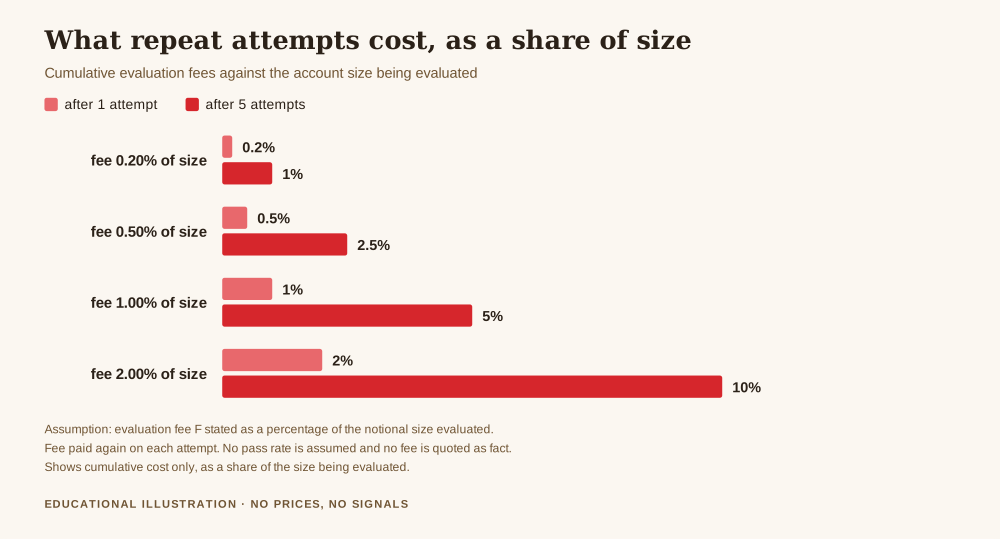
Then there is the cost line, which a business owner should model before the first attempt rather than after the third. Treat the evaluation fee as a percentage of the account size being evaluated, and let it repeat. The chart above shows the cumulative cost. At a fee worth 0.50 per cent of the size, five attempts cost 2.50 per cent of that size. At 1.00 per cent, five attempts cost 5.00 per cent. At 2.00 per cent, five attempts cost 10.00 per cent, and it would take 50 attempts for the fees alone to equal the size being evaluated.
No pass rate is assumed anywhere in that arithmetic, and I have quoted nobody's price. It is simply the cost of the route, and it belongs in the same column of your plan as data fees and platform costs, which is the discipline covered in the fixed and variable costs of a trading business.
Get the free REX one page trading business plan, with the risk limit, the review cadence and the cost lines on a single sheet, so the structural decision on this page is made once rather than every month. One email, no spam, unsubscribe anytime.
Get the free business plan →What an operator does with this
Three decisions follow, and none of them is about which route is better in the abstract.
Classify the arrangement before you fund it. Ask whether the entity is a registered broker or dealer carrying your account, or a counterparty to a contract. The answer determines which rules apply when something goes wrong, and it is a question with a documented answer rather than a matter of opinion.
Put the route's cost in the plan as a line item. Evaluation fees are a cost of doing business, and a cost you model in advance behaves differently from one you absorb repeatedly while telling yourself the next attempt is the one. Decide how many attempts you are willing to fund, in advance, in writing. That single number removes most of the damage this route does to people.
Stop treating the leverage cap as the limit. The regulatory floor permits 50 to 1 on major pairs. That is permission, not advice, and no rule is going to protect you from using it. Your own risk ceiling is the operative constraint, which is the whole argument of the one page trading business plan template.
Frequently asked questions
What is the difference in prop trading vs retail in one sentence?
Retail is a statutory classification you fall into by not meeting the eligible contract participant threshold of 10 million dollars, or 5 million when hedging, while proprietary trading is an institution deploying its own capital for its own account, and most retail funded account programmes are a third thing that is neither.
Is a funded account the same as proprietary trading?
Structurally, no. In proprietary trading the firm's own balance sheet carries the loss. In a typical evaluation arrangement your fee is the capital you have put at risk and you are a counterparty to a contract rather than a customer of a carrying broker, which changes which rulebook governs a dispute.
Why is the leverage so much higher in forex than in stocks?
Different rules. The retail forex floor under 17 CFR 5.9 is a 2 per cent deposit for major pairs, which implies 50 to 1, while Regulation T requires 50 per cent on margin equity securities, which is 2 to 1. The forex figure permits 25 times the notional on identical capital, and permission is not a recommendation.
Can I become an eligible contract participant?
Only by meeting the threshold, which for an individual is more than 10 million dollars invested on a discretionary basis, or more than 5 million where the trade manages the risk of an asset you own or a liability you have incurred. For almost every reader the practical answer is that retail status is a permanent operating condition, so build the business inside it.
Does a bigger funded account make the maths easier?
It changes the denominator, not the process. A larger evaluated size with the same percentage fee costs proportionally more per attempt, and the operating discipline that decides the outcome, the risk ceiling and the number of attempts you will fund, is identical at every size.
Where REX Trading Signal fits
REX Trading Signal is free to follow. The daily record on Telegram includes losing days, because a record that only shows winners is not a record. There is a free one page trading business plan for anyone who wants the limits and the review cadence in one place, and an optional Kit for people who want the full operating method. Nothing here promises a profit and nothing here is a signal service. The foundation this article sits on is the one page trading business plan template, the comparison of the two counterparties is in prop firm versus broker, the business model behind the evaluation route is in how prop firms make money, the downside case is in what happens if you fail a prop firm challenge, and the cost discipline is in the fixed and variable costs of a trading business.
About the author. Rex writes REX Trading Signal and treats an account the way an operator treats a business, with limits set before the week starts and a review that happens whether the month was good or bad. He is less interested in what a trader thinks will happen next than in what the records say already happened. The figures here are quoted from the rules linked above or computed from the stated assumptions so you can repeat them with your own numbers, the sources were checked before publication, nothing here is investment advice or a recommendation to use or avoid any firm or arrangement, and no entry, stop or target discussed should be treated as a signal.