
If you want to understand any business, look at where the revenue actually enters, not at what the business says it sells. Ask how do prop firms make money and the marketing answer is that they take a share of trading profits, which makes them sound like a partner with the same interests as you. The structural answer is more interesting, and it changes what you should do about it.
I am not going to name firms, accuse anyone of anything, or tell you whether to take an evaluation. I am going to do what I would do before entering any commercial arrangement, which is work out the counterparty's economics and check whether my role in them is the one I was told I had.
Two Places the Money Can Come From
A firm offering funded accounts has exactly two possible revenue lines.
The first is the profit split. Traders who get funded, make money and withdraw, and the firm keeps its share. This is the line the marketing describes, and it is a genuine business model. It requires a supply of traders who are persistently profitable.
The second is evaluation fees. Everyone who attempts a challenge pays, most do not pass, and the fees of those who fail stay with the firm. This line requires no profitable traders at all. It requires applicants.
Both lines are legitimate. The question is not which one is honest, it is which one is larger, because that determines what the firm is optimising for, and therefore what the rules you are being asked to trade under are designed to do.
How Do Prop Firms Make Money When the Test Is Designed Well?
Here is the part that gets missed. A well designed evaluation and a fee generating evaluation are not opposites. They can be the same document.
So I modelled one. The rules below are a composite of the structures these programmes commonly publish, not a copy of any particular firm's terms, and every assumption is stated so you can change it.
The model: risk 1% of the starting balance per trade. Winners pay 2R. Phase one target 8%, phase two target 5%, and a maximum loss of 10% in each phase. Up to 300 trades per phase. Forty thousand simulated runs per configuration.
Then I ran three traders through it. One with a real edge, winning 40% of trades at 2R, which is an expectancy of +0.20R per trade and a genuinely good result. One with no edge whatsoever, winning exactly one third at 2R, which is break even before costs. One below cost, at -0.10R per trade.
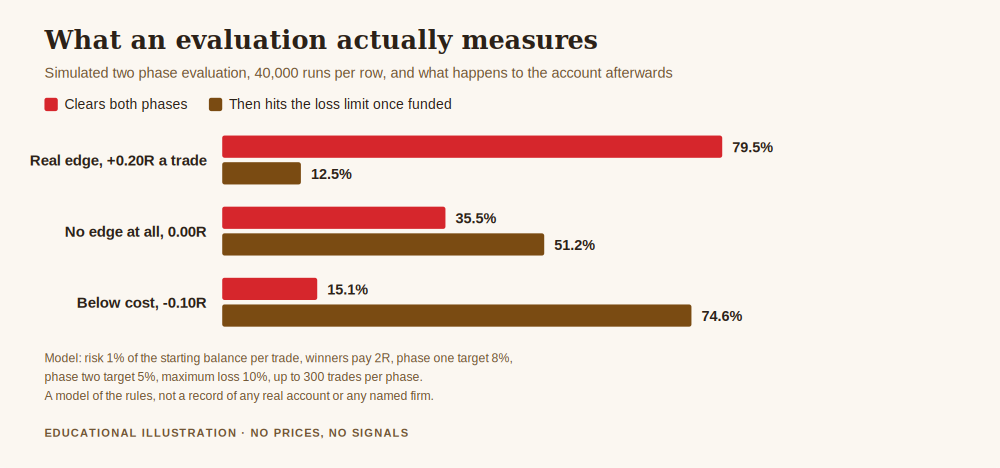
The trader with a real edge clears both phases 79.5% of the time. That is the test working.
The trader with no edge at all clears both phases 35.5% of the time.
Sit with the second number, because it is the whole article. Someone with nothing, no skill, no method, no advantage of any kind, walks through a two phase evaluation better than one time in three. Not by cheating. By ordinary variance.
The trader who is actively below cost still clears 15.1% of the time.
Thirty One Trades Is Not a Measurement
The reason is sample size, and it is worth being concrete. In the model, phase one reaches a verdict after a median of 31 trades for the no edge trader, and 24 trades for the one with a real edge.
Thirty one trades cannot distinguish a +0.20R edge from nothing. Not because the test is badly built, but because no test of that length can. The variation between traders of identical skill over 31 trades is far larger than the difference the test is trying to detect. You would need a sample several times longer before the signal separated from the noise, and an evaluation that long would sell to almost nobody.
This is not a hidden trick. It is a straightforward consequence of measuring a small effect with a small sample, and it is the same problem that makes your own recent results such a poor guide to your own method. If you want the academic treatment of how hard persistent skill is to identify in short horizon trading, Barber, Lee, Liu and Odean's The Cross-Section of Speculator Skill: Evidence from Day Trading in the Journal of Financial Markets is the place to start.
What Happens to the Ones Who Pass
Now follow the funded accounts forward, using the same rules and the same edges.
The trader with a real edge hits the loss limit before reaching a further 10% only 12.5% of the time. The account survives, which is what you would expect from someone who actually has an advantage.
The no edge trader who got funded on luck hits the loss limit 51.2% of the time. The below cost trader does so 74.6% of the time.
So the funnel is self cleaning. Traders who passed on variance are removed later by variance, and the firm carries very little of that cost, because the account was never a real capital allocation in the way the word funded implies. Meanwhile the fees from everyone who did not pass have already been collected.
The Arithmetic That Follows
Run the business logic to its end. If a fraction of applicants pass, the firm collects one fee from each of the rest. At a 20% pass rate, five fees arrive for every funded account created. At 10%, ten fees. At 5%, twenty.
Against that certain, immediate revenue sits the uncertain, deferred cost of paying out a profit split to whichever funded traders turn out to be genuinely good, minus everyone whose account closes first.
I do not know any particular firm's pass rate or fee, and I am not going to guess at figures I cannot verify. The point does not depend on the specific numbers. The point is the shape: one revenue line is immediate and scales with applicants, the other is delayed and scales with a small population of skilled traders. Businesses grow the line that is easier to grow. That is not cynicism, it is what any business does, and you would do it too.
What a Business Owner Does With This
None of the above says do not take an evaluation. It says take it with the correct model of what it is, which changes four decisions.
Price the fee as a cost of goods, not an investment
An evaluation fee buys an attempt with a probability attached, and probabilistic purchases belong in your costs. Book it where you book your data feed and your spread. If you would not accept that cost as a recurring line item, you have your answer before you start.
Never let the pass become your evidence
This is the expensive mistake. Passing feels like external validation, an institution confirming you can trade. On these numbers a pass is weak evidence at best, since a third of no edge traders receive the same confirmation. Traders who take the pass as proof size up afterwards, which is precisely when the loss limit arrives.
Keep your own measurement running
Your expectancy over your own full record, across a sample long enough to mean something, is the number that tells you whether you have an edge. The evaluation does not answer that question, and it was never built to. Keep the books you would keep if no firm were watching, because those are the only books that describe your business.
Read the payout terms before the profit terms
The profit split is prominent, and the conditions attached to withdrawing are usually less so. Consistency rules, minimum trading days, maximum single day contribution and similar clauses all affect whether the split is reachable in practice. Before entering any financial arrangement, checking the firm's registration status and reading the terms is ordinary diligence, and the CFTC's Learn and Protect resources are a reasonable starting point for the general question of who you are dealing with.
Get the free REX one page business plan, the sheet where your risk ceiling, your costs and your own expectancy live together, so no external test has to tell you whether the business works. One email, no spam, unsubscribe anytime.
Get the free business plan →Frequently Asked Questions
So how do prop firms make money, in one sentence?
From two lines, a share of the profits of funded traders and the fees of everyone who attempts an evaluation, where the second is immediate and scales with the number of applicants while the first is delayed and depends on a much smaller population. Which line dominates at any particular firm is something only that firm's accounts would show.
Does a 35.5% pass rate for a no edge trader mean the evaluations are rigged?
No, and I want to be clear about that. It is what happens when you measure a small edge over a short sample, and it would happen with a perfectly fair and well intentioned test. The rules in the model are not unusual or predatory. The limitation is statistical, and it exists regardless of anyone's motives.
Are these real pass rates from real firms?
They are not. They are outputs from a simulation of a rule structure, with every assumption stated in the article, run 40,000 times per configuration. No firm's actual data is used, no firm is named, and your result under different rules or a different method would differ. Change the assumptions and rerun them if you want numbers that fit the specific programme you are looking at.
If I passed an evaluation, does that mean I have no edge?
It means the pass is not much evidence either way, which is a different statement. Plenty of traders with genuine edges pass, at a higher rate than those without. The instruction is to get your evidence from your own record over a long sample rather than from the outcome of roughly thirty trades.
Is a funded account real capital?
That depends entirely on the arrangement, and it is worth establishing rather than assuming. Some are, some are structured as simulated environments where the firm's exposure is the payout obligation rather than the trading capital. The terms will say. The distinction matters for who is actually carrying risk while you trade.
Would trading my own smaller account be better?
It is a different set of trade offs, not automatically better. Your own account has no fee, no deadline and no external rules, and it also has less capital and no one imposing discipline on you. What I would resist is treating either route as a way to skip having a measured edge, because neither of them is.
What is the single number I should take from this?
Thirty one trades. That is the median length of a phase one verdict in the model, and it is the reason the test cannot tell you what you want it to tell you. Any conclusion about your ability drawn from a sample that size, whether by a firm or by you, is mostly noise.
Where This Leaves You
The evaluation industry is not a scandal and it is not a shortcut. It is a business with a clear structure, and once you can see the structure you can decide about it the way you would decide about any supplier, on terms, cost and what you actually receive.
What you receive is an attempt, priced. What you do not receive is a verdict on your ability, because a verdict on your ability takes a sample nobody is selling. That number you have to build yourself, in your own records, over a length of time that no one will find exciting.
The framework this sits in is the one page trading business plan template. The economics of a single trade are in the trading business model, and what to record so your own edge becomes measurable is in key metrics every trading business should track.
About the author. Rex writes REX Trading Signal. He treats an account as a small business with costs, capacity and a set of books, on the view that most trading problems turn out to be operational once someone bothers to write the numbers down.
Disclaimer: This article is general educational content about the economics of proprietary trading evaluation programmes. It is not financial advice, not legal advice, and not a recommendation for or against any firm, programme or arrangement. No firm is named, and no firm's data is used anywhere in it. Trading gold, CFDs and leveraged products carries a high risk of losing money rapidly. No entry, stop or target discussed should be treated as a signal. All pass rates, failure rates and trade counts are outputs of a Monte Carlo simulation of a composite rule structure using the assumptions stated in the article, with costs and slippage excluded; they describe a model rather than any real programme or real account, and no real trading results are represented. Terms, rules and regulatory status vary between firms and jurisdictions, and you should read the actual terms and verify registration yourself. No price levels are quoted anywhere in this article.