
Somebody asks me this every few weeks, usually a day or two after it has already happened to them, and the question is always framed emotionally when it is really an accounting question. What happens if you fail a prop firm challenge? The honest answer has three parts: a mechanical part about what the firm does next, a financial part about what it just cost you, and a decision part about whether you buy another one. Most people only think about the first part, spend a while on the second part in silence, and never do the third part properly at all.
So let us do it the way you would do it for any other line item in a business. Not with encouragement, and not with discouragement either. With a spreadsheet.
What Happens If You Fail a Prop Firm Challenge, Mechanically
The general shape is consistent across the industry, though the specifics differ from firm to firm and you must read your own agreement rather than trust a summary from me or anyone else.
You breach a rule, most commonly a daily loss limit or a maximum drawdown limit, occasionally a consistency or time rule. The evaluation account is closed automatically, usually the moment the breach registers rather than at the end of the day. The evaluation fee you paid is not returned, because you did not buy a chance at a refund, you bought an attempt. You are then invited to buy another attempt, sometimes at a discount, sometimes with a reset option priced below the original fee.
That is the whole mechanism. Nothing dramatic happens. No debt is created, and on a properly structured evaluation you were trading a simulated account, so there is no loss beyond the fee itself. Which is precisely why the emotional framing is a trap: the event is small, the recurring decision it triggers is not.
The First Question a Business Owner Asks
Not "what went wrong", and not yet. The first question is: what did that cost, and what category does it go in?
An evaluation fee is an operating expense. It is not an investment, it is not capital, and it does not sit on a balance sheet waiting to come back to you. You spent money to acquire a chance at a revenue stream, the chance did not convert, and the money is gone. We went through this distinction in whether a losing trade is a business expense, and the same logic applies here with one important difference. A losing trade is a cost of operating. An evaluation fee is a customer acquisition cost, except you are the customer.
Which means it belongs in the same mental column as advertising spend: a repeatable outlay with an uncertain conversion rate, and therefore something you model rather than something you feel.
The Arithmetic Nobody Runs Before They Start
Here is the calculation that would have changed the decision, and it takes one line.
Treat each attempt as independent, with some probability p of passing. Assume the fee F is paid again on every retry and a failed attempt returns nothing. That is the geometric distribution, and the expected number of attempts before you pass is simply 1 divided by p. The expected total fee outlay is that same figure multiplied by F.
Run it across a range of pass rates, because nobody knows their own with any precision:
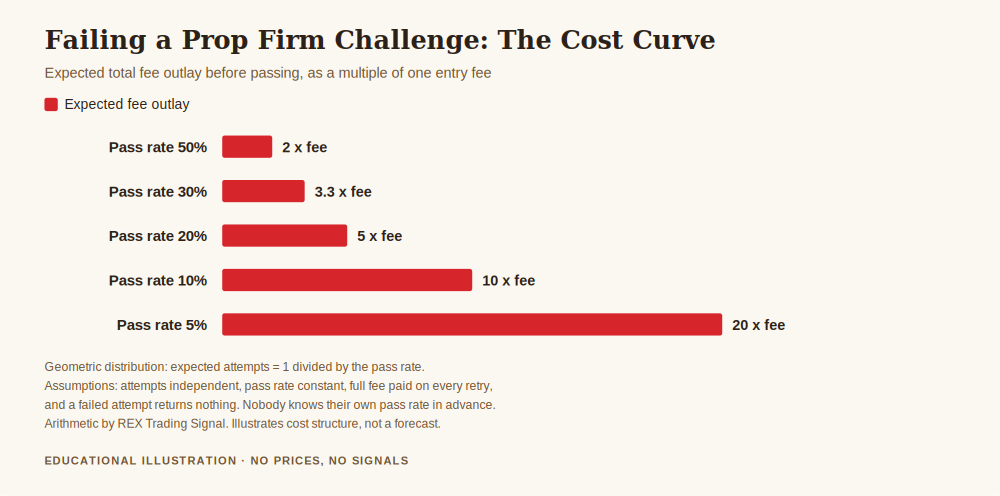
At a 50 percent pass rate you expect 2 attempts, so 2 times the fee. At 30 percent, 3.3 attempts. At 20 percent, 5 attempts and 5 times the fee. At 10 percent, 10 attempts and 10 times the fee. At 5 percent, 20 attempts and 20 times the fee.
Now the part that matters more than the average, because averages hide the tail. The probability that you have still not passed after n attempts is (1 minus p) to the power of n. At a 20 percent pass rate, there is a 51.2 percent chance you are still trying after three attempts, a 32.8 percent chance after five, and a 10.7 percent chance you are still going after ten. At a 10 percent pass rate, there is a 34.9 percent chance you are still buying attempts after ten of them.
That is not a story about whether you are good. It is what repeated sampling looks like. Any business that buys a lottery ticket ten times in a row without writing down a stopping rule is not running a strategy, it is running a habit.
Break-Even, and the Number That Surprises People
Say you pass eventually. You have spent 1 divided by p times the fee getting there. Now the funded account has to earn enough for your profit share to repay that outlay before you are square.
If s is your share of the profits, the funded account must generate F divided by (p times s) before the fees are recovered. At a 20 percent pass rate and an 80 percent profit share, that is 6.25 times the entry fee. At a 10 percent pass rate and the same share, 12.5 times. At a 20 percent pass rate and a 90 percent share, 5.6 times.
Read that carefully, because it reframes the whole proposition. The funded account does not start at zero. It starts in a hole equal to every fee you paid to reach it, and the hole is deeper the worse your pass rate was, which is to say deeper for precisely the people most likely to need several more attempts. That is not a criticism of the model. It is the model, and it is perfectly legible once you write it down.
None of these figures are a forecast. They are arithmetic on assumptions I have stated, and your own numbers will differ. The point is that the calculation exists and takes two minutes, and almost nobody does it before the first purchase.
The Question About Who You Are Actually Dealing With
Separate from the arithmetic, and arguably more important, is the counterparty question. A trading firm offering evaluations is not necessarily a regulated broker, and the relationship you have with it is contractual rather than the relationship a client has with a licensed intermediary. That is not an accusation, it is a description of a structure, and it means the ordinary business duty of checking who you are dealing with falls entirely on you.
Two checks cost nothing. The CFTC maintains a page on checking registration and backgrounds before you trade, and the National Futures Association runs BASIC, its public database of registration and disciplinary history. Neither will tell you whether a challenge is worth buying. Both will tell you whether the entity taking your money is who it says it is, which is a question you would ask of any supplier before sending them an invoice payment.
And read the rule set as though it were a supplier contract, because it is one. The daily loss limit, whether drawdown is measured on balance or on equity, whether it trails, what happens to open positions at rollover, what the payout schedule actually is. Most failed evaluations I hear about were failed on a rule the trader had read once and misremembered, not on a bad market view.
So How Should a Business Decide?
Three rules, and they are the same three any owner would apply to a marketing budget.
First, set the total budget before the first attempt, not after the third. Decide the maximum number of attempts you will fund, in advance, in writing, as a number. When it is spent, it is spent, and the decision to continue becomes a fresh decision made deliberately rather than a reflex made while annoyed.
Second, require that something change between attempts. If attempt four is identical to attempt one in method, sizing and preparation, you are not iterating, you are repurchasing. The only justification for another attempt is a specific, articulable change to the thing that caused the breach.
Third, be honest about which problem the evaluation exposed. Most failures are position sizing, not analysis. A rule set that caps daily loss and maximum drawdown is, functionally, a test of whether you size correctly under a constraint. If you failed it, the finding is about size. Our position sizing for gold trading piece and the one page trading business plan template are where that gets fixed, and neither costs anything.
The unglamorous conclusion is that failing a challenge is not a verdict. It is a receipt. It tells you what you spent and what you learned, and whether it becomes a business expense or a subscription depends entirely on whether you wrote the stopping rule down before you needed it.
Get the free REX one page business plan, the sheet where the evaluation budget, the maximum number of attempts and the stopping rule live in one place instead of in your memory. One email, no spam, unsubscribe anytime.
Get the free business plan →Frequently Asked Questions
What happens if you fail a prop firm challenge, in one sentence?
The evaluation account is closed at the moment the rule is breached, the fee is not refunded, and you are offered another attempt, often at a discount. Specific terms vary by firm, so read your own agreement rather than any summary.
Do I owe money if I lose on a challenge account?
On a properly structured evaluation you are trading a simulated account, so the loss beyond the fee is not yours to repay. Check the agreement, because the answer comes from the contract rather than from custom.
Is it worth retrying immediately?
Only if something specific has changed. Attempt four run exactly like attempt one is repurchasing rather than iterating, and the arithmetic above shows how quickly repeated attempts accumulate into a serious number.
How many attempts should I budget for?
That is a decision to make before the first one, not during the fourth. Write the maximum number down, treat it as a fixed marketing budget, and when it is spent make a fresh and deliberate decision rather than a reflexive one.
Why do I keep failing on the drawdown rule rather than on direction?
Because an evaluation is largely a test of sizing under a constraint. If the breach keeps arriving before the thesis plays out, the finding is about position size and not about analysis, and that is a fixable and unglamorous problem.
Where REX Fits
REX Trading Signal is free to follow, with daily XAUUSD analysis and the reasoning stated before the trade, and an optional Kit for people who want the operating side written down properly. Nothing here promises a profit and nothing here ever will.
The operating side is the whole point. The one page trading business plan template is the pillar this sits under, because a stopping rule only works if it exists on paper before it is needed. How prop firms make money explains the other side of the transaction described here, fixed and variable costs of a trading business is where an evaluation fee belongs in the accounts, and how to get funded by a prop firm covers the attempt itself.
About the author. Rex writes REX Trading Signal. He is interested in the unglamorous half of this business, the costs, the controls and the review dates, on the view that an account survives on its operating discipline long before it succeeds on its ideas.
Disclaimer: This article is general educational content about the cost structure of trading firm evaluations. It is not financial advice, not investment advice, and not a recommendation to buy, avoid, or retry any evaluation, or to deal with any particular firm. Trading gold, CFDs and leveraged products carries a high risk of losing money rapidly, and no entry, stop or target discussed should be treated as a signal. The description of what happens on a failed evaluation is a general summary of common industry practice and is not a statement about the terms of any specific firm; terms vary and only your own agreement governs your account. The expected attempt counts of 2, 3.3, 5, 10 and 20, the fee outlay multiples that follow from them, the continuation probabilities of 51.2, 32.8, 10.7 and 34.9 percent, and the break-even multiples of 5.6, 6.25 and 12.5 times the fee were all computed by me from the geometric distribution on assumptions stated in the text: that attempts are independent, that the pass probability is constant, that the full fee is paid on every retry, and that a failed attempt returns nothing. Real attempts are not independent and no one knows their own pass rate in advance, so these figures illustrate the shape of the cost question rather than predicting anyone's outcome. They are arithmetic, not forecasts, and not claims about returns. No gold price level is quoted anywhere in this article and no trading results are represented.