
Prop firm vs broker is a comparison I kept assuming someone else had explained properly, until enough people asked me the same question in the same confused way. The confusion is understandable. Both hand you a trading platform, both show you an account balance, both let you take positions in gold. From the chair, they look like two products in one category.
They are not in the same category. One is a place you keep your money. The other is a company you buy a contract from. Every practical difference that matters follows from that single structural fact, and it is worth getting straight before any money moves, because the decision is not really about which gives better terms. It is about which risk you are taking.
Everything numerical below is my own calculation from stated assumptions, except the regulation, which is quoted and linked.
Prop firm vs broker, reduced to the only question that matters
Ask it this way: whose money is in the account, and what happens to it if the company fails?
With a broker, the money is yours. You deposited it, the position is yours, the profit and the loss are yours, and the firm is holding your property. That relationship is regulated precisely because it involves holding someone else's money.
With a prop firm, you have not deposited trading capital at all. You paid a fee for access to an evaluation, and if you pass, for the right to receive a share of the profits produced on an account the firm controls. You own a contractual claim on a payout. You do not own an account balance, because there is no balance of yours to own.
That is the whole comparison. The rest of this article is what follows from it.
What the regulation actually requires, which is the part people assume
In the United States, a futures commission merchant, the registered intermediary that holds customer money for futures trading, operates under 17 CFR 1.20, titled "Futures customer funds to be segregated and separately accounted for". The text is not subtle. The firm "must separately account for all futures customer funds and segregate such funds as belonging to its futures customers", must hold them under an account name identifying them as customer funds, and must "at all times maintain in the separate account or accounts money, securities and property in an amount at least sufficient in the aggregate to cover its total obligations to all futures customers". The obligation traces back to sections 4d(a) and 4d(b) of the Commodity Exchange Act.
Registration is equally concrete. The CFTC delegated registration of futures commission merchants to the National Futures Association in 1984, recorded at 49 FR 39593, and the NFA publishes who has to register. A registered firm is one you can look up.
Now the comparison people never make. None of that attaches to a challenge fee. Segregation rules protect customer funds, and a fee you paid for a product is not customer funds, it is the company's revenue the moment you pay it. This is not a criticism of prop firms. It is a description of which legal machinery is running. A broker that fails has a body of rules about returning your property. A prop firm that fails leaves you as an unsecured creditor holding a contract.
If you are weighing the broker side of this seriously, choosing a broker like a business partner goes through regulation, segregation and withdrawals as a supplier decision, which is the right frame for it.
The evaluation is a product with a known pass rate
Here is where a business owner should get interested, because the evaluation can be priced.
Assume a target of 10 per cent on the account and a maximum loss cap of 5 per cent. Assume you risk 1 per cent per trade at one to one reward to risk, so each trade moves you one unit up or one unit down. Assume trades are independent, and ignore fees and slippage, both of which make the real answer worse. That is an absorbing random walk with barriers at plus 10 and minus 5, and it has an exact solution, so no simulation is needed.
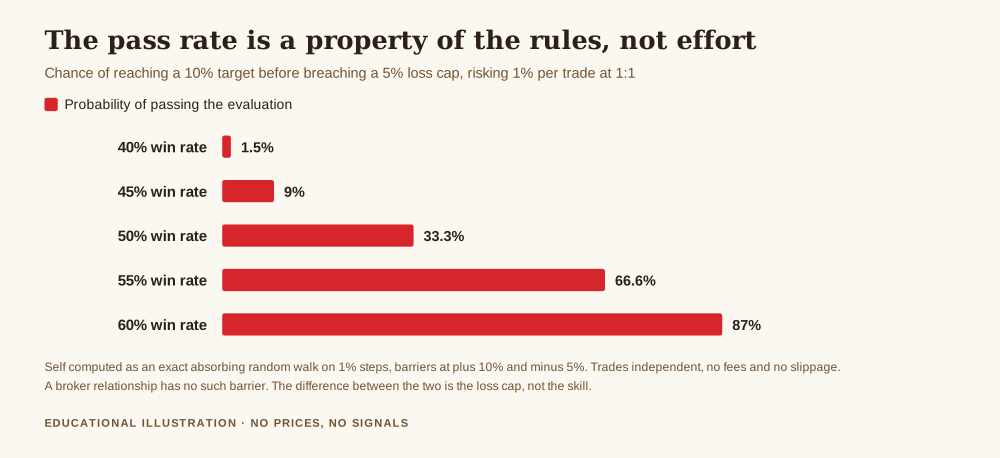
At a 50 per cent win rate, the probability of passing is 33.3 per cent. Not because you are bad, but because the barriers are asymmetric. You have to travel twice as far up as down, so a coin flip process fails twice as often as it succeeds.
At 45 per cent it is 9.0 per cent. At 40 per cent, 1.5 per cent. In the other direction, 55 per cent gives 66.6 per cent and 60 per cent gives 87.0 per cent.
Look at the gradient between 45 and 55 per cent. A ten point change in win rate moves the pass probability from 9.0 per cent to 66.6 per cent. The evaluation is not a slightly demanding version of ordinary trading. It is a filter with enormous sensitivity to a parameter most traders cannot state about themselves to within ten points.
And notice what has no equivalent in a broker relationship: the 5 per cent cap. Trade your own account at a broker and a 5 per cent drawdown is a bad fortnight, not a terminal event. The cap is the product. It is what the firm is selling and what you are being measured against.
Get the free REX one page business plan, the sheet I use to decide whether a cost like this belongs in the business at all. One email, no spam, unsubscribe anytime.
Get the free business plan →Pricing the fee the way you would price any other purchase
A business does not ask whether a purchase feels worth it. It asks what has to be true for it to pay for itself.
The fee is non refundable and paid per attempt. If you pass, you receive a share of the first payout. Call the fee F, the share you keep s, and the first payout V. Breaking even requires the probability of passing, times your share, times the payout, to equal the fee. So the break even pass rate is F divided by s times V.
On an 80 per cent profit split, if the first payout you realistically expect is twice the fee, you need to pass 62.5 per cent of the time to break even. If it is three times the fee, 41.7 per cent. Five times, 25.0 per cent. Eight times, 15.6 per cent. Ten times, 12.5 per cent.
Set that against the chart. At a 50 per cent win rate the pass probability is 33.3 per cent. On those assumptions the purchase clears its own cost if your expected first payout is around five times the fee or more, and does not if it is two or three times. That is a real answer, and it is neither the promotional one nor the cynical one. It says the arrangement can be rational, and that whether it is depends on two numbers most buyers never write down.
The honest caveat: that calculation ignores the attempts you pay for and fail, and the time cost of the evaluation period. Both push the break even requirement up. It also assumes you can estimate your own win rate, and expectancy is the more useful quantity if you have enough records to compute it.
What each arrangement is actually good at
I do not think this is a contest with a winner, so here is the fair version.
A broker is the right structure when the capital is yours and the point is to compound it. You keep 100 per cent of the result, nobody imposes a drawdown cap, and the regulatory machinery around segregation exists for your benefit. The cost is that the money at risk is your own.
A prop arrangement is the right structure when your constraint is capital rather than method. It converts a large unknown loss into a small known fee, which is a genuine piece of risk transfer and the reason the model exists. The cost is the cap, the split, and the fact that you are a counterparty rather than a customer.
The failure case is using one to avoid a problem belonging to the other. Paying evaluation fees repeatedly because your own account keeps drawing down is not solving a capital problem, it is paying a subscription for the same drawdown in a different building. What happens if you fail a prop firm challenge covers that loop, and how prop firms make money explains why the fee structure is designed the way it is.
What this article is not saying
It is not saying prop firms are a scam. The model is coherent, the risk transfer is real, and plenty of firms do exactly what they advertise.
It is not saying every broker is safe. Segregation rules reduce one risk, they do not remove all of them, and they apply to registered firms in the jurisdictions that impose them, which is a thing to verify rather than assume.
It is not saying the figures above describe any particular firm. Targets, caps, splits and fees vary, and the arithmetic is only as good as the numbers you substitute. Put your own in.
And it is not telling you which to use. That is a capital structure decision for your business, and it depends on money and circumstances I know nothing about.
The four questions I would answer before paying anything
Put these in the operating section of your plan, next to your other supplier decisions.
One. Whose money is in the account, and if the company stopped trading tomorrow, what exactly would I be holding? If the answer is a contract rather than property, price it as a contract.
Two. Is the firm registered, and where can I look that up? For a broker this is a lookup. For a prop firm the honest answer is often that no equivalent register applies, which is information rather than an accusation.
Three. What is the loss cap, is it measured against the starting balance or a trailing peak, and what pass probability does that imply at my win rate? The chart above assumes a static cap, which is the friendlier version.
Four. What payout, as a multiple of the fee, do I actually expect, and does that clear the break even pass rate? If you cannot answer this one, you are not buying a business input, you are buying a lottery ticket with better branding.
Review the answers in your weekly review like any other supplier relationship.
Frequently asked questions
Prop firm vs broker, what is the core difference?
A broker holds your money and the account is your property. A prop firm sells you access to an evaluation and, if you pass, a contractual share of profits on an account it controls. You own a balance in one case and a claim in the other.
Is my money protected at a prop firm the way it is at a broker?
Generally not, because there is no customer money to protect. Segregation rules such as 17 CFR 1.20 apply to customer funds held by a registered futures commission merchant. A non refundable fee is the company's revenue, not your segregated property.
What are the odds of passing an evaluation?
On the assumptions in this article, a 10 per cent target against a 5 per cent cap at 1 per cent risk per trade gives 33.3 per cent at a 50 per cent win rate, 9.0 per cent at 45 per cent and 66.6 per cent at 55 per cent. Your firm's actual rules will differ, so substitute them.
Why is the pass probability so low even at a 50 per cent win rate?
Because the barriers are asymmetric. You must gain 10 per cent before losing 5 per cent, so you have to travel twice as far in the favourable direction, and an even process fails roughly twice as often as it succeeds.
Can a prop firm arrangement ever be the cheaper option?
Yes. If your expected first payout is a large multiple of the fee, the break even pass rate falls below your actual pass probability and the purchase pays for itself. On an 80 per cent split and a payout of five times the fee, break even is a 25.0 per cent pass rate.
Can I use both at the same time?
Many people do, and as a business decision it is a question about where your capital and your attention go rather than about loyalty. Just keep the accounting separate, because the fee is a cost of the prop arrangement and should be judged against what that arrangement returns.
Where REX fits
REX Trading Signal is a free journal about running a trading account like a business, which mostly means writing decisions down before taking them rather than justifying them afterwards. Nothing here is sold on a promise of returns. The free one page business plan is the sheet I use to decide whether a cost belongs in the business at all, and a challenge fee is exactly the kind of line it is designed to catch. The piece underneath all of it is the one page trading business plan.
About the author. Rex paid for one evaluation before working out the break even pass rate, then worked it out, and has treated every recurring trading cost as a purchase with a hurdle rate since. He runs the account like a business because the alternative was running it like a hobby that happened to involve money.
Risk disclosure. This article is educational and is not financial advice. Trading gold and other leveraged products carries a high risk of losing money rapidly, and no entry, stop or target discussed should be treated as a signal. The pass probabilities and break even figures are computed from the stated assumptions, treat trades as independent, exclude fees and slippage, and are illustrations of arithmetic rather than forecasts or any firm's published results. The segregation requirement is quoted from 17 CFR 1.20 and the registration delegation from 49 FR 39593, both linked above. Rules differ by firm and by jurisdiction, so verify your own. Decide your own risk, and never trade money you cannot afford to lose.