
Someone in the group asked me last week whether he needed a licence before he could call his trading a business. He had been trading his own savings for two years, had just started keeping proper books, and had reached the point where the word "business" felt honest rather than aspirational. His question, more or less, was how to register trade licence paperwork for what he was doing, and whether he had been operating illegally without realising it.
The answer turned out to be more interesting than either of us expected, because there are two completely different questions hiding inside it, and mixing them up is what produces both unnecessary panic and genuinely dangerous complacency.
How to register trade licence paperwork, and the two questions underneath it
The first question is commercial. Does the place you live require anyone running a business to hold a general trade or business licence, register a company, or file for a permit? This varies enormously by country, and in many places it depends on whether you incorporate at all. It is a local administrative question, and it is genuinely local: the answer in one jurisdiction tells you nothing about the answer in another.
The second question is financial regulation. Does what you do require authorisation from a financial regulator? This one is not about paperwork or bookkeeping at all. It turns almost entirely on a single distinction, and once you see the distinction, most of the confusion evaporates.
The distinction is this: are you trading your own money, or are you touching somebody else's?
Trading your own capital is not a regulated activity
Financial regulators authorise firms that provide a service to other people. They are not in the business of licensing individuals to take risk with their own savings, and the definitions in the rulebooks say so plainly if you read them.
Take the United States, which matters here because retail gold and forex trading falls under the Commodity Futures Trading Commission rather than the securities regulator. The National Futures Association, which handles registration on the CFTC's behalf, defines a commodity trading advisor as an individual or organization that, for compensation or profit, advises others, directly or indirectly, as to the value of or the advisability of buying or selling futures contracts, commodity options, retail off-exchange forex contracts or swaps.
Read the two conditions in that sentence. For compensation or profit. Advises others. Trading your own account satisfies neither. You are not advising anyone, and nobody is compensating you for advice. The commodity pool operator category alongside it works the same way: it describes someone who operates a pool into which a number of persons have contributed funds. One person, one account, own money, no pool.
So the man in my group had not been operating illegally. He had been doing the one thing in this entire industry that requires no permission from anybody: risking money that belongs to him.
The line you can cross without noticing
Here is where it gets worth paying attention, because the transition from unregulated to regulated does not feel like a transition. It feels like being helpful.
You post your reasoning in a group. Someone asks what you would do. You tell them. They start copying you. Then someone offers to pay you for the calls, or asks you to trade their account for them, or three friends put money together and ask you to run it. At no point does an alarm sound. But somewhere along that sequence, depending on where you are and exactly what you did, you have moved from trading your own money into advising others for compensation, or into operating a pool.
American rules do at least tell you where the edge sits, in numbers. The CFTC's own regulation at 17 CFR 4.14(a)(10) exempts a trading advisor from registration if, during the course of the preceding 12 months, it has not furnished commodity trading advice to more than 15 persons and it does not hold itself out generally to the public as a commodity trading advisor.
Fifteen persons in twelve months, and no holding out to the public. Both conditions, not either. A public channel offering trading advice fails the second test regardless of how few people read it. And note what the exemption is not: it is not permission to take custody of anyone's money, which is a different activity under different rules.
I am not a lawyer and this is not legal advice for your situation. What I am saying is narrower and I think more useful: the question "do I need a licence" has a clean answer for the ordinary case, and the ordinary case is trading your own capital, where the answer is no. The moment other people's money or paid advice enters the picture, stop guessing and ask someone qualified in your own jurisdiction.
What registering actually buys a solo trader
Set the regulator aside, then, and take the commercial question on its own terms, because that is the decision most readers of this site are actually facing. Should you incorporate, register a business, and put the account inside it?
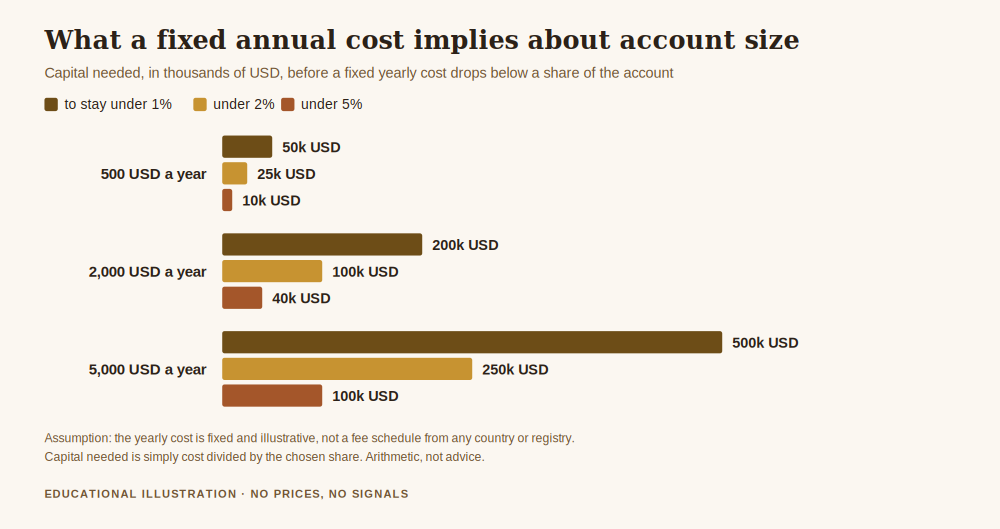
Incorporation is not free, and the honest way to evaluate it is the way you would evaluate any other fixed cost in a business. A fixed cost does not scale with your results. It lands whether the year was good or bad, which means it behaves like a hurdle you clear before anything counts as profit.
So ask what account size makes that hurdle tolerable. If forming and maintaining the structure costs 2,000 USD a year, that cost is 2 per cent of a 100,000 USD account and 20 per cent of a 10,000 USD one. At 5,000 USD a year you need a quarter of a million before the cost drops under 2 per cent. The chart above runs that arithmetic across three cost levels, and the numbers are deliberately illustrative rather than quoted from any registry, because the actual figures differ by country by an order of magnitude.
The conclusion is uncomfortable but consistent with how every other small business works: a structure that makes sense at 250,000 USD is a meaningful drag at 25,000 USD. Most people asking this question are at the second number and reading advice written for the first.
If you have not yet put a number on what your trading already costs you to run, fixed and variable costs of a trading business is the place to start, and the break-even point of your trading business turns those costs into the hurdle this section is describing.
What to do instead, if the answer is not yet
Deciding you do not need to register anything yet is not the same as doing nothing. Almost everything that makes a trading business legible to a registrar, an accountant or a tax authority is worth doing before any of them ask.
Keep the trading capital separate from household money, in its own account, with its own statements. Record every cost, including the ones that do not arrive as invoices, such as data subscriptions and the share of your internet bill you would honestly attribute to the work. Keep the trade record in a form you could hand to someone else. Know your own tax position for trading gains where you live, because that obligation exists whether or not any licence does, and it is the part people actually get caught by.
Do those four things and the day registration becomes worthwhile is an administrative afternoon rather than a reconstruction project. Skip them and the structure you eventually build sits on records that cannot support it.
Get the free REX one page trading business plan, including the fixed cost line this article argues you should fill in before you pay to register anything. One email, no spam, unsubscribe anytime.
Get the free business plan →Frequently asked questions
Do I need a licence to trade my own money?
For the ordinary case, no. Financial regulators authorise firms that serve other people, and the definitions bear that out: the NFA describes a commodity trading advisor as someone who advises others for compensation or profit, and a commodity pool operator as someone running a pool of funds contributed by a number of persons. Trading your own account is neither. Local business licensing is a separate question with a genuinely local answer, and that one is worth ten minutes on your own government's website rather than a guess from an article.
What changes the moment I manage money for someone else?
Almost everything. You move from risking your own capital to holding a duty toward someone else's, and that is precisely the activity regulators exist to supervise. Registration, disclosure, record keeping and capital requirements can all attach, and doing it informally for a friend or a relative does not exempt you. This is the single point in this article where I would tell you to stop reading and get proper advice in your own jurisdiction before accepting a single deposit.
Does the 15 person threshold mean I can advise 15 people freely?
No, and it is a common misreading. The exemption in 17 CFR 4.14(a)(10) has two conditions joined by "and": not more than 15 persons in the preceding 12 months, and not holding yourself out generally to the public as a commodity trading advisor. Fail either and the exemption is gone. A public channel or an advertised service fails the second condition however small the audience. It is also a United States rule, so it tells you nothing about where the line sits anywhere else.
Should I incorporate to reduce tax?
That is a question for an accountant who knows your country and your numbers, and anyone answering it confidently in a blog post is guessing. What I can offer is the framing: incorporation adds a fixed annual cost, and a fixed cost is a hurdle you clear before anything counts as profit. Work out what the structure costs per year, divide by your capital, and look at the percentage honestly before you look at any tax argument. If that number is uncomfortable, the tax argument usually is not big enough to rescue it.
Where do the capital figures in the chart come from?
They are arithmetic, not a fee schedule. I took three illustrative fixed annual costs and divided each by one, two and five per cent to get the account size at which that cost falls below the chosen share. Nothing there is quoted from any registry or company formation service, because real costs vary by country by an order of magnitude and any specific figure would be wrong for most readers within a year. The method is the transferable part: put your own local number in and run the same division.
Is a prop firm account a way around all this?
It is a different arrangement rather than a way around anything, and it brings its own contract terms to read carefully. You are not managing other people's money in the sense the rules are aimed at, and you are not registering a business to do it. What you are doing is accepting someone else's rules on drawdown, size and conduct in exchange for capital. Whether that trade is worth it is covered in how prop firms make money, which is a more useful read on the subject than anything about licences.
Where REX fits
REX Trading Signal is free, and it treats a trading account as a business with books, costs and a hurdle rate rather than a scoreboard. There is no profit promise here and there never will be, because nobody can make one honestly. The Telegram channel is where the same reasoning gets applied to what gold is doing on the day, with the thinking stated before the outcome is known.
If you are working through the structure of the business, how to open a trading company covers the entity decision this article deliberately left to your own jurisdiction, and how to keep track of day trading for taxes covers the obligation that exists whether or not a licence does. Both sit underneath the one page trading business plan template, which is where the cost lines live. The full library is at all REX articles.
About the author. Rex writes REX Trading Signal and treats an account as a business with books, costs and a hurdle rate rather than a scoreboard. He spent an embarrassing amount of time worrying about paperwork he did not need and not enough on the records he did. Nothing in this article is financial, legal or tax advice, and no entry, stop or target discussed should be treated as a signal.