
In a business, a trade taken outside the mandate has a name. It is called an unauthorised transaction, and no firm treats it as a feelings problem. They treat it as a controls problem, because the person who did it was perfectly calm about the first forty trades and the system is supposed to survive the forty first. That is the useful way to think about how to overcome revenge trading: not as a character flaw to be talked out of, but as a gap in your own procedures that one bad hour found.
What is actually happening, in operational terms
Revenge trading is normally described emotionally: you lost, you got angry, you wanted it back. True enough, but the description is useless because it offers nothing to fix. Strip out the feeling and look at what changed in the business.
Three things change, and they change in a specific order.
First, the approval step disappears. The trade is taken without passing whatever test your other trades pass, because the decision has already been made and the chart is being asked to agree. Second, the size goes up. Not by a planned increment, by whatever is needed to make the previous loss go away. Third, the time limit vanishes. A position that was meant to be held for a defined period is now held until it works, because closing it would make the loss final.
Every one of those is a control that existed an hour earlier and does not exist now. Nobody edited the trading plan. The plan was simply not consulted, and a plan that only applies when you feel like consulting it is not a control, it is a preference.
About 34 messages in my inbox mention revenge trading or chasing the market, and that is a keyword count rather than a survey, but the sequence repeats almost word for word. One reader wrote, "Not like before, I'm chasing the market too much, over trade." Another was blunter about the cost, "Because of my poor trading psychology, ego and revenge trading, I lost almost 900 dollars three weeks back." A third described exactly the mechanism above, "How are you able to cope with revenge trading and increasing the lot sizes to cover the loss, this is what has been happening to me, growing the account consistently and one single mistake like today brought my account to a massive drawdown."
Read that last one again. Growing consistently, then one mistake. The method was never the problem. The absence of a limit on a single bad session was.
What the escalation actually costs
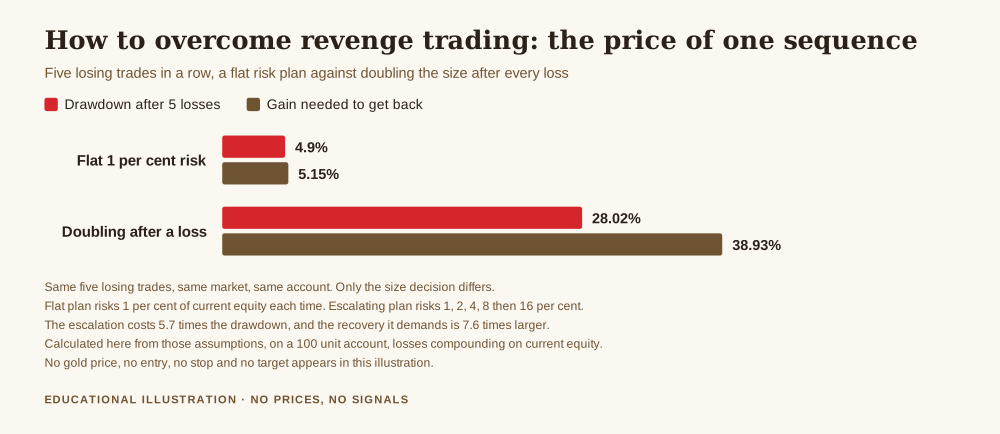
The reason this matters more than ordinary mistakes is that revenge trading does not add losses, it multiplies them. Here is the arithmetic on a 100 unit account, assuming five losing trades in a row and losses compounding on the running balance.
Run the flat plan first. Risk 1 per cent of current equity each time, lose five times, and you finish at 95.10. A drawdown of 4.90 per cent, and you need a 5.15 per cent gain to get back to flat. That is a bad week and nothing more.
Now run the same five losing trades with the size doubling after each loss, so 1 per cent, then 2, then 4, then 8, then 16. You finish at 71.98. That is a drawdown of 28.02 per cent, and it needs a 38.93 per cent gain to get back to where you started.
Same market, same five trades, same account, same trader. The escalation costs 5.7 times the drawdown of the flat plan, and the recovery it demands is 7.6 times larger. Nothing about the quality of the analysis changed. Only the size decision did, and the size decision was made by a person who had just lost money.
That asymmetry is the whole argument. A trading business can survive being wrong five times. It often cannot survive being wrong five times while escalating, and the escalation is the only part that was optional.
The evidence that more trading is not the fix
There is a reflex underneath revenge trading that says the way back is through more activity. It is worth knowing that this has been measured, and the answer is unambiguous.
Brad Barber and Terrance Odean examined 66,465 households with accounts at a large discount broker between 1991 and 1996. The households that traded most earned an annual return of 11.4 per cent while the market returned 17.9 per cent, and the average household earned 16.4 per cent while turning over 75 per cent of its portfolio each year. Their stated conclusion was that trading is hazardous to your wealth, and they attributed the high trading levels to overconfidence.
The gap between the most active group and the market is 6.5 percentage points a year. Compound that and it stops being a statistic: at 17.9 per cent a year, capital multiplies 5.19 times over a decade, while at 11.4 per cent it multiplies 2.94 times. Same market, same period, and the difference is activity.
That study is about overtrading in general rather than revenge trading specifically, and the distinction is worth keeping. But revenge trading is overtrading in its most concentrated form, taken at the worst moment and in the largest size, and there is no reading of that evidence in which the answer to a loss is a burst of extra trades.
Why willpower is the wrong control
Most advice on this topic amounts to telling someone to stay disciplined. It fails for a structural reason, not a moral one.
Discipline is a judgement made at the moment of temptation, and the moment of temptation is precisely when judgement is worst. Asking yourself to decide well right after a loss is asking the impaired system to supervise itself. No business runs its controls that way. The reason a bank's risk limits are enforced by a system rather than by the trader's conscience is not that traders are untrustworthy, it is that nobody is trustworthy at 4pm on a losing day.
So the fix has to be a rule that executes without your participation. It must be written before the session, specific enough to be unambiguous, and it must not require you to agree with it at the moment it binds.
How to overcome revenge trading with controls, not willpower
These are ordinary operational limits. None depends on feeling calm.
- A daily loss limit, stated in R and written down. Two or three R in a day and the terminal closes, whatever the setup looks like. The number matters less than the fact that it was chosen in advance by someone who had not just lost. This is the single control that converts a catastrophic session into an ordinary one.
- A fixed size, with escalation forbidden in writing. Not "try not to increase size" but a stated rule that position size never rises inside a losing sequence. The arithmetic above is the reason. A business that doubles its bet to recover a loss is not managing risk, it is financing it.
- A mandatory gap after a loss. A set number of minutes before the next order can be placed, enforced by standing up rather than by intention. The gap is not there to calm you down, it is there to put time between the loss and the next decision, because the two being adjacent is what creates the problem.
- A plan compliance column in the log. One character per trade, yes or no, recorded at the time. This is what turns revenge trading from a feeling you vaguely recall into a number you can count at the end of the month.
That last one deserves emphasis because it is the one people skip. Without it you have opinions about how often this happens to you. With it, after fifty trades, you have a figure, and almost everyone discovers the figure is higher than their memory of it. The log for that lives in a trading journal in Google Sheets, and it costs about fifteen seconds a trade.
The monthly review that catches what the day missed
Controls stop working quietly. The point of a review is to notice that before the market does.
Once a month, split your results in two: trades where the compliance column says yes, and trades where it says no. Average each group separately. You are looking for one specific pattern, which is a positive expectancy on the compliant trades and a negative figure overall. That pattern is extremely common, and it means your method is not the thing that needs changing.
If that is what you find, the work for the next month is not strategy research. It is making one of the four controls above actually enforceable, and the right number of controls to fix at once is one. The metrics that frame this review are in the key metrics every trading business should track.
A reader described the version of this that works, "I took some days off to clear my mind from revenge trading." Stepping away is a legitimate control. It is also a blunt one, and the aim of writing limits down is that you need it less often, because the daily loss limit has already ended the session before the damage gets large enough to need a week off.
What good looks like afterwards
The target is not a trader who never feels the urge. The urge is normal and will not be negotiated away. The target is a business where feeling it changes nothing, because the size is fixed, the daily limit is external, and the next order cannot be placed for twenty minutes regardless of what you want.
One reader got there and described it in terms that sound like an operator rather than a gambler, "I set a limit order for the one you sent. Like you said, don't chase the market, let the market come to you." That is the same person, same market, same urge. The difference is that the decision had already been made by someone calmer, and all the present moment had to do was follow it.
Get the free REX one page trading business plan, including the daily loss limit and the no escalation rule that stop one bad session from becoming a bad quarter. One email, no spam, unsubscribe anytime.
Get the free business plan →Frequently asked questions
How to overcome revenge trading when the urge hits mid session?
You mostly do not, and that is why the question has to be answered earlier. In the moment, the only reliable moves are the ones that do not require judgement: close the platform, honour the daily loss limit you wrote down, and let the mandatory gap run. Anything that depends on you assessing the next setup fairly is asking the wrong part of your brain at the wrong time.
Is revenge trading the same as overtrading?
Overtrading is taking too many trades. Revenge trading is a specific, more dangerous case of it: trades taken immediately after a loss, usually in larger size, with the explicit aim of recovering the loss. The danger is not the extra trades on their own, it is that the size escalates at the same time, which is what turns a 4.90 per cent drawdown into a 28.02 per cent one.
What daily loss limit should I use?
Pick a number you can state in R and survive comfortably, commonly two or three R, then write it down and treat it as external. The exact figure matters far less than two things: that it was chosen before the session rather than during it, and that hitting it ends the day automatically rather than prompting a discussion with yourself.
Does doubling down ever make sense after a loss?
Not as a response to the loss. If a larger position would be justified for a reason that has nothing to do with what just happened to your account, that is a planned sizing decision and it belongs in your written rules. The test is simple: if the previous trade's outcome is part of your reasoning for this trade's size, the reasoning is not about the market.
How long should the pause after a loss be?
Long enough that the next decision is not made in the same emotional state, and short enough that you will actually honour it. Many operators use fifteen or twenty minutes, away from the screen rather than staring at it. The point is the separation between the loss and the next order, not the specific duration.
How do I know if revenge trading is really my problem?
Count it. Add a plan compliance column to your log, record yes or no on every trade at the time rather than later, and after fifty trades average the two groups separately. If the compliant trades are profitable and the overall figure is not, you have measured it, and the answer is a controls fix rather than a new strategy.
Where this leaves you
The short answer to how to overcome revenge trading is that you stop trying to overcome it in the moment and start preventing it in advance. Write a daily loss limit, forbid escalation inside a losing sequence, put a mandatory gap after every loss, and record plan compliance so the problem becomes a number instead of a feeling. None of those require you to be calm, which is the point, because you will not be.
The sample of 66,465 households, the returns of 11.4 per cent for the most active traders against 17.9 per cent for the market, the 16.4 per cent average household return and the 75 per cent annual turnover are from Brad M. Barber and Terrance Odean, "Trading Is Hazardous to Your Wealth: The Common Stock Investment Performance of Individual Investors", Journal of Finance volume 55 issue 2, pages 773 to 806, DOI 10.1111/0022-1082.00226, verified through Crossref and linked above in the authors' own copy. The drawdowns of 4.90 and 28.02 per cent, the recoveries of 5.15 and 38.93 per cent, the multiples of 5.7 and 7.6 times, the 6.5 percentage point gap and the ten year multiples of 5.19 and 2.94 times were all calculated here from the stated assumptions, namely a 100 unit account, five consecutive losing trades, risk taken on the running balance, and a doubling sequence of 1, 2, 4, 8 and 16 per cent. No gold price appears anywhere in this article, and no entry, stop or target is given.
If you want the surrounding system, the one page trading business plan is where these limits get written down in the first place, and how to know when to stop trading covers the daily limit in more detail. If the damage has already happened, how to recover from a trading loss is the one to read next, and the trading rules checklist is where the controls above turn into something you can tick.
REX Trading Signal publishes the process rather than a number to copy, and the free one page business plan above is where the limits in this article are written down. Following along is free, the Kit is optional, and nothing here promises a profit.
About the author. Rex writes REX Trading Signal for traders who treat the account as a business with books, limits and a review cycle, because the operators who last are the ones who wrote the rules down before the market tested them. This is education and not financial, legal or tax advice, and no entry, stop or target discussed should be treated as a signal.