
Most traders reach this decision from the wrong direction. They have a messy year behind them, a filing deadline in front of them, and they go looking for someone to make the problem disappear. That is how you end up paying a stranger to do work you cannot evaluate, which is the single most expensive way to buy any professional service. How to hire an accountant is a procurement decision like any other your business makes, and it runs better when you treat it as one: define the scope, verify the credential, price the alternative, then choose.
Price what you are doing now, before you price anyone else
A business owner who cannot say what a job currently costs has no way to judge a quote for it. So start there.
The US Bureau of Labor Statistics puts the median pay for accountants and auditors at 83,680 dollars a year, or 40.23 dollars an hour, as of May 2025, across 1,595,200 jobs, with employment projected to grow 5 per cent between 2025 and 2035. Those two figures imply a 2,080 hour year, which is a useful sanity check on any hourly rate you are quoted.
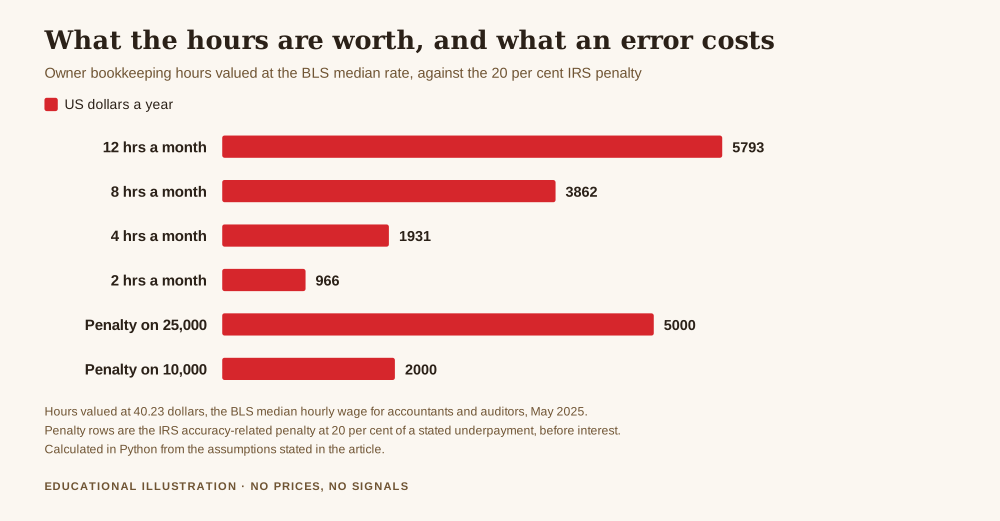
Now value your own bookkeeping time at that market rate, because that is what the work is worth when someone qualified does it. Two hours a month is 24 hours a year, or 966 dollars. Four hours a month is 48 hours, or 1,931 dollars. Eight hours a month is 3,862 dollars, and twelve hours a month is 5,793 dollars a year of someone else's billable time that you are performing yourself, usually badly, usually at the end of a trading day when your judgement is at its worst.
That is not an argument for hiring. It is the number you need before the argument can start. If you spend two hours a month and a firm wants 4,800 dollars a year, the arithmetic is telling you something clear. If you spend twelve hours a month and a firm wants 1,200, it is telling you something equally clear in the other direction.
How to hire an accountant, the four steps in order
Step one, write the scope before you call anyone
Decide what you are actually buying, because the word accountant covers at least four separate jobs and the price of each is different.
Bookkeeping is recording what happened. Tax preparation is filing the return. Tax planning is arranging affairs before the year ends so the return comes out differently. Advisory is someone looking at the business and telling you what they see. A trading business usually needs the first two, often benefits from the third, and rarely needs the fourth at the start.
Write down which of those you want, how many accounts and statements are involved, roughly how many transactions a year, and which jurisdiction you file in. That one page turns a vague request into something three firms can quote on comparably. Without it you will receive three incomparable numbers and choose the smallest, which is how people end up with a preparer who does not understand what a broker statement is. The reconciliation side of that scope is covered in how to reconcile your broker statement.
Step two, verify the credential rather than the website
This is the step people skip, and it is the one with teeth.
The IRS is blunt about the floor: anyone can be a paid tax return preparer as long as they have an IRS Preparer Tax Identification Number. A PTIN is a registration, not a qualification. It says the person is permitted to charge you, not that they know anything.
Above that floor sit the credentials that mean something: certified public accountants, enrolled agents and attorneys. The IRS maintains a Directory of Federal Tax Return Preparers listing those who hold a recognised professional credential or an Annual Filing Season Program record of completion, and it points taxpayers there precisely so the question does not rest on trusting a brochure.
So check the directory, and check the state board for a CPA licence. It takes a few minutes. The IRS also notes that return preparer fraud is a common tax scam, which tells you that the few minutes is not paranoia.
Step three, ask the questions that reveal fit
Five, and the answers matter more than the credentials at this point.
Ask whether they have other clients who trade, and what those clients file. A preparer who has never seen a 1099-B from a broker is going to be learning on your return at your expense. Ask who actually does the work, because at larger firms the person selling is rarely the person preparing. Ask how they charge, fixed fee or hourly, and what triggers extra billing. Ask what they need from you and when, since a cheap fee attached to an impossible document deadline is not cheap. And ask what happens if the return is questioned, because the answer separates a filing service from a professional relationship.
One warning sign worth naming plainly. A preparer who promises a particular outcome before seeing your records, or whose fee is a share of the refund, is selling something other than accounting. Walk away from both.
Step four, price the downside, not just the fee
The fee is the visible cost. The error is the invisible one, and the IRS publishes exactly what it charges for it.
The accuracy-related penalty is 20 per cent of the underpayment attributable to negligence or disregard of rules, or to a substantial understatement of income tax. For an individual, substantial understatement means understating by more than 10 per cent of the tax required to be shown on the return, or 5,000 dollars, whichever is greater.
Put numbers on that. An underpayment of 2,000 dollars carries a 400 dollar penalty before interest. At 5,000 it is 1,000. At 10,000 it is 2,000. At 25,000 it is 5,000 dollars, on top of the tax you owed anyway. And the threshold test bites early: with 20,000 dollars of tax due, understating by more than 5,000 puts you inside it, since 5,000 is greater than 10 per cent of 20,000. Only once the tax due passes 50,000 does the percentage test start to govern instead of the flat figure.
Interest runs on top of all of it. The penalty is the published part, not the whole bill.
Putting the two sides together
Now the decision is arithmetic rather than anxiety. Take the hours you would get back, valued at the market rate, and add the expected cost of an error you are no longer making.
Assume four hours a month returned to you, worth 1,931 dollars a year, and assume a 5 per cent annual chance of a 10,000 dollar underpayment, which carries an expected penalty cost of 100 dollars. Together that is 2,031 dollars of value. Against a 1,200 dollar fee, the fee is covered comfortably. Against 2,400 it is not, on those assumptions, and against 4,800 it is not close.
Raise the error probability to 10 per cent and the total becomes 2,131 dollars, which still does not reach 2,400. That is worth noticing, because it shows the penalty risk is rarely what justifies the fee at small scale. The hours are. Anyone selling you an accountant primarily as insurance against penalties is arguing from the weaker half of the case.
The assumptions are yours to change, and they should be. If you spend twelve hours a month rather than four, the value is 5,793 dollars and a 4,800 dollar fee starts to make sense. The point is not my numbers. It is that the decision has numbers at all, which is the same discipline applied in fixed and variable costs of a trading business and recorded in the one page trading business plan.
What stays yours after you hire
One thing does not transfer with the engagement letter, and it catches people out.
The return is signed by you and the liability for it is yours. A preparer's mistake does not become the preparer's tax bill. That is why the verification step is not a formality and why handing over a shoebox and looking away is not delegation, it is abdication.
Keep the records yourself, in a form you can read. Review what is filed before it is filed, and ask about any line you do not understand, because a professional who cannot explain a line in plain words either does not understand it either or does not respect you enough to try. Keep your own monthly statements so the annual conversation starts from something, which is the habit described in your monthly profit and loss review.
Get the free REX one page trading business plan, including the records section that makes an annual conversation with an accountant short and cheap instead of long and expensive. One email, no spam, unsubscribe anytime.
Get the free business plan →Frequently asked questions
How to hire an accountant if my trading business is tiny?
The same four steps, with a smaller scope. A small operation often needs tax preparation only, with bookkeeping kept in-house. Price your own hours first, because at two hours a month, worth about 966 dollars a year, a full service engagement is unlikely to pay for itself on time saved alone.
What is the difference between a CPA, an enrolled agent and a preparer?
A paid preparer needs only a Preparer Tax Identification Number from the IRS, which is a registration rather than a qualification. Certified public accountants and enrolled agents hold professional credentials recognised by the IRS and appear in its Directory of Federal Tax Return Preparers, alongside attorneys and holders of an Annual Filing Season Program record of completion.
Is an accountant worth it just to avoid penalties?
Usually not on that basis alone, which surprises people. The accuracy-related penalty is 20 per cent of the underpayment, so a 5 per cent chance of a 10,000 dollar underpayment is an expected cost of about 100 dollars a year. The hours returned to you are almost always the larger half of the case.
How much should I expect to pay?
That depends on scope and jurisdiction, and anyone quoting a figure without seeing your scope is guessing. The useful anchor is the BLS median of 40.23 dollars an hour for accountants and auditors as of May 2025, which lets you sanity check an hourly rate and estimate what a quoted fixed fee implies in hours.
Can I just use software instead?
For recording transactions, often yes, and doing so lowers the scope you need to buy. Software does not replace judgement on how something should be treated, and it does not sit with you if the return is questioned. Many trading businesses land on software for bookkeeping plus a credentialed preparer for the return.
Am I off the hook if my accountant makes the mistake?
No. The return is yours and the tax liability stays with you regardless of who prepared it. That is the reason to verify the credential before engaging and to read what is filed before it goes, rather than after a letter arrives.
Where this leaves you
The answer to how to hire an accountant is that you do it the way you would hire anyone else for your business: scope, verify, ask, price. Scope so three firms can quote on the same thing. Verify through the IRS directory and the state board rather than the website, because the legal floor for charging you is only a registration number. Ask who does the work and what happens when it is questioned. And price it against both sides, the hours at 40.23 dollars and the 20 per cent penalty on an error.
Run your account like a business and this stops being a once a year panic. The traders who find this decision expensive are almost always the ones making it in March with a year of unsorted records behind them. The ones who find it cheap did the recording monthly and are buying a review rather than a rescue.
The wage and employment figures in this article, namely the median pay of 83,680 dollars a year and 40.23 dollars an hour as of May 2025, the 1,595,200 jobs and the projected 5 per cent growth between 2025 and 2035, come from the US Bureau of Labor Statistics Occupational Outlook Handbook entry for accountants and auditors, linked above. The accuracy-related penalty of 20 per cent of the underpayment and the substantial understatement threshold of the greater of 10 per cent of the tax required to be shown or 5,000 dollars come from the IRS accuracy-related penalty page, and the statement that anyone with a Preparer Tax Identification Number may be a paid preparer, together with the Directory of Federal Tax Return Preparers, come from the IRS page on choosing a tax professional, both linked above. The annual values of 966, 1,931, 3,862 and 5,793 dollars, the implied 2,080 hour year, the penalties of 400, 1,000, 2,000 and 5,000 dollars, the threshold figures, and the break even comparisons of 2,031 and 2,131 dollars against fees of 1,200, 2,400 and 4,800 were all calculated here in Python from the assumptions stated in the text. This article describes general practice and United States federal rules only. Tax rules differ by country and change over time.
REX Trading Signal publishes the daily record with the quiet days and the losing days included, so you can judge a process rather than a highlight reel. The free business plan above is the one page version of the operating rules used here. Following along is free, the Kit is optional, and nothing here promises a profit.
About the author. Rex writes REX Trading Signal for people who want to run an account like a business rather than a hobby, because the operators who last are the ones who wrote the rules down before the market tested them. This is education and not financial, tax or legal advice, tax rules differ by country and change over time, your own circumstances decide what any of this means for you, and no entry, stop or target discussed should be treated as a signal.