
Every real business on earth does one boring thing every month, and almost no retail trader does it. They take their own record of what happened and they lay it beside the record kept by the institution holding their money, and they check that the two agree. That is all reconciliation is. If you have never worked out how to reconcile your broker statement, you are running the only business I know of where the owner accepts the counterparty's arithmetic without ever auditing it.
I am not suggesting your broker is stealing from you. In nearly every case I have looked at, nobody was stealing anything. The differences were mundane: a fill that went through at a worse level than the one on the screen, a swap charge applied on a night the position was supposedly closed, a commission booked at the wrong tier. Mundane, small, and permanent, because nobody ever looked.
What reconciliation actually means in a trading business
In accounting, reconciliation means comparing two independent records of the same events and explaining every difference between them. Not noticing the differences. Explaining them. A difference you have investigated and understood is reconciled. A difference you have shrugged at is not.
For a trading account you have exactly two records. There is what you believe happened, which lives in your journal: the instrument, the direction, the size, the intended entry, the intended exit, the time. And there is what the broker says happened, which lives in the statement: the filled price, the filled size, the commission, the swap, the resulting balance.
Most traders keep the first record badly and never open the second. That is the gap this article is about.
The four differences that actually show up
Over the years the same four categories account for nearly everything I have seen.
The first is execution difference. You intended one level, you were filled at another. This is normal and often unavoidable, particularly around news or at session boundaries. It only becomes a problem when it is consistent in one direction and you have never measured it.
The second is financing. Swap or rollover charges are applied on a schedule that does not always match your mental model of when your position was open, and the rate can change without any announcement reaching you. This is the single most commonly missed line, because it does not appear next to a trade.
The third is commission and fee tiering. Many accounts have rates that depend on volume, account type, or instrument. A rate applied at the wrong tier is invisible unless you multiply it out yourself.
The fourth is simple booking error. Wrong size, duplicated ticket, a close that registered as a partial. Rare, but it happens, and it is the category most likely to be fixed if you report it promptly and most likely to be refused if you report it eight months later.
What this sounds like before anyone calls it reconciliation
People describe this problem constantly without ever using the accounting word for it. Roughly 44 of the conversations in my inbox mention spread or slippage, and that is a keyword count across my own messages rather than a survey.
One reader wrote: Why did the trade you set up cause me to lose and you to gain? I think my stop loss was hit because of the spread.
That is a reconciliation question. It has an answer, and the answer is in the statement.
Another: my broker's spread has gone from 20 cents to almost 1.00, that i don't like.
Also reconciliation. Something measurable changed, and it was noticed by accident rather than by process.
A third: that's why I put it pending because in manual I often get slippage and spread.
That is a trader who has detected a pattern by feel and adjusted behaviour around it, without ever quantifying it.
And one more: Some brokers have different spread for demo and live and other things could be different.
Correct, and the only way to know which applies to you is to check your own records.
In every one of those messages the person is doing the hard part already. They have noticed. They just have no procedure to turn the noticing into a number.
How to reconcile your broker statement in about twenty minutes a week
Here is the actual procedure. It is deliberately simple, because a complicated process will not survive a busy month.
Begin by exporting the statement for the period rather than scrolling the terminal. You want a file you can sort, because the whole method depends on being able to compare columns.
Next, check the balance walk before you look at any individual trade. Opening balance, plus net profit and loss, minus commission, minus swap, plus or minus any deposits and withdrawals, should equal closing balance exactly. If that identity does not hold, stop there. Nothing further matters until it does, and a break at this level is the one case that justifies contacting the broker immediately.
Then compare your journal rows to the statement rows, matching by ticket. You are looking for trades in one record and not the other, which is usually your journal being incomplete, and sizes that do not match, which is usually more serious.
After that, isolate the costs. Total the commission and total the swap for the period, separately from profit and loss. Most traders have never seen these two numbers as standalone figures, and seeing them is often the single most useful output of the entire exercise.
Finally, measure your execution difference. For each trade, record intended level against filled level, and average it across the period. One trade tells you nothing. Fifty trades tell you whether you have a systematic cost you have been treating as bad luck.
Why it is worth twenty minutes
Let me put a number on the cost of not doing it, with the assumptions stated so you can substitute your own.
Assume a standard gold lot is 100 ounces and you trade 0.10 lots, so 10 ounces a trade. Assume a difference of 10 US cents an ounce goes unnoticed on each trade, which is a one dollar difference per trade. Assume a 10,000 dollar account.
At 100 trades a year that is 100 dollars, or 1.0 per cent of the account. At 200 trades, 2.0 per cent. At 400 trades, 4.0 per cent. At 800 trades, 8.0 per cent.
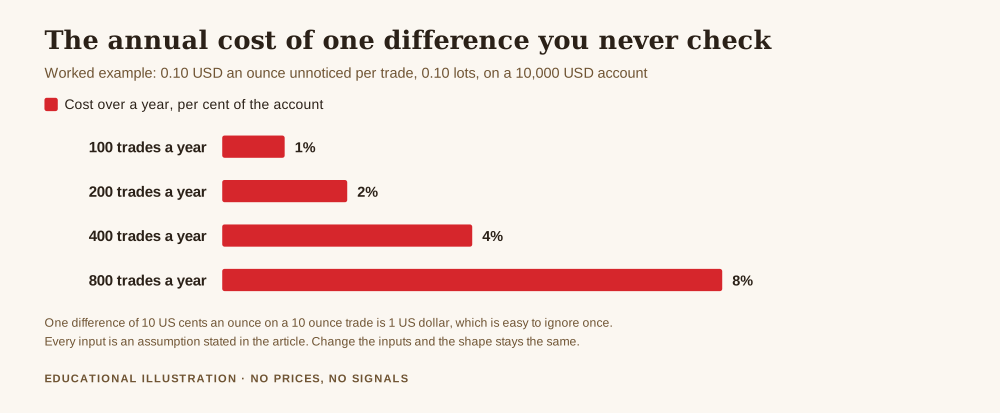
A one dollar discrepancy is genuinely not worth your attention. Four hundred of them is a line item that would get a supplier reviewed in any other business. That is the entire argument, and it does not depend on anyone behaving badly.
There is a second benefit that is harder to quantify. The trader who checks every week knows their real cost base. The one who does not is estimating their edge using a cost figure they have never verified, which means their backtest, their position sizing and their monthly target are all built on a number they guessed.
What to do when you find a genuine difference
Raise it in writing, with the ticket number, the date and time, the expected figure, the actual figure, and the difference. Firms respond to specifics and deflect vagueness, and that is not cynicism, it is just how support queues work.
Be willing to accept a reasonable explanation. Slippage during a news release is not an error. A swap rate that changed and was disclosed in the terms you agreed to is not an error either. The point of reconciliation is to know which differences are explained, not to win an argument.
If a difference is not explained and not corrected, escalate to the regulator rather than to a forum. In the United States, the National Futures Association maintains BASIC for due diligence on registered firms and provides a complaint route, described on its investor education and resources page. Your own jurisdiction will have an equivalent. Knowing the route before you need it is part of running the business properly.
It is worth keeping some perspective on scale here. The FBI's Internet Crime Complaint Center recorded investment fraud losses of 6,570,639,864 US dollars in 2024, up 43.8 per cent on 2023, according to the IC3 2024 Annual Report. That figure covers investment fraud in general and says nothing about regulated brokers specifically. I include it because the habit of checking records is the same habit that catches the serious cases early, and the people who get hurt worst are usually the ones who never looked at a statement until the money was gone.
What this is not
This is not a claim that brokers routinely cheat clients. The overwhelming majority of differences you find will be explainable, and several will turn out to be your own record being wrong.
It is not a strategy, and it will not improve your entries. Reconciliation is bookkeeping. It tells you what your business actually costs to run, which is a different question from whether your trading works.
And it is not a one-off project. A reconciliation done once a year is an archaeology exercise. Done weekly it is a control, which is the only version that is worth anything.
Get the free REX one page trading business plan, which includes the weekly control checklist this article describes. One email, no spam, unsubscribe anytime.
Get the free business plan →Frequently asked questions
How to reconcile your broker statement if you have never kept a journal?
Start with the statement alone and check the balance walk: opening balance plus net profit and loss, minus commission and swap, adjusted for deposits and withdrawals, should equal closing balance. Then begin recording intended entry and exit from today forward. You cannot reconcile the past you did not record, but you can start the control now.
How often should I reconcile?
Weekly for the trade level comparison, monthly for the full cost totals. Weekly matters because the window in which a broker will readily investigate a booking error is measured in days, not months.
Is slippage an error I can dispute?
Usually not. Execution difference during fast conditions is a normal feature of the market, and most terms of business say so explicitly. The reason to measure it is not to dispute individual fills, it is to know your average cost so your sizing and expectations reflect it.
What is the single most commonly missed line?
Swap or rollover financing, because it does not appear beside a trade and accumulates quietly on positions held across sessions. Total it separately for the period and you will often find it is larger than you assumed.
What does an unchecked difference actually cost?
On the assumptions in this article, a 10 cent per ounce difference on 0.10 lot trades costs 1 per cent of a 10,000 dollar account at 100 trades a year and 8 per cent at 800. Substitute your own trade size and frequency, the method is in the article.
My broker and my platform show different figures. Which is right?
The statement from the entity holding your money is the record that counts, because that is the one your balance is settled against. If your platform disagrees with it persistently, that is itself a finding worth raising in writing.
Where REX Trading Signal Fits
REX Trading Signal is free to follow. The daily record goes up on Telegram with the losing days included. There is a free one page business plan for anyone who wants the operating rules in one document, including the weekly control checklist this article describes, and an optional Kit for people who want the full system. Nothing here promises a profit and nothing here is a signal service. The record you reconcile against is built in how to keep a trading journal like a professional, the numbers worth totalling are in the key metrics every trading business should track, the template that holds it together is the one page trading business plan template, and another cost most traders never budget for is in what market data fees are.
About the author. Rex writes REX Trading Signal. He spends more time in spreadsheets than on charts, which he considers the correct ratio and most people consider a personality defect, and he is mainly interested in the unglamorous machinery of a trading business, the costs, the controls and the records, because that is the part actually within your control. Calculations here state their assumptions so you can repeat them with your own figures. Nothing in this article is a recommendation to trade, it is not financial, accounting, legal or tax advice, and no entry, stop or target discussed should be treated as a signal.