
A reader wrote to me in August having passed an evaluation, traded a funded account for three weeks, made money, and then been told his withdrawal was blocked. Nothing had gone wrong with his trading. He had broken a clause he had agreed to and never read, and the clause was the consistency rule. He wanted to know whether it was a scam. It was not, and that is the less comfortable answer, because the rule was in the contract and the arithmetic of it was entirely knowable in advance. Working out how to calculate consistency rule in trading takes about five minutes, and it is five minutes best spent before you fund an account rather than after your first good day.
This article is the arithmetic. What the rule says, how to compute where you stand against it, and what it quietly demands of your position sizing. Everything numerical here is my own calculation from assumptions I state as I go, apart from two figures from public records that I have sourced and linked. Nothing here is financial advice, and the specific terms vary by firm, so treat the worked examples as a method rather than as your contract.
What the rule says, and the business reason it exists
The clause goes by different names and usually reads something like this: no single trading day may account for more than a set share of your total profit when you request a withdrawal. Twenty per cent is the most common figure I see. Twenty five per cent appears often. Some firms use fifty.
Read it as a business and the purpose is obvious. The firm is buying a repeatable process, not a lucky week. One enormous day inside an otherwise flat month tells them very little about whether you can do it again, and quite a lot about whether you sized up and got away with it. The rule is a filter for variance dressed up as a payout condition.
That is a legitimate commercial interest. It is also, and this is the part people miss, a constraint that binds far more often than anybody expects, including traders who have done nothing reckless at all.
How to calculate consistency rule in trading, step by step
Three numbers and one division.
Step one. Take your largest single day's profit since the account was funded. Call it your best day. Use the daily closed profit figure your firm uses, not your own spreadsheet, and check whether their day ends at your midnight or theirs.
Step two. Take your total profit over the same period.
Step three. Divide the best day by the total. If the answer is above the cap in your contract, the rule binds and the withdrawal will not clear.
Now run it backwards, which is the version worth keeping. If your best day is fixed and the cap is twenty per cent, then your total profit must be at least five times your best day. The general form is simply one divided by the cap. A twenty per cent cap needs five times. Twenty five per cent needs four times. Fifty per cent needs two times.
Put numbers on it. Say your best day made 1,000 dollars and the cap is twenty per cent. Your total must reach 5,000 dollars before anything can be withdrawn. You already have the 1,000, so you need 4,000 more. If a typical day for you makes 200 dollars, that is twenty more trading days of work, created by a single good afternoon.
Nobody tells you this at the moment of the good day. The good day feels like progress. In the arithmetic of the rule it is a liability that has just extended your timeline by a month.
The rule is really a minimum number of trading days
Here is the part I had not appreciated until I simulated it, and it changed how I read these contracts.
If every trading day produced exactly the same profit, your best day would be one divided by the number of days, so five equal days would put you exactly at the twenty per cent line. Real days are not equal, and that variation works entirely against you, because the rule looks at your maximum rather than your average.
So I ran it. Assume daily profit and loss is independent and normally distributed with a mean of 150 dollars and a standard deviation of 400 dollars. Those assumptions are mine and they describe a modestly profitable account with ordinary daily swings. Across 200,000 simulated runs with a fixed seed, counting only the runs that ended profitable, here is how often the best day exceeded a fifth of the total.
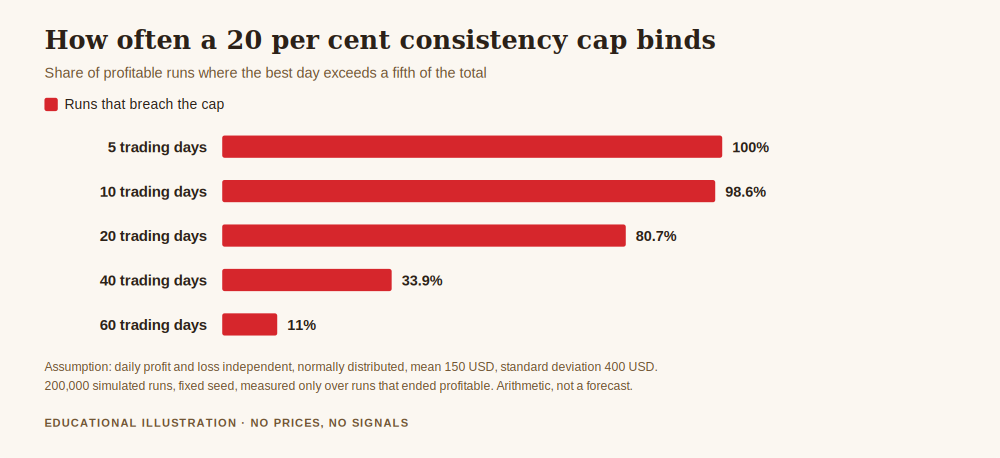
Over five trading days the cap is breached essentially always. Over ten days, 98.6 per cent of the time. Over twenty days, which is a full month of weekdays, it still binds in 80.7 per cent of profitable runs. It takes forty days to get the breach rate down to a third, and sixty days to get it to eleven per cent.
Read that again, because it is the whole point of the article. A trader doing nothing wrong, with an ordinary distribution of results, will fail a twenty per cent consistency check four times in five after a profitable month. The rule is not primarily measuring recklessness. It is measuring elapsed time.
What it demands of your position sizing
Once you see the rule as a variance constraint, the operational response follows, and it is not the intuitive one.
The instinct after a good day is to press. Under this rule, pressing is the single most expensive thing you can do, because every new personal best resets the total you need to five times a larger number. You can be profitable every week and move further from a withdrawal, which is an unusual way to lose and a very demoralising one.
The constraint says: cap the upside of any single day. If your target total is 5,000 dollars and the cap is twenty per cent, then no day may contribute more than 1,000 dollars, so your maximum position size is whatever makes 1,000 dollars an unlikely outcome rather than a good one. That is a deliberate ceiling on your best days, accepted in exchange for a payout that actually clears.
I know how that sounds. You are being asked to make less on your best days in order to be paid at all. It is still the correct operating decision, because the alternative is an account that performs well on paper and never converts. A business that cannot invoice is not a business, whatever the gross figures say.
If you want the companion calculation, how to calculate consistency in trading covers measuring the variance of your own results, which is a different question from this one. That article asks whether your results are stable. This one asks whether a contract will pay you.
Who writes the rule, and why that matters
A rule is only as trustworthy as the party enforcing it, and in this corner of the industry that deserves stating plainly.
In its complaint against Traders Global Group, trading as My Forex Funds, the US Commodity Futures Trading Commission alleged that more than 135,000 customers signed up during the relevant period, paying at least 310 million dollars in fees, and that the firm, rather than any third party liquidity provider, was the counterparty to substantially all customer trades. Those are allegations in a filed complaint rather than findings, and the case is a matter of public record. What it establishes for our purposes is structural: in this model the entity writing the rulebook can also be the entity on the other side of your trades.
That does not make every consistency rule improper. It does mean the rule is a commercial term set by a counterparty, not a neutral standard, and it should be read with the same attention you would give any other contract that decides whether you get paid.
The wider context is the one ESMA, the European Securities and Markets Authority, set out when it restricted retail CFDs: national regulators found between 74 and 89 per cent of retail accounts typically lose money, with average losses per client ranging from 1,600 to 29,000 euros. A firm selling evaluations into that population has a business model that works whether or not you do.
Running it as a policy instead of a surprise
Here is what I would actually do, written as operating procedure rather than advice.
Before funding, find the clause and write the cap at the top of your trading plan as a number. Not "be consistent", the actual figure.
Then compute your target total and divide by the cap to get your maximum permitted day. That number is now a position sizing input with the same standing as your risk per trade.
Track the ratio weekly, not at withdrawal time. Best day divided by running total, one cell in a spreadsheet. The moment it goes above the cap you know exactly how much more profit you need, and you can decide calmly whether to keep going or to reduce size and grind the ratio down.
And set a minimum number of trading days before you request anything. On the simulation above, sixty days takes the breach rate to eleven per cent. Patience does more work here than skill does, which is an uncomfortable thing to write and a cheap thing to implement.
If you are weighing the evaluation model as a whole, what happens if you fail a prop firm challenge prices the attempt side of it, and how to get funded by a prop firm covers the route in.
Get the free REX one page business plan, the sheet I use to run an account like a business, including where a payout constraint like this one belongs in your sizing rules. One email, no spam, unsubscribe anytime.
Get the free business plan →Frequently asked questions
How do I calculate the consistency rule quickly?
Divide your best single day's profit by your total profit. If that figure is larger than the cap in your contract, the rule binds. To find the total you need instead, divide your best day by the cap: a 1,000 dollar best day against a twenty per cent cap requires 5,000 dollars in total.
Does a losing day help or hurt?
It hurts, because it reduces the total while leaving your best day untouched, which pushes the ratio up. This is why the rule tightens during a choppy patch even if your best day was weeks ago.
Is the rule the same at every firm?
No. The cap varies, commonly twenty or twenty five per cent, and so does the definition of a day, whether it is measured on closed profit or including open positions, and whether it resets after a withdrawal. The method here works for all of them once you substitute your own cap, but you have to read your own contract for the definitions.
Can I fix a breach by trading more?
Only by growing the total without growing the maximum, which means trading smaller for longer. Trading bigger is the one response guaranteed to make it worse, because a new best day raises the total you need by five times the increase.
Where do your simulation numbers come from?
From 200,000 simulated runs with a fixed seed, assuming daily profit and loss is independent and normally distributed with a mean of 150 dollars and a standard deviation of 400 dollars, counting only runs that ended profitable. Change those assumptions and the breach rates change. The shape, that the rule binds far less as the number of days rises, does not.
Is a consistency rule a sign of a bad firm?
Not by itself. It is a reasonable way for a firm to filter out one lucky day. What matters is whether the clause was disclosed clearly before you paid, whether the definitions are precise, and who the counterparty to your trades actually is. Those are the questions to ask, rather than whether the rule exists.
Where REX fits
REX Trading Signal is a free journal about running a trading account the way you would run a business, with books, costs, policies and an operating manual. Everything here is free to read. The one optional piece is the one page business plan above. I do not promise profits, I do not sell a method, and I do not think anyone can tell you what your account will do. The piece this one hangs off is the one page trading business plan, which is where a constraint like this belongs once you have calculated it.
About the author. Rex writes REX Trading Signal and treats an account as a business with books, costs and an operating manual. He has read more funded account contracts than he would like, and the clause that has cost the people writing to him the most money is never the drawdown limit they worry about, it is this one. Nothing here is financial advice, and no entry, stop or target discussed should be treated as a signal.