
Most advice on how to get funded by a prop firm is about mindset. Stay disciplined, respect the rules, trust the process. All fine, and none of it tells you the thing you actually need before you pay the fee, which is what the rules do to your arithmetic. So I built the evaluation as a model and ran it 200,000 times, and the result changed which lever I would pull first.
The short version: the rule that ends most attempts is not the one everybody worries about, and the fix has nothing to do with how good your trading is.
How to Get Funded by a Prop Firm Without Mispricing the Attempt
An evaluation fee is not a purchase. It is a bid for a chance at an asset, and a bid you may have to place more than once. That distinction is the whole difference between a plan and a hope.
If your probability of passing on any one attempt is p, then the expected number of attempts before you are funded once is one divided by p, and your expected total spend is that many fees. Write the fee as F and the table looks like this:
- Pass rate 50 percent: 2.00 attempts, expected spend 2 times F.
- Pass rate 30 percent: 3.33 attempts, expected spend 3.33 times F.
- Pass rate 20 percent: 5.00 attempts, expected spend 5 times F.
- Pass rate 10 percent: 10.00 attempts, expected spend 10 times F.
- Pass rate 5 percent: 20.00 attempts, expected spend 20 times F.
The right hand column is the real price of a funded account, and nobody advertises it. Note also how quickly patience stops helping. At a 10 percent pass rate, the chance you are still unfunded after three paid attempts is 72.9 percent. At 20 percent it is 51.2 percent. Budgeting for one attempt when the arithmetic calls for five is not optimism, it is a costing error, and it is the same error a shop owner makes when they price a product on the assumption nothing gets returned.
Which means the useful question is not how to get funded by a prop firm in general. It is what actually determines p.
What I Modelled, and What I Assumed
I modelled the evaluation rules that most programmes share. A profit target of 10 percent of the starting balance. A maximum overall loss of 10 percent. A daily loss limit of 5 percent.
Then I gave the trader a genuinely good business. A 40 percent win rate with winners twice the size of losers, which is an expectancy of plus 0.2R per trade. That is better than most retail results and I chose it deliberately, because I wanted to know what happens to a competent operation, not a doomed one. Risk is a flat 1 percent of the starting balance per trade, six trades a day, up to 250 trades per attempt. Trades are independent, there are no costs inside the model, and none of this is a promise about any real firm or any real account. It is arithmetic on a set of rules.
Two hundred thousand simulated attempts later, the pass rate was 63.0 percent. Better than I expected. But the interesting number was not the pass rate, it was the breakdown of the failures.
The Rule That Ends Attempts Is Not the One You Think
Of the attempts that failed, almost all of them died on the daily loss limit, not the maximum loss.
Passed: 63.0 percent. Breached the daily loss limit: 35.0 percent. Breached the maximum overall loss: 2.0 percent.
Read that ratio again. The 10 percent overall drawdown, the rule that gets all the attention and all the anxiety, ended 2 percent of attempts. The 5 percent daily limit ended more than a third of them. A competent trader with a real edge was seventeen times more likely to be knocked out by one bad afternoon than by a genuine, sustained losing run.
And once you see why, the fix is obvious and it is not psychological.
The Arithmetic Nobody Puts on the Sales Page
Your maximum possible loss in a day is your risk per trade multiplied by the number of trades you are willing to take that day. Nothing else. Not your edge, not your win rate, not your discipline.
At 1 percent risk, five losing trades in a day is 5 percent, which is the daily limit exactly. So a trader taking up to six trades a day has, every single day, given the rule permission to end their attempt. A trader taking four has not, because four losses is 4 percent and the rule cannot reach them.
Same edge, same risk, same rules, only the daily trade count changes:
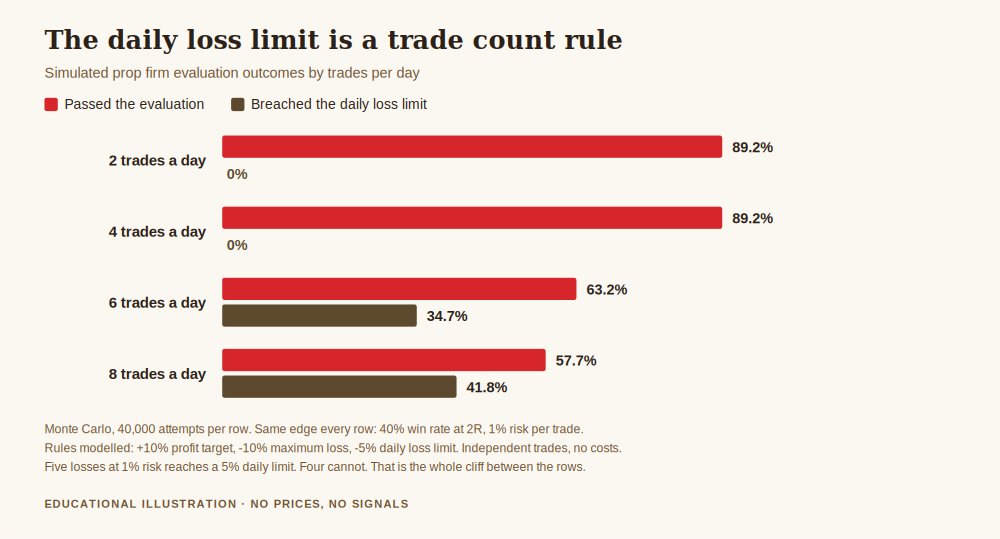
At two trades a day the pass rate was 89.2 percent, with zero daily limit breaches. At four trades a day, 89.2 percent, again zero. At six trades a day it collapses to 63.2 percent with 34.7 percent breaching the daily limit. At eight, 57.7 percent and 41.8 percent breaching.
The cliff sits exactly where the arithmetic says it should, between four trades and five. Not because the fifth trade is a bad trade, but because the fifth trade is the one that lets a normal cluster of losses reach a hard rule.
The other lever is the same lever from the other end. Halve the risk to 0.5 percent per trade and six trades a day becomes safe again, 94.3 percent pass rate and no daily breaches, because six losses at 0.5 percent is 3 percent and the rule cannot reach that either. What matters is the product of the two numbers, and it needs to stay clear of the limit with room for a bad day.
Get the free REX one page business plan, the sheet where your risk per trade, your daily trade ceiling and the cost of an attempt live on the same page, so the rules of a programme meet a number instead of a mood. One email, no spam, unsubscribe anytime.
Get the free business plan →What Passing Does Not Prove
Here is the number that keeps the rest of this honest. I reran the model with the edge removed, a win rate of exactly one in three at the same two to one payoff, which is an expectancy of precisely zero.
At two trades a day, a trader with no edge whatsoever passed 50.5 percent of the time.
That is not a criticism of evaluations. It is a property of any test with a target and a floor at similar distances: a random walk gets to the target first about half the time. But it means passing is weak evidence about your trading and strong evidence about your risk management, and the two get confused constantly. The trader who passes on the second attempt and concludes their strategy is validated has learned considerably less than they think, and the funded account is where that misunderstanding gets expensive.
It is worth putting alongside the base rates in the wider industry. The European regulator's review of retail contracts for difference found that 74 to 89 percent of retail accounts lose money. If passing an evaluation reliably identified skill, that distribution would look different.
Treat the Fee Like Startup Capital, Because That Is What It Is
Every other small business in the world understands this part, and traders keep having to relearn it. You are buying access to working capital, and the purchase has a failure rate.
For a sense of scale outside our industry, the United States Bureau of Labor Statistics tracks how long new establishments survive. Of those born in March 2015, 79.6 percent were still active after one year, and 50.2 percent after five. Half of all new businesses, across every sector, gone within five years. A funded trading account is not exempt from that arithmetic, and the operators who last are rarely the ones with the best product. They are the ones who did not spend the reserve on the first attempt.
So before you buy an evaluation, write down four numbers. The fee. The number of attempts you can fund without touching money you need. Your risk per trade. Your maximum trades per day, chosen so that the product of the last two sits clear of the daily limit with a margin. If those four numbers do not fit together, the answer is not a better strategy, it is a smaller position or a cheaper programme, and finding that out on paper costs nothing.
Frequently Asked Questions
What is a realistic pass rate for a prop firm evaluation?
I cannot tell you what any firm's real rate is, because those figures are not published in a form I can verify, and I am not going to quote a number I cannot source. What the model says is that the rules themselves move the rate enormously: the same trader with the same edge passed 89 percent of the time at four trades a day and 63 percent at six. Before assuming the rate is about skill, check what your own trade count does to it.
How many attempts should I budget for?
Expected attempts is one divided by your pass rate, so a 20 percent chance implies five attempts and five fees on average. Budget for the expectation, not the best case, and treat any fee you cannot afford to lose twice as a signal to size down rather than to try harder.
Why is the daily loss limit harder than the maximum loss?
Because it resets, and because it sits close to a normal cluster of losses. In the simulation, 35.0 percent of attempts breached the daily limit and only 2.0 percent breached the overall loss cap. Five losses at 1 percent reaches a 5 percent daily rule on an ordinary bad afternoon, while reaching a 10 percent overall cap takes a genuinely sustained losing run.
Does a smaller position size really help that much?
In this model, yes, and for a mechanical reason. At 0.5 percent risk the pass rate was 94.3 percent whether the trader took two trades a day or six, because six losses at that size cannot reach the daily rule. Halving your risk does slow the profit target down, which the model accounts for, and it still came out ahead.
Is getting funded proof that my strategy works?
No. With a zero expectancy strategy and two trades a day, the model passed 50.5 percent of the time. Passing tells you that you stayed inside the rules for one attempt. Whether you have an edge is a separate question that needs a much larger sample, and it is the question worth answering first.
What should I check in the rules before paying?
The daily loss limit and how it is measured, whether from the day's opening balance or from the highest equity reached, since the second is meaningfully stricter. Whether the maximum loss is fixed or trails your profits. And the payout terms, because the value of the whole exercise sits there rather than in the target.
Where This Leaves You
How to get funded by a prop firm comes down to a capacity decision you make before you place a single trade. Pick your risk per trade, pick a daily trade ceiling, and multiply them. If the product can reach the daily loss limit, the programme has an option on your attempt that you handed over for free, and the model says that option gets exercised about a third of the time.
The rest is the ordinary work of running the business properly, and none of it is specific to evaluations. The framework this sits in is the one page trading business plan template. If you want to understand the counterparty first, how prop firms make money covers where their revenue actually comes from, and the key metrics every trading business should track is where the numbers above should end up once they are yours rather than mine.
About the author. Rex writes REX Trading Signal, where a trading account is treated as a small business with costs, capacity limits and a set of books. He is more interested in the constraint that ends the quarter than in the trade that started it.
Disclaimer: This article is general educational content about the arithmetic of evaluation programme rules. It is not financial advice, not a recommendation of any proprietary trading firm, programme or account, and not a suggestion to open any particular position. I have no commercial relationship with any prop firm and none is named here. Trading gold, CFDs and leveraged products carries a high risk of losing money rapidly. No entry, stop or target discussed should be treated as a signal. The pass rates, breach rates and expected costs above are outputs of a Monte Carlo simulation I wrote, run over 200,000 attempts, under stated assumptions: a 10 percent profit target, a 10 percent maximum loss, a 5 percent daily loss limit, 1 percent risk per trade unless stated otherwise, a 40 percent win rate at a two to one payoff unless stated otherwise, independent trades and no trading costs. They describe a model, not any real firm, any real account or any real trader, and real evaluation rules and real results differ. The business survival figures are from the United States Bureau of Labor Statistics and the retail loss figures from ESMA, both linked above. No gold price is quoted anywhere in this article and no trading results are represented.