
Somebody is going to charge you money every month for an opinion about where gold is going. The question are trading signals worth it gets argued about endlessly and almost always in the wrong currency, which is feelings. A business does not decide this with feelings. It prices the thing, works out what it has to earn, and then checks whether it earned it.
So this article does that. The arithmetic is mine and the assumptions are written out so you can disagree with them. The one external figure comes from the FBI rather than from a forum. I should say plainly that REX runs a signal channel, so I am pricing my own product category here, and the test below applies to us exactly as it applies to anybody else.
Are Trading Signals Worth It: the Only Version of the Question That Can Be Answered
"Worth it" on its own is unanswerable. Worth it compared with what, measured over how long, against which alternative. Businesses answer this kind of question by turning the subscription into what it actually is, a recurring expense, and asking what it must produce to justify its line on the sheet.
That reframing does something useful immediately. It stops you asking whether the signals are good, which you cannot measure from inside a month of enthusiasm, and starts you asking how much better than nothing they must be, which you can compute before you ever subscribe.
The Hurdle, Computed
Here are the assumptions. The subscription is billed monthly and held for twelve months. Risk per trade is a fixed percentage of the account, which makes one R equal to that percentage. Break-even here means the service covers its own fee and nothing else, so it is a hurdle rather than a forecast and it promises nobody anything.
On a 5,000 account risking 1 per cent a trade, one R is 50. A subscription at 99 a month costs 1,188 a year, which is 23.8 per cent of that account, which is 23.8R. Close to 2R every month, for twelve months, before you keep a single cent.
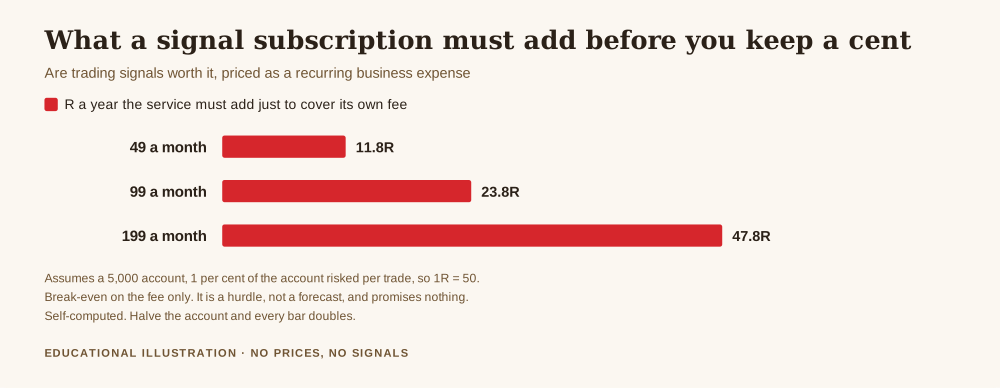
Three things fall out of that chart, and none of them is an opinion.
The first is that the hurdle scales with the fee and inversely with the account. The same 99 a month on a 2,000 account is 59.4 per cent of the account, which is 59.4R a year, which is roughly 5R a month. On a 10,000 account it is 11.9R. The subscription that is a rounding error for one trader is the entire year for another, and the price tag is identical.
The second is that the hurdle is incremental, not absolute. The service does not need to produce 23.8R. It needs to produce 23.8R more than you would have produced without it. If you were already roughly break-even on your own, those are the same number. If you were losing, the service has to fix that first and then clear the hurdle on top.
The third is the uncomfortable one. Most people cannot tell you what they made last year in R, which means they cannot compute the left side of this comparison at all. They are not in a position to answer the question they are asking.
What the Inbox Actually Sounds Like
I keep the messages. Roughly 79 of them in my inbox mention signal groups directly, and I should be clear that this is a keyword count across a message archive rather than a survey of anything. It is not representative and it does not prove a general claim. It is useful for one thing only, which is hearing how the decision actually gets made.
One reader wrote: "I have paid a lot to enter different signal groups but I have wasted over 3000 in the course of 5 months trying to get things right." That is the clearest statement of the problem in the whole archive. The fee was never the expensive part. The five months were.
Another wrote: "Do you have a free signal channel where I can join and raise some money for the subscription?" Read that twice. The plan is to use signals to fund the signals. The business has no capital, so the expense has to pay for itself immediately, which is precisely the condition under which the hurdle above is unclearable.
A third: "I have been copying some of my trades from your public channel for a while now, but my portfolio isn't doing well at all." Copying some. Which brings us to the part of this that nobody prices.
A fourth, shorter: "Your signal is good, but sometimes I don't trade the signal."
A fifth: "Can I grow the 140 capital with these signals?"
The Three Costs That Never Appear on the Invoice
The fee is the cost you can see, and it is usually the smallest of the three.
The second cost is selection. If you take some of the calls and skip others, you are no longer running the service's results, you are running your own filter applied to the service's calls. Those are different businesses with different outcomes, and the one you are actually operating has never been measured by anybody. The two readers above who said they trade the signals selectively have no way to know what they bought, and neither do I.
The third cost is the one that compounds. Every month spent executing somebody else's decisions is a month not spent building the ability to make your own. That is a reasonable trade if you have decided to be a permanent subscriber and have priced it as a permanent line item. It is an expensive trade if you were telling yourself this was temporary, which is what most people tell themselves.
What the Fraud Numbers Add
There is a floor under this question that has nothing to do with value for money, and the FBI's Internet Crime Complaint Center puts numbers on it. Its 2025 annual report records 1,008,597 complaints and 20.877 billion dollars in reported losses, a 26 per cent increase in losses on the previous year, with an average loss of 20,699 dollars.
Investment fraud was the largest single component of those losses. Overall losses to investment scams exceeded 8 billion dollars, and cryptocurrency investment fraud alone accounted for 7.2 billion, the highest single source of losses reported that year.
The detail that matters for this article is how the report describes the approach. Victims, it says, are introduced to investment groups representing themselves to be knowledgeable industry insiders offering guidance on trading or investing in cryptocurrency or gold. That is a description of a paid signal group. Not every paid group is that, obviously, but the shape of the pitch is identical, and the sum involved is not small.
So the hurdle arithmetic assumes the counterparty is honest and merely expensive. Before you run it, establish that you are in that case at all. A group that will not show losing calls, that pressures on a deadline, that routes deposits to a platform it recommends, or that cannot be found in any regulator's register, is not a pricing problem. It is a different problem and the answer to it is no.
How a Business Actually Decides This
The procedure is unglamorous and it takes a quarter.
Before you subscribe, write down what you did last quarter in R. Not in currency, in R, because R is the only unit that survives a change in account size. If you cannot produce that number, you have found the first thing to fix, and it costs nothing.
Then take the service's free or trial output and log every call on paper for a month, taking all of them, not the ones you liked. Record what the result would have been including costs. At the end you have a number in R for the service and a number in R for yourself, measured the same way.
Then compare the difference with the hurdle from the chart. If the gap does not clear the fee by a comfortable margin, the answer is no, and it is no without any argument about whether the analysis was good.
Keep doing it quarterly after you subscribe, because the answer is not permanent. Services change, markets change, and the expense renews whether or not it is still earning.
Get the free REX one page trading business plan, the document where recurring costs like this one get written down and reviewed on a schedule instead of renewing quietly. One email, no spam, unsubscribe anytime.
Get the free business plan →What This Article Does Not Say
It does not say signal services are worthless. It says they are an expense with a computable hurdle, and that most buyers have never computed it.
It does not say the hurdle is unclearable. On a larger account with a modest fee it is genuinely small. The arithmetic simply shows who it is small for, and it is not the person with 140 in the account.
It does not promise that any service, mine included, will clear its hurdle. Nothing in this article is a forecast, nothing here is a recommendation to subscribe to anything, and the numbers are arithmetic about costs rather than any claim about results.
Frequently Asked Questions
Are trading signals worth it for a beginner?
That is the hardest case, because the hurdle is set by the fee as a share of the account and beginners usually have the smallest accounts. At 99 a month on a 2,000 account the service has to add about 59.4R a year to break even. The same service on a 10,000 account needs 11.9R.
How do I measure whether a service is actually helping?
Log every call for a month without filtering, record results including costs, and express both your own result and the service's in R. Then compare the difference with the annual fee expressed in R. Anything less rigorous will measure your mood rather than the service.
Is it a problem if I only take some of the signals?
For measurement, yes. Selective following means the results belong to your filter rather than to the service, so neither published results nor your own expectations describe what you are running.
What makes a signal group an outright scam rather than a bad deal?
Pressure on a deadline, no losing calls ever shown, deposits directed to a platform the group recommends, and no traceable regulatory registration. The FBI's 2025 report describes groups presenting themselves as industry insiders offering guidance on trading gold or cryptocurrency, within a category that lost victims more than 8 billion dollars.
Where did these numbers come from?
The hurdle figures are computed here from the assumptions stated above, and you can reproduce them with one division. The fraud figures are from the FBI Internet Crime Complaint Center 2025 annual report, linked below.
Where REX Trading Signal Fits
REX Trading Signal is a free journal about running a trading account the way you would run any other business, with cost lines, limits and a plan written down before the market tests them. There is a free community and an optional paid tier, and the honest position is that the test in this article applies to that paid tier too. Run it on us. If the gap does not clear the fee, do not pay it. Nothing here is sold on a promise of returns.
The document where a recurring cost like this gets reviewed instead of renewing quietly is the one page trading business plan. If you want the measurement side first, how to keep a trading journal like a professional is where the R figures come from, and how much should I spend on my trading setup applies the same expense test to everything else you pay for. The fraud figures quoted above are from the FBI Internet Crime Complaint Center annual reports.
About the author. Rex writes REX Trading Signal. He runs a signal channel and is therefore the last person who should be trusted on whether you need one, which is why this article hands you the arithmetic instead of the conclusion. Nothing in this article is a recommendation to trade, and no entry, stop or target discussed should be treated as a signal.
Disclaimer: This article is general educational content about pricing recurring business expenses and evaluating third party trading services. It is not financial advice, not investment advice and not a recommendation to buy, sell, subscribe to or avoid any product or firm. Fees, services and fraud statistics change over time and the figures quoted refer to the dates stated. Trading carries risk of loss and most retail accounts lose money. Only trade with capital you can afford to lose.