
Every business that lasts has a number it refuses to go past. Not a target, a limit. For a trading account that number is the trading 1 percent rule, and it belongs in the same category as the restaurant capping food waste or the workshop capping what it spends on tooling in a quarter. Nobody finds these numbers inspiring. They are what stops one bad month from becoming the last month.
The rule is almost always explained badly. It gets presented as caution, or as advice for beginners, or as something you graduate out of once you are good. It is none of those. It is a spending limit, and this article works out exactly what it buys you.
All the arithmetic below is reproducible from the assumptions stated next to it. There is no gold price anywhere in it.
What the Trading 1 Percent Rule Actually Says
The rule is one sentence: no single trade may cost more than 1.00 percent of the account.
Notice what it does not say. It says nothing about how many trades to take, what to trade, where to enter, or how often to be right. It is not a strategy and it does not claim to make money. It constrains one variable only, the size of the worst outcome of any one decision.
That is precisely what a spending limit does in any other business. A limit does not tell you what to buy. It tells you the largest cheque you may write without a different conversation happening first.
And like any spending limit, the reason it exists is not the single transaction. One trade at 5 percent will not end you. The rule exists because of what happens when several go wrong in a row, which is the part almost nobody sits down and calculates.
The Arithmetic of a Run of Losses
Capital remaining after n consecutive losing trades, each costing share r of the account at the time, is (1 - r) raised to the power of n. Compounding works in both directions, and here it works against you.
Ten losses in a row, at four different spending limits:
- Risking 1 percent: 90.44 percent of the account left
- Risking 2 percent: 81.71 percent left
- Risking 5 percent: 59.87 percent left
- Risking 10 percent: 34.87 percent left
Look at the shape of that. Moving the limit from 1 to 2 percent does not double the damage, it roughly doubles it. But moving from 1 to 10 percent, a factor of ten in the setting, turns a 9.6 percent dent into losing nearly two thirds of the business. The relationship is not linear, and intuition consistently underestimates it.
The Half Nobody Calculates: Getting Back
The loss column is only half the story, and it is the less painful half. A drawdown has to be recovered, and recovery is not symmetric with the fall. To get back to where you started after losing share d of the account, you need a gain of 1/(1 - d) - 1, measured on the smaller balance that is left.
- Down 5 percent, you need to make 5.3 percent
- Down 10 percent, you need 11.1 percent
- Down 20 percent, you need 25.0 percent
- Down 30 percent, you need 42.9 percent
- Down 50 percent, you need 100.0 percent
- Down 70 percent, you need 233.3 percent
That bottom row is the one to sit with. A business that has lost 70 percent of its capital has to more than triple what remains simply to arrive back at the starting line, with no progress to show for any of it.
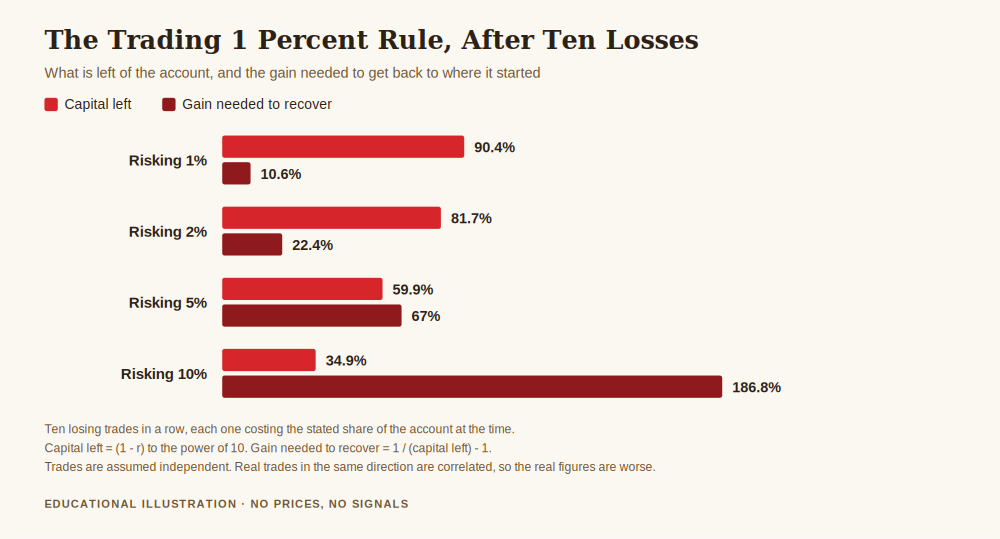
Put the two columns together and the case closes itself. After the same ten losing trades:
- At 1 percent per trade: 90.4 percent left, needing a 10.6 percent gain to recover
- At 2 percent per trade: 81.7 percent left, needing 22.4 percent
- At 5 percent per trade: 59.9 percent left, needing 67.0 percent
- At 10 percent per trade: 34.9 percent left, needing 186.8 percent
The trader who risked five times as much per trade does not have five times as much work to do to get back. They have 6.3 times as much. That multiplier is the entire argument for the rule, and it is arithmetic rather than opinion.
How Often Does a Run of Ten Actually Happen?
The obvious objection is that ten losses in a row is a freak event worth planning around about as much as a meteor. It is worth checking rather than assuming.
Assume a 45 percent win rate, which is unremarkable for a method that uses targets wider than its stops, and assume trades are independent. The probability of hitting at least one run of ten consecutive losses can be computed exactly with a small Markov chain rather than estimated:
- Over 100 trades: 10.1 percent
- Over 200 trades: 19.9 percent
- Over 500 trades: 43.3 percent
At 200 trades a year, that is roughly a one in five chance in any given year. Not a meteor, and not something to plan around as though it were rare. Over a career of several hundred trades a year it stops being a question of whether and becomes a question of when.
One caution on my own numbers: the independence assumption is generous. Real trades taken in the same direction on the same instrument in the same week are correlated, and correlated trades cluster their losses. The true probability of a bad run is worse than the table above, not better. I would rather state that plainly than quote a figure that flatters the argument I am making.
Regulators Set Limits Like This Too
It is worth noticing that this is not a retail trading superstition. Institutions that lend against positions impose the same kind of floor, in writing.
FINRA Rule 4210 sets out maintenance margin for US brokerage accounts, requiring 25 percent of the current market value of all margin securities
held long in the account. Under the European regime, the ESMA product intervention measures include a margin close out rule on a per account basis
, standardised at 50 percent of minimum required margin.
The point is not that these numbers are your risk limit, because they are not. The point is the principle: every party in this chain that has money at stake operates a hard threshold that triggers action regardless of anybody's conviction about the position. Your broker has one. Your regulator requires one. The only participant who might not have one is you, and you are the one with the most to lose.
Choosing Your Own Number
One percent is a sensible default, not a sacred figure. It is a business decision, and three inputs actually bear on it.
How long your record is. A method tested over 40 trades tells you very little. Until the record is long enough to distinguish an edge from luck, the correct response is a smaller limit, because you are paying for information rather than harvesting an edge.
How correlated your positions are. If you routinely hold three positions that are really one bet on the same move, your effective risk per decision is three times your per trade number. Size against the bet, not against the ticket.
What drawdown would change your behaviour. This is the one people skip, and it is the most important. There is a depth at which you stop following your own process, start trading to get it back, and become a different and much worse operator. Find that depth honestly, then set a limit that keeps an ordinary bad run comfortably above it.
If that reasoning lands you at 0.5 percent, that is a well run business. If it lands you at 2 percent with a long record and uncorrelated positions, that is defensible too. What is not defensible is having no number, which in practice means the number is whatever you felt like at the time, on the day you felt worst.
Get the free REX one page trading business plan, the sheet where your risk limit, your review schedule and your stop trading rule live on a single page instead of in your head. One email, no spam, unsubscribe anytime.
Get the free business plan →Frequently Asked Questions
What is the trading 1 percent rule, in one sentence?
It is a spending limit stating that no single trade may cost more than 1.00 percent of the account, which caps the damage any one decision can do without making any claim about profit.
Is 1 percent of the account or 1 percent of the position?
Of the account, and the distinction matters enormously. One percent of the account is the money you lose if the stop is hit. Position size is then worked backwards from that figure and the stop distance, which is the opposite order to how most people do it.
Does the rule slow growth down?
It caps the speed of gains as well as losses, yes. What the tables above show is that the trade is heavily asymmetric in the rule's favour, because recovery costs grow much faster than the risk setting does. A limit that costs you some upside and removes the outcomes that end the business is a good trade for a business that intends to continue.
Should I raise the limit after a winning streak?
A winning streak is weak evidence about your edge and strong evidence about recent conditions. If the limit moves, it should move because the record got longer, not because the last few weeks were pleasant. Raising a limit on the strength of a hot run is the mechanism that turns a good quarter into a bad year.
Does the rule work if my win rate is low?
The rule does not depend on your win rate at all, which is the point. It bounds the worst case of each decision. Whether the business is profitable depends on your edge, and the rule is what keeps you solvent long enough to find out whether you have one.
Where did the numbers in this article come from?
The 25 percent maintenance margin figure is quoted from FINRA Rule 4210 and the 50 percent margin close out level from the ESMA measures, both linked above and both checked live before publication. Every other figure is computed from the assumptions stated beside it, a 45 percent win rate and independent trades for the streak probabilities, and the compounding formulas given in the text.
Where REX Fits
REX Trading Signal is free to follow. Daily XAUUSD setups with a stop loss, a reason and a rule, posted live on Telegram, wins and losses alike. There is a free one page business plan for anyone who wants their limits written down, and an optional Kit for people who want the full operating system. Nothing here promises a profit and nothing here is a signal to copy blindly.
A limit is only real once it is written down and reviewed. The one page trading business plan template is the pillar this article belongs under, how to manage risk in gold trading sets the monthly ceiling this per trade limit sits inside, and position sizing for gold trading turns the percentage into an actual order size. More about who writes this is on the about page.
About the author. Rex writes REX Trading Signal and treats an account as a business with books, limits and a review schedule rather than a series of opinions. He has more time for a boring rule that survives a bad month than for a clever one that does not. Nothing in this article is a recommendation to trade, and no entry, stop or target discussed should be treated as a signal.
Disclaimer: This article is general educational content about risk limits and position sizing in leveraged trading. It is not financial advice, not investment advice, not tax or legal advice, and not a recommendation to buy, sell or use any product, venue or firm. Regulatory wording is quoted from the sources linked in the text and may change. Trading leveraged products carries a substantial risk of loss and most retail accounts lose money. All figures are illustrative calculations from stated assumptions, not predictions or performance claims.