
Somebody messaged me last week after a bad Friday, and the way they put it was honest enough to sting. One reader wrote: "Before, after a losing trade, I would often try to make it back immediately. I was taking too many trades, using bigger lot sizes, and sometimes entering without a proper setup." Every part of that happened after the decision to trade had already been made. So the question I want to answer here is the one that comes earlier: when should you absolutely avoid trading, and how do you settle that in writing before the morning arrives and your judgement is no longer neutral.
This is not the same question as when to stop for the day, which I have written about separately. Stopping is a response to something that has already gone wrong. What follows is a policy you set in advance, on a quiet afternoon, about days you will not open the desk at all. A business decides its opening hours before the week starts. A trading account should too.
Why a written stand-down policy beats a judgement call
The argument is simple. The moments when you most need to decide not to trade are exactly the moments when you are least equipped to decide anything. After three losses, into a news print, on four hours of sleep, your assessment of whether conditions are suitable is the least reliable instrument you own. A rule written a week earlier, by a calmer version of you, is better evidence than a feeling you are having right now.
Roughly 16 messages in my inbox mention overtrading directly, which is a keyword count rather than a survey, and the pattern inside them is consistent. One reader put it like this: "I used to overtrade. I opened too many positions, and most of them lacked logic and were driven by FOMO. That's why my account never grew." Another, more briefly: "I usually overtrade, but I think I have to make this change." Nobody in that inbox is asking how to find more trades. The constraint they are missing is a rule that tells them when not to look.
When should you absolutely avoid trading, as a diarised list
I split my own policy into four categories. Two are scheduled and can go in a calendar a year ahead. Two are conditional and have to be checked on the morning. The scheduled half is where most of the value sits, because it needs no self assessment at all.
One: scheduled macro events you already know the dates of
This is the part people treat as unpredictable and is in fact published a year or more in advance. The Federal Reserve states on its own site that the FOMC holds eight regularly scheduled meetings per year, and the exact dates sit on its published calendar years ahead. The Bureau of Labor Statistics does the same for its two most market sensitive releases. Its schedule pages list twelve Consumer Price Index releases and twelve Employment Situation releases for the 2027 calendar year, each at 08:30 United States Eastern time.
Add them up and the number is smaller than the anxiety around it suggests. Eight plus twelve plus twelve is 32 events. I checked the published 2027 dates and the three sets do not land on the same day as each other even once, so that is 32 distinct days. Against a trading year of about 252 days, which is 261 weekdays in 2027 less nine assumed market holidays, those 32 days are 12.7 per cent of the calendar. A desk that stands down on every one of them still has at most 220 trading days left, or 87.3 per cent of the year.
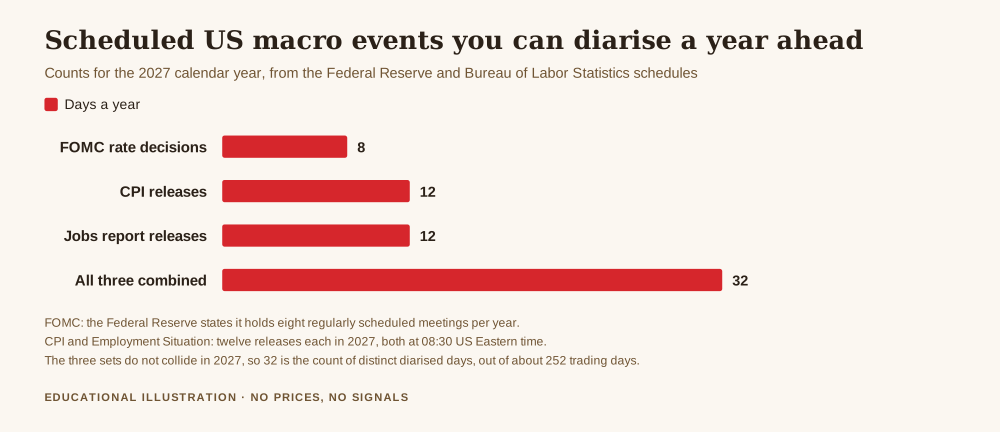
That arithmetic is the entire argument for taking the scheduled half seriously. Sitting out every FOMC decision, every inflation print and every jobs report costs you less than an eighth of your available days, and it removes the specific conditions under which spreads widen, fills get unreliable and a stop becomes a suggestion rather than a protection. If your edge depends on those 32 days, it is worth asking whether it is an edge or a lottery ticket. If it does not, standing down is nearly free.
I am not telling you that trading those days is wrong. Plenty of people run event strategies deliberately and well. I am telling you to decide which you are, in writing, before the day arrives, rather than discovering your policy at 08:29.
Two: structural conditions in the calendar
The second scheduled category is thin liquidity. Market holidays, the days either side of them, and the end of year stretch all share a property: the same order moves price further than it would in a normal session, because there is less depth to absorb it. This is not a forecast, it is a mechanical feature of a thinner book, and it is knowable in advance from any exchange holiday calendar. I have written about the December version of this in detail, and the same logic applies to any long weekend.
Three: your own infrastructure
Now we move to conditions you check on the morning rather than diarise. Do not open a position when any part of your own operation is degraded. A connection you do not trust, a platform that has been throwing errors, a VPS you have not verified since an update, a charting feed that disagrees with your broker. A business does not take orders it cannot fulfil. An account with an unreliable route to the exchange cannot honour its own stop, and a stop you cannot honour is not a risk control, it is a hope.
This one is easy to wave away because the failure is rare. The point is that the cost when it happens is unbounded, while the cost of standing down for a morning is one morning. That asymmetry decides it.
Four: the operator
The last category is you, and it is the one that needs the firmest wording because it is the one you will argue with. My own list is short and deliberately unflattering: materially short of sleep, actively angry about the previous session, under financial pressure that makes a specific outcome necessary, or carrying a decision you have already made and are now looking for a chart to justify. That final one is the most dangerous, because it does not feel like an emotional state. It feels like conviction.
The useful version of this rule is not a resolution to be disciplined. It is a question with a yes or no answer, asked before the platform opens, written down where you cannot negotiate with it later. One reader described the version that works: "No need for too many trades in a day. This is enough." That sentence is a policy, not a mood.
Putting it on paper so it survives a bad morning
A policy nobody can audit is not a policy. Mine lives in three lines at the top of the same document as my risk ceiling, and it is deliberately boring.
Line one lists the diarised stand-down dates for the year, pulled once from the Federal Reserve and BLS calendars in January and never revisited. Line two lists the infrastructure checks that must pass, as a checklist with boxes, because a checklist is harder to lie to than a memory. Line three is the operator question, phrased so that an honest yes closes the platform.
The review matters as much as the writing. Once a week I look at whether I traded on a day the policy said not to, and that count is the only number I care about from this part of the business. Not whether those trades won. Whether they happened. A rule you break profitably is still broken, and it will be there waiting on the day the same breach goes the other way. I have written about the mechanics of that review in the weekly review, and the rule set it belongs in is the trading rules checklist.
What this is not
Two clarifications, because this topic attracts bad advice from both directions.
It is not a market timing claim. Nothing above says prices do anything in particular on a CPI morning, and I am not forecasting direction, volatility or anything else. The argument is about execution conditions and about the reliability of your own judgement, both of which you can assess without a view on price.
It is also not the same as quitting, or taking a break after a loss. If the question you are actually asking is whether to step away after a run of bad results, that is a different decision with different inputs, and when to stop trading covers it properly. A stand-down policy is a schedule. Stopping is a response. Keep them apart, because mixing them turns a calm administrative rule into an emotional one.
Get the free REX business plan template, one page covering your risk ceiling, your stand-down days and the review schedule that keeps a record honest. One email, no spam, unsubscribe anytime.
Get the free business plan →Frequently asked questions
When should you absolutely avoid trading, in one sentence?
On days your written policy named in advance, which for most people means scheduled high impact releases and thin liquidity sessions, plus any morning when your platform or your own state fails a check you wrote while calm.
How many days a year does a stand-down policy actually cost?
If you sit out every FOMC decision, CPI release and jobs report, that is 32 distinct days in 2027 out of roughly 252 trading days, or 12.7 per cent. You keep at most 220 days. The scheduled half of the policy is cheaper than people assume.
Is avoiding news days just an excuse not to trade?
It can be, which is why the policy is written in advance and reviewed weekly. The test is whether you are following a rule you set when you had nothing at stake, or inventing one now. The weekly count of breaches tells you which.
Where do I find the dates?
The Federal Reserve publishes FOMC meeting dates years ahead on its calendar page, and the Bureau of Labor Statistics publishes CPI and Employment Situation release dates on its schedule pages. Both are linked above, both are free, and pulling them takes about ten minutes once a year.
What if my strategy is built around news events?
Then your policy says so, and your stand-down list is about infrastructure and operator state instead. The point is not that event days are bad. The point is that the decision should be made once, in writing, rather than every morning under pressure.
Does this replace a risk ceiling?
No. A stand-down policy decides whether you trade at all on a given day. A risk ceiling decides how much is exposed once you do. You need both, and they belong in the same one page document.
Where REX Trading Signal fits
REX Trading Signal is a free channel about running a trading account the way you would run a small business, with a risk ceiling, a cost line and a review you actually do. There is nothing sold on a promise of returns here. The free business plan template is one page, and its job is to make you write down the limits before the market asks you about them. The piece everything else hangs off is the one page trading business plan template.
About the author. Rex writes REX Trading Signal. He once traded through a jobs report on four hours of sleep because he had decided the setup was too good to miss, got a fill nowhere near his level, and spent the rest of the month explaining it to himself. The stand-down list went into writing the following weekend and has not been a judgement call since.
Sources and method. The statement that the FOMC holds eight regularly scheduled meetings per year is quoted from the Federal Reserve's own FOMC page, and the meeting dates are from its published calendar. The counts of twelve CPI releases and twelve Employment Situation releases for the 2027 calendar year, and the 08:30 United States Eastern release time, are from the Bureau of Labor Statistics schedule pages for each release. The BLS pages return 403 to a command line request because the site blocks automated clients, so both were opened and read in a browser to confirm they are live and to take the dates. All four sources are linked above. The 32 distinct diarised days, the check that the three sets do not collide in 2027, the 261 weekdays, the 252 trading days on an assumption of nine weekday market holidays, and the resulting 12.7 and 87.3 per cent, are my own arithmetic on those published dates, written out here so you can repeat or dispute it.
This article is educational and is not financial advice. Trading gold and other leveraged products carries a high risk of losing money rapidly, and no entry, stop or target discussed should be treated as a signal. Nothing here forecasts price, direction or volatility on any date, and nothing here claims that avoiding any particular day improves returns. Reader quotations are real messages, anonymised and lightly edited, and the inbox count is a keyword count rather than a survey. Decide your own risk, and never trade money you cannot afford to lose.