
Every business depends on something it does not control staying open. A restaurant depends on its suppliers, a haulier on the road being there, and a trading business on the market accepting orders. Most owners never think about that last one until the day it is not true. So this is the operations question worth answering while nothing is happening: when do they halt trading on a stock, what does the halt actually do to a position you are holding, and which part of the damage is decided by you rather than by the exchange?
I am going to use the published circuit breaker rules, which are exact and free to read, then do my own arithmetic on what an inability to exit costs. The conclusion is not the one most people expect, and it has nothing to do with picking better entries. No gold price appears in this article, and nothing here is a signal.
When Do They Halt Trading on a Stock: The Three Situations
A halt is not one thing. There are three separate mechanisms and they behave differently, which matters because your exposure to each is different.
The first is a halt on one security for news. A company is about to release something material, and the exchange pauses trading so that the information reaches everybody at once rather than reaching the fastest reader first. These are announced, they are specific to that security, and they are the most common kind you will see.
The second is a volatility pause on one security. When a security's price moves outside a permitted band within a short window, trading pauses briefly to let orders reassemble. The width of that band and the length of that pause vary by the security's tier, its price, and the time of day, and they are set out in the venue's own rulebook rather than being a single universal number. I am not going to quote a figure here, because the correct figure is the one in the rulebook of the venue you actually trade on, and it is worth twenty minutes of your time to go and read it.
The third is the one that stops everything at once, and it is the one with published, exact, universal numbers. That is the market wide circuit breaker.
The Market Wide Circuit Breaker, in Exact Numbers
The US equity, options and futures exchanges operate a coordinated cross market halt procedure for severe declines. The rules are public, and the current version has been in force since Monday 8 April 2013. Before that revision the thresholds were declines of 10, 20 and 30 percent measured against the Dow Jones Industrial Average. They were deliberately lowered and re-anchored.
As Nasdaq sets them out, the current arrangement is this. The reference is the S&P 500 index measured against the prior day's closing price, and the trigger thresholds are recalculated daily rather than quarterly. There are three levels:
| Level | Decline | Before 3:25 pm | At or after 3:25 pm |
|---|---|---|---|
| Level 1 | 7 percent | Halt 15 minutes | Trading continues, unless Level 3 |
| Level 2 | 13 percent | Halt 15 minutes | Trading continues, unless Level 3 |
| Level 3 | 20 percent | Halt remainder of day | Halt remainder of day |
Three details in that table are worth pulling out, because they change how you should think about the risk.
The 3:25 pm rule is the first. Late in the session, a Level 1 or Level 2 breach does not halt anything. Trading continues into the close. The mechanism that would have paused the market at eleven in the morning declines to pause it at half past three, on the reasoning that a halt near the close does more harm than good. If you were relying on a halt to give you a breather, it is least available exactly when the day is running away.
The second is that Level 3 has no time qualifier at all. Twenty percent, at any time, and the day is over. Not paused. Over. Whatever position you are holding, you are holding it overnight, and in practice until the market reopens.
The third is that these thresholds apply to a broad index, so a Level 1 halt is not a statement about any single company. It is the whole venue stopping. Every position, including the ones you were relying on to offset each other, stops at once.
Fifteen Minutes Sounds Short Until You Price It
A regular US equity session runs six and a half hours, which is 390 minutes. A 15 minute halt is therefore 3.8 percent of one session. Written that way it sounds trivial, and as a fraction of your year it genuinely is.
That framing is also the mistake. The cost of an outage is not proportional to its length. It is proportional to what happens to the price across it. And the defining feature of a halt is that it occurs precisely when the price is moving fastest.
So let us price it properly, with an arithmetic example. The assumptions are mine and I am stating all of them: an account of 10,000, a risk ceiling of 1 percent per trade, which is 100, and a stop placed 0.5 percent away from entry. Those two figures together imply the position size, because a 0.5 percent move must equal 100. The position is therefore 20,000, which is twice the account.
Now suppose you cannot exit, and when you can, the price is somewhere else.
| Gap across the halt | Loss | Times the planned risk | Share of the account |
|---|---|---|---|
| 0.5 percent, the stop | 100 | 1x | 1 percent |
| 3 percent | 600 | 6x | 6 percent |
| 7 percent, Level 1 | 1,400 | 14x | 14 percent |
| 13 percent, Level 2 | 2,600 | 26x | 26 percent |
| 20 percent, Level 3 | 4,000 | 40x | 40 percent |
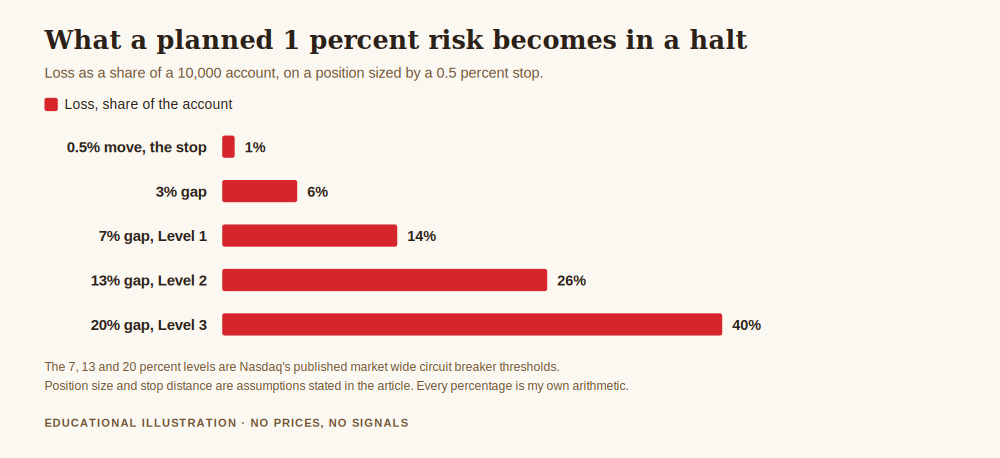
A business that had decided its maximum acceptable loss on one position was 100 discovers that the actual loss was 4,000. Nothing about the decision was wrong. The stop was placed, the risk was calculated, the rule was followed. The mechanism that was supposed to enforce the decision simply was not available at the moment it was needed.
The Stop Is Not a Control During a Halt
This is the part I want to state plainly, because it is the operational lesson and it is widely misunderstood.
A stop loss is an instruction to the market. It works by finding a counterparty at or near your level. It is an excellent control while the market is running, and it is not a control at all when the market is not. During a halt there is nobody to transact with, and when trading resumes your order executes at whatever price exists then, not at the price you nominated. The stop did not fail. It was never the kind of thing that could work in that state.
There is exactly one variable in the table above that you set in advance and that keeps working when everything else stops, and it is position size. Turn the arithmetic around and the point becomes concrete. If you want a 20 percent gap to cost you the same 1 percent of account you had budgeted, the position can be no larger than 500, which is 5 percent of the account. That is forty times smaller than the 20,000 position the 0.5 percent stop implied.
I am not telling you to trade at one fortieth of your current size, and that is not the conclusion. The conclusion is that the size implied by a tight stop and the size that survives an outage are two completely different numbers, and most people have only ever calculated the first one. Knowing both, and choosing deliberately between them, is the whole of the discipline. It is the same argument as position sizing for gold trading, arriving from the direction of infrastructure failure instead of ordinary variance.
Gold and Currencies Have Their Own Version of This
You may be reading this as a gold trader and thinking that equity circuit breakers are somebody else's problem. The specific mechanism is, and the exposure is not.
Futures venues run their own daily price limits and pause procedures, which differ by contract and are published in each contract's rulebook. Spot currency and metals markets have no single exchange to halt them, but they are closed every weekend, which is a scheduled outage of roughly two days during which no order of yours can execute at any price. And your broker sits between you and all of it: platforms widen spreads, raise margin requirements, restrict new positions and occasionally suspend an instrument entirely around events they consider disorderly. That last category is contractual rather than regulatory, which means the terms are in your client agreement and not in any exchange rulebook.
The common structure across all of them is worth naming, because once you see it you stop being surprised. There are periods, some scheduled and some not, during which your exit instruction does not exist as a live thing. Your only protection across those windows is the size of the position you were carrying into them. This is the same idea I worked through in how your trading business survives a market shock, and in how long can a trade stay open, which is really a question about how many of these windows a position is exposed to.
What Goes in the Continuity Plan
Here is what I would actually write down, because a procedure you have not written down is a procedure you do not have.
The overnight and weekend size rule. One sentence stating the maximum position you will carry through a window in which you cannot act. It will be smaller than your intraday size. Write the number, not the principle.
Where you read your venue's halt rules. A link, in the plan, to the rulebook page for every venue you use. Not because you will memorise it, but so that on the day you are not searching while your hands shake.
What you do during a halt. Decide now, in writing, between the two honest options: do nothing until the reopen and accept the outcome, or reduce elsewhere to bring total exposure down. Both are defensible. Choosing between them at the moment is not.
What you do at the reopen. The first minutes after a resumption are the worst conditions of the day, with the widest spreads. A plan that says exit immediately and a plan that says wait for a stated interval are both better than improvising.
The review trigger. A halt you were exposed to goes into the weekly review as an event, with what it cost and what you would change. That is the entire mechanism by which a business learns anything, and it is covered in how to run a weekly review.
Get the free REX one page business plan, the sheet where the dull decisions like your overnight size rule get written down while you are calm rather than invented while you are not. One email, no spam, unsubscribe anytime.
Get the free business plan →Frequently Asked Questions
When do they halt trading on a stock, in one sentence?
Either for a pending news release on that specific security, or for a volatility breach on that security under its venue's rules, or because the whole market has hit a circuit breaker level, which under the current US arrangement means a 7, 13 or 20 percent decline in the S&P 500 against the prior day's close.
How long does a market wide halt last?
Level 1 and Level 2 halts last 15 minutes if the breach occurs before 3:25 pm. At or after 3:25 pm, a Level 1 or Level 2 breach does not halt trading at all. A Level 3 breach halts trading for the remainder of the day, at any time.
Will my stop loss protect me during a halt?
No, and that is the single most important sentence in this article. A stop needs a live market to execute against. During a halt there is none, and on resumption your order fills at the price available then. Position size is the only control that keeps working through an outage.
Do circuit breakers apply to gold or forex?
Not these ones, which are US equity market rules. Futures venues run their own price limits per contract, spot markets close at weekends, and your broker may restrict or suspend instruments under your client agreement. Different mechanisms, same practical exposure: windows in which you cannot act.
Is a halt a bad sign for the security?
A news halt is neutral by design, since its purpose is fair distribution of information rather than judgement about it. A market wide halt says something about the market rather than about any one company. Treat a halt as an operational event, not as a forecast.
Where did the figures in this article come from?
The 7, 13 and 20 percent thresholds, the S&P 500 reference against the prior close, the 15 minute durations, the 3:25 pm rule, the Level 3 remainder of day rule, the daily recalculation and the 8 April 2013 implementation date are taken from Nasdaq's market wide circuit breaker page, linked above. The 390 minute session, the 3.8 percent figure, the position size arithmetic and every number in the gap table are my own arithmetic on the assumptions written into the text.
Where REX Fits
REX Trading Signal is free to follow. Gold analysis and trade ideas posted with the reasoning attached, losing days included, plus an optional Kit for people who want the operating side written down. Nothing here promises a return, because a business that promises returns is not a business.
The operating side is the whole point. The one page trading business plan template is the pillar this sits under, because your overnight size rule belongs on a sheet rather than in your head. How your trading business survives a market shock is the wider version of this continuity problem, how to manage risk in gold trading covers the size arithmetic in the ordinary case, and the trading rules checklist is where a decision like this stops being a good intention.
About the author. Rex writes REX Trading Signal. He is interested in the unglamorous half of this business, the costs, the controls and the review dates, on the view that the interesting half takes care of itself once the dull half is written down.
Disclaimer: This article is general educational content about exchange halt mechanisms and about the arithmetic of position size during an outage. It is not financial advice, not legal or regulatory advice, not a recommendation to buy or sell any asset, and not a solicitation to trade. Circuit breaker rules, venue volatility bands and broker terms differ by venue and by jurisdiction and change over time, so verify the current rules with your own venue and read your own client agreement. The threshold percentages, halt durations, timing rules and implementation date are taken from Nasdaq's published market wide circuit breaker page. Every currency figure, multiple and percentage in the gap table is my own arithmetic on the stated assumptions and is not a measurement of any market or anyone's results. No gold price appears in this article. Trading gold, CFDs and leveraged products carries a high risk of losing money rapidly, and no entry, stop or target discussed should be treated as a signal. Readers should consider their own circumstances and speak to a licensed professional in their jurisdiction.