
Ask what is span margin in trading and the short answer is that it is a way of working out how much cash a clearing house holds against your whole position at once, rather than against each leg separately. SPAN is the name in common use for that approach, short for Standard Portfolio Analysis of Risk. It is a model, not a rule of thumb. It takes your portfolio, pushes the market around in a set of scenarios, finds the worst plausible one-day outcome, and asks you to post enough to cover it. The important part for an operator is not the mathematics. It is that the model comes with a published standard it has to meet, a review cadence and a daily test, which is three more things than most trading accounts have.
What is span margin in trading, in plain words
Start with the problem it solves. Suppose you hold two positions that partly cancel each other. A simple margin system looks at each one, asks for money against each one, and adds the two numbers together. That overcharges you, because the two positions cannot both go maximally wrong at the same time. They offset.
A portfolio model does the opposite. It treats your positions as one book, revalues the whole book under a range of market scenarios, and takes the worst result as the requirement. If your positions genuinely offset, the requirement falls. If they all point the same way, it does not fall at all, and may be higher than you expected, because the model has noticed you have one bet wearing several hats.
That second case is the one worth internalising. Traders often believe they are diversified because they have five positions. A portfolio margin model does not care how many tickets you have written. It cares how much you lose when the one thing those tickets have in common moves against you. If you are long gold, long silver and short the dollar, you do not have three positions. You have one position, expressed three times, and a model that nets risk will tell you so in the only language that gets attention, which is the size of the deposit.
The precise scenarios, price moves and parameters are set by each clearing house, are reviewed regularly and change with market conditions, so there is no single table of numbers to memorise. What does not change is the standard the result has to satisfy, and that is written in regulation.
The standard the model has to meet
In the United States, clearing houses are regulated as derivatives clearing organizations, and the risk management rule is 17 CFR 39.13. Paragraph (g) is about margin, and it is unusually readable for a federal regulation. Four requirements matter here.
It has to cover the gap until liquidation. The rule says margin models must generate requirements "sufficient to cover the derivatives clearing organization's potential future exposures to clearing members based on price movements in the interval between the last collection of variation margin and the time within which" it could liquidate a defaulting member's positions. That interval has a floor: "a minimum liquidation time that is one day for futures and options". For swaps on agricultural commodities, energy commodities and metals it is also one day, and for all other swaps it is five days.
It has to hit a stated confidence level. The coverage produced by those models "shall meet an established confidence level of at least 99 percent, based on data from an appropriate historic time period". Not "should be prudent". Ninety nine percent, measured, per product, per spread and per account.
It has to be reviewed every day. Paragraph (g)(6) is two sentences long and titled Daily review: "On a daily basis, a derivatives clearing organization shall determine the adequacy of its initial margin requirements."
It has to be tested against reality. Paragraph (g)(7) requires backtests "using an appropriate time period but not less than the previous 30 days", run daily for products experiencing significant market volatility. The model does not get to be right in theory. It has to be checked against what the market actually did, continuously.
Taken together, that is a risk policy with a number, a horizon, a review cycle and an audit. Read it once and you may find, as I did, that it is a better document than the one most of us run our own accounts on.
What ninety nine percent actually promises, and what it does not
This is where people misread margin, so it is worth doing the arithmetic out loud.
A 99 percent confidence level over a one-day horizon means the requirement is expected to be sufficient on 99 of every 100 days. Turn that around. It is expected to be insufficient on 1 day in 100. Assuming roughly 252 trading days in a year, 252 multiplied by 0.01 is about 2.5 days a year on which a model performing exactly to standard does not cover the move.
That is not a flaw in the rule. It is the rule being honest. There is no margin number that covers every conceivable day, and a system designed to cover every conceivable day would require so much capital that nobody could trade. So the regulator picked a confidence level, wrote it down, and required daily testing to make sure the real coverage matches the claim. Behind the margin sits a further layer of protection, a default fund and the clearing house's own capital, precisely because everyone involved knows 99 percent is not 100 percent.
Carry that into your own account and it reframes a common complaint. Margin is not a prediction that you are safe. It is a buffer sized to a stated percentile over a stated horizon, with a known and accepted failure rate. Anyone who tells you a level is "enough" without naming the percentile and the horizon has not told you anything.
What a margin rate tells you about leverage
Margin arrives as a dollar figure, which hides the thing you most need to see. Convert it into a percentage of the notional you control and two facts fall out immediately.
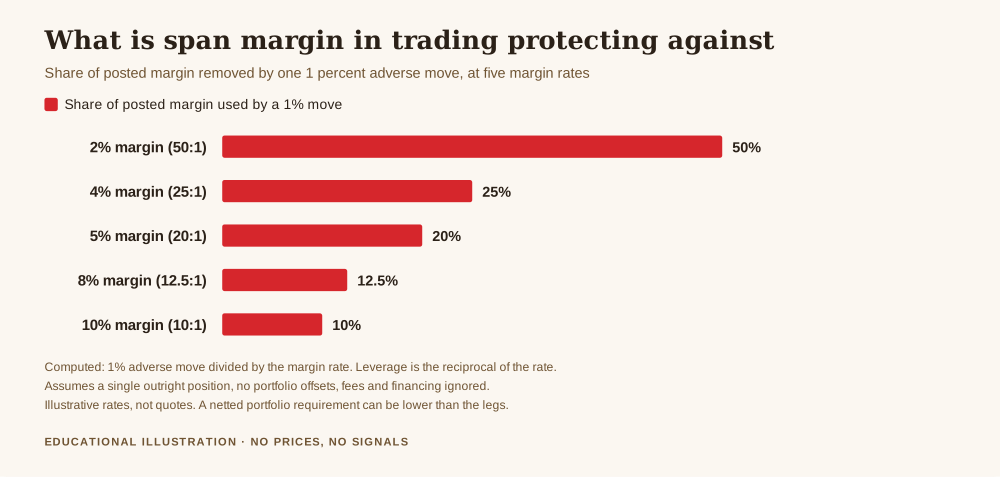
If the margin rate is a given percentage of notional, then the maximum leverage is the reciprocal, and the adverse move that consumes the entire deposit is that same percentage. Those two statements are the same arithmetic viewed from either end.
- 2 percent margin: 50 to 1 leverage, and a 1 percent adverse move consumes 50 percent of the margin posted.
- 4 percent margin: 25 to 1, and 1 percent consumes 25 percent.
- 5 percent margin: 20 to 1, and 1 percent consumes 20 percent.
- 8 percent margin: 12.5 to 1, and 1 percent consumes 12.5 percent.
- 10 percent margin: 10 to 1, and 1 percent consumes 10 percent.
Those are computed, and the assumptions are worth stating so you can redo them: a single outright position, no portfolio offsets, the move measured against the notional at entry, financing and fees ignored. A real portfolio margin figure can be lower than the sum of the legs, which is the whole purpose of netting, so treat the single-leg version as the pessimistic bound rather than the quote.
The reason I labour this is that margin is the one number traders adjust in the wrong direction under stress. About 73 messages in my inbox touch on leverage or margin. That is a keyword count across my own inbox and not a survey, so take it as a measure of how often the subject comes up. One reader described the manoeuvre exactly: "My account initially had leverage at 1:50, then when I started losing I got it to 1:500 to open bigger positions, but I went really bad as you can see." Another had met the mechanic without recognising it: "I placed a buy order, but it didn't get triggered. I think it might be due to insufficient margin." A third asked the honest beginner question: "Can you please tell me what this leverage means, and what size of leverage I should choose here?" And a fourth reported the feeling rather than the number: "Just missed the margin call. That makes me sweat."
Raising the leverage multiple after a loss does not add capital. It lowers the percentage of notional you are holding, which raises the share of your deposit that an ordinary move removes. The account did not get stronger. The buffer got thinner, and the arithmetic above says exactly how much thinner.
Borrow the clearing house's three habits
Here is the part I actually want you to take from this. You cannot run SPAN on your account, and you do not need to. What you can copy is the shape of the policy, because the three habits in the regulation cost nothing.
Name a percentile and a horizon. The clearing house does not say "we hold enough". It says 99 percent, one day. A trading business can write the same sentence about its own buffer: this reserve is sized to cover a bad day of a stated size, and here is the size. The number can be anything you justify. What matters is that it exists and is written down, because an unnamed buffer is adjusted by mood.
Review on a cadence, not on a feeling. Paragraph (g)(6) says daily. The point is not the frequency, it is that the review happens whether or not anything alarming occurred. Most retail risk reviews are triggered by pain, which means they happen exactly when judgement is worst.
Backtest over a fixed window. At least the previous 30 days, says (g)(7). This is the cheapest of the three and the rarest. Take your own rule, look at the last 30 days of your actual records, and count how often it would have been breached. If the count is far above what you intended, the rule is decoration.
None of that requires software, a bigger account or a view on the market. It requires a document and the discipline to read it on a schedule, which is the whole content of running an account like a business rather than a hobby.
Get the free REX one page trading business plan, the limits, the review cadence and the records to keep, on a single sheet. One email, no spam, unsubscribe anytime.
Get the free business plan →Frequently asked questions
What is span margin in trading, in one sentence?
It is portfolio-based margining: the clearing house revalues your whole book under a set of market scenarios and asks you to post enough to cover the worst plausible one-day result, rather than charging you separately for each position. SPAN is the common name for that method, short for Standard Portfolio Analysis of Risk.
Is SPAN margin lower or higher than ordinary margin?
It depends on your book, and that is the point of it. Positions that genuinely offset each other produce a lower requirement than adding the legs together, because the model recognises the netting. Positions that all depend on the same move produce no reduction, and the requirement can be larger than a trader expecting a discount assumed. The model rewards real diversification and ignores cosmetic diversification.
Why did my margin requirement go up when I did not change anything?
Because the inputs are not fixed. Clearing houses review requirements continuously, and 17 CFR 39.13(g)(6) requires them to determine the adequacy of initial margin daily. When volatility rises, the scenarios used to stress a portfolio imply larger losses, so the requirement rises even though your positions are identical. A requirement is a measurement of current conditions, not a price you locked in.
Does a 99 percent confidence level mean I cannot be wiped out?
No, and reading it that way is the common error. Ninety nine percent over a one-day horizon means the requirement is expected to fall short on about 1 day in 100, which on roughly 252 trading days is about 2.5 days a year. That is why clearing houses hold a default fund and their own capital behind the margin. Applied to your own account the lesson is the same: a buffer sized to a percentile has a known failure rate, and pretending otherwise is how the failure becomes a surprise.
Does any of this apply if I only trade spot gold with a retail broker?
The specific rule does not, because 17 CFR 39.13 governs clearing houses rather than retail brokers, and a spot position is not cleared the same way. The arithmetic transfers completely. Whatever percentage of notional your broker holds, the reciprocal is your leverage and that same percentage is the adverse move that consumes the deposit. The three habits transfer too, and they are free.
Where REX Trading Signal fits
REX Trading Signal is free to follow. The daily record on Telegram includes losing days, because a record that only shows winners is not a record. There is a free one page trading business plan for anyone who wants the limits and the review cadence in one place, and an optional Kit for people who want the full operating method. Nothing here promises a profit and nothing here is a signal service. The foundation this article sits on is the one page trading business plan template. Beside it, the measure that puts a return next to the capital it risked is in what risk adjusted return on capital is, the buffer this whole article is really about is in how to build a cash reserve for your trading business, the statement where a margin deposit shows up as an asset is in what a balance sheet equity line is, and the labels you post it against are in what a chart of accounts looks like.
Outside sources used here: the requirement that margin models cover exposure to the point of liquidation, the minimum liquidation time of one day for futures and options and five days for other swaps, the confidence level of at least 99 percent, the daily review of margin adequacy and the backtesting window of not less than the previous 30 days are all from 17 CFR 39.13(g), as published by Cornell Law School and checked against the official eCFR text. The expansion of SPAN as Standard Portfolio Analysis of Risk is the name in common industry use and is not taken from that regulation. Scenario parameters are set by individual clearing houses, change over time and are not quoted here. Every leverage figure, percentage and day count is computed from the assumptions stated in the text, so you can reproduce all of it.
About the author. Rex writes REX Trading Signal and treats an account the way an operator treats a business, with limits set before the week starts and a review that happens whether the month was good or bad. He is less interested in what a trader thinks will happen next than in what the records say already happened. The regulatory figures here are quoted from the rule linked above and the leverage arithmetic is computed from the stated assumptions so you can repeat it with your own numbers, margin rates shown are illustrative of the mechanic rather than quotes from any clearing house or broker, this article is educational and is not tax, accounting or investment advice, nothing here is a recommendation to use or avoid any firm, platform or product, and no entry, stop or target discussed should be treated as a signal.