
Every business that survives a bad quarter has a rule written down somewhere that says what happens when losses reach a certain size. Trading accounts usually do not. So the question what is a drawdown policy sounds technical, and it is not: it is the single sheet of paper that decides, in advance and in daylight, how much of the account you are willing to lose before you stop and review. Prop firms impose one on you. A self funded trader has to write their own, and most never do.
What is a drawdown policy, in business terms
A drawdown is the fall from a previous high in your account balance or equity. A drawdown policy is the written rule that says what you do at each level of that fall. In a trading business it has four parts and they fit on one page.
First, the measure: what you are counting, balance or equity, on what time frame, from which high. Second, the ceilings: the daily, weekly and monthly numbers that trigger action. Third, the action itself: what you actually do at each ceiling, stated as a behaviour and not as an intention. Fourth, the re-entry condition: what has to be true before you trade at full size again.
That is the whole document. The reason it works is not sophistication. It is that the decision gets made when you are calm and costs nothing, rather than when you are down and every option feels expensive.
One reader described a policy they had arrived at by themselves, without calling it that: "my account has a max drawdown of 800, so you can say I am effectively trading with that amount. I focus on low risk, and if I make around 20 to 30 in a day, I usually stop trading for the rest of the day to protect my capital." Two ceilings, one downside and one upside, decided in advance. That is a drawdown policy, written or not.
The arithmetic that makes the ceiling pay for itself
Here is the part that convinces people who find rules irritating.
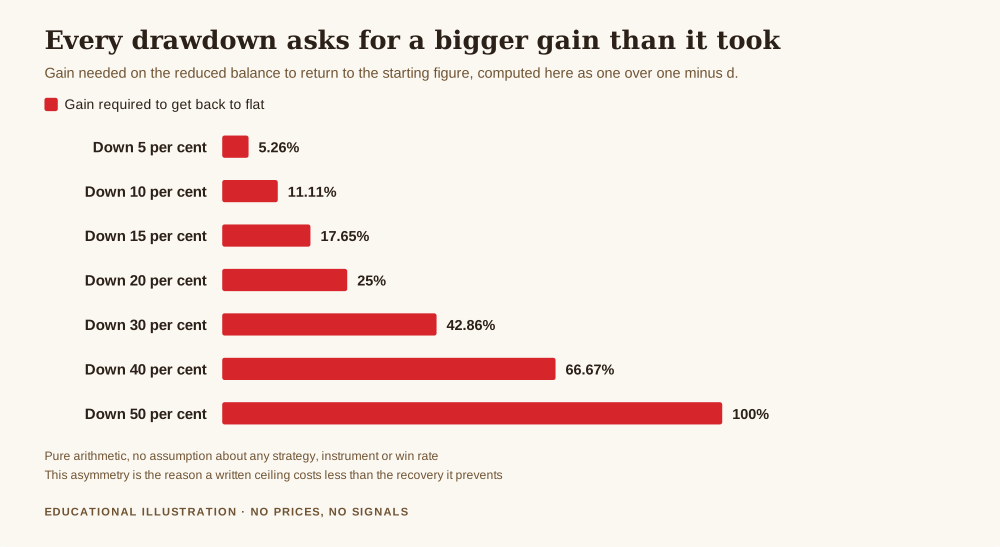
Recovering from a drawdown always requires a larger percentage gain than the percentage you lost, because you are earning it on a smaller balance. The calculation is one divided by one minus the loss, minus one. I ran it in Python across the usual range, and the asymmetry is brutal at the far end:
- down 5 per cent needs a 5.26 per cent gain to get back to flat
- down 10 per cent needs 11.11 per cent
- down 20 per cent needs 25 per cent
- down 30 per cent needs 42.86 per cent
- down 50 per cent needs 100 per cent
Nothing in that list depends on your strategy, your instrument or your win rate. It is pure arithmetic, which is why it belongs in a business document rather than in a motivational post. The cost of a ceiling set at 10 per cent is that you stop early sometimes. The cost of having no ceiling is that the recovery curve gets steeper exactly when your judgement is getting worse.
Put the two together and the policy stops looking like caution. It looks like the cheapest insurance available to a one person business, which is the framing used throughout the one page trading business plan.
How deep the hole gets at a given risk per trade
The second calculation tells you where to set the number, and it is the one most people skip.
Assume every loss costs exactly 1 per cent of the balance at the time, compounding down. Six consecutive full losses take 5.85 per cent of the account. It takes eleven consecutive full losses to breach a 10 per cent monthly ceiling, leaving the balance at 89.53 per cent of where it started.
Now ask how likely a streak like that is. Assume, purely as a modelling assumption about a coin rather than a claim about anybody's results, that each trade is a loss with probability one half and that trades are independent. Over 100 trades:
- at least one run of five losses occurs with probability 81.0 per cent
- at least one run of six occurs with probability 54.6 per cent
- at least one run of seven occurs with probability 31.8 per cent
- at least one run of eight occurs with probability 17.0 per cent
Read that against the first calculation and the design problem becomes obvious. Losing runs of six or seven are not rare events, they are ordinary features of a hundred trade sample. So a ceiling that a routine losing run breaches is not a risk control, it is a scheduled interruption. Either the ceiling goes up or the risk per trade comes down, and the second is usually the right answer.
This is the same calculation as position sizing, approached from the other end, so it pairs with position sizing and with the risk of ruin arithmetic.
What the firms that impose one actually do
If you have traded a funded account you have already lived inside somebody else's drawdown policy, and it is worth noticing how simple theirs is.
One reader described it exactly: "I tried it on a prop firm account for a week. It did well, and later it was stopped because the drawdown was 5 per cent of a 100k account." No negotiation, no discussion of whether the strategy was about to recover. The number was known in advance and the system enforced it.
Another wrote mid-episode, which is the version that stays with me: "this week the market went completely against the grain and my account is at a 6 per cent loss, with only 6 per cent left to absorb the daily drawdown." That trader knew precisely how much room remained. Most self funded traders, asked the same question on a bad week, could not answer it to the nearest 5 per cent.
Regulators work the same way, in a cruder form. In the European Union, a retail contract for difference provider must close out positions when account equity falls to 50 per cent of the minimum required margin, and negative balance protection caps the loss at the money in the account. Those are floors imposed from outside, set where the provider's risk ends rather than where yours does. A policy you write sits far above that line, which is the entire point of writing one.
Writing yours, with the numbers filled in
Four decisions, and the answers belong in the same file as the rest of your business documents.
The measure. Closed balance or open equity. Equity is stricter and harder to ignore, because it counts the trade you are currently holding and hoping about. Pick one, write it down, and do not switch to the kinder one during a bad week.
The ceilings. A daily figure that stops the session, a weekly figure that stops the week, and a monthly figure that triggers a review rather than another trade. Set them using the arithmetic above, so that the ordinary losing run described by the probability table does not breach them.
The action. Specific and physical. Platform closed, orders cancelled, back tomorrow. An intention to "be more careful" is not an action, it is a feeling. The clearest version of the action question is covered in knowing when to stop trading.
The re-entry condition. This is the part everyone forgets, and it is where a policy becomes a business process rather than a punishment. Something like: trade at half size for the next ten trades, review the journal first, and return to full size only when the reason for the drawdown has been identified and written down.
If you want a model, use the prop firm structure and make it stricter: a daily ceiling of roughly a third of the monthly ceiling, and a monthly ceiling that an ordinary losing run cannot reach. Those two relationships matter more than the specific figures you choose.
The failure mode the policy exists to prevent
It is not the drawdown. It is what people do once they are inside one.
The pattern arrives in my inbox in the same words almost every month. One reader: "one single mistake brought my account to a massive drawdown." Another, on the psychology of watching it happen: "in MT5 I cannot stop looking at candles and my position, so I often close too early and hold too much in drawdown." The drawdown itself was survivable. The behaviour it produced, sizing up to recover faster, holding losers because closing them makes the loss official, trading more often because fewer trades feels like doing nothing, is what turns a 10 per cent problem into a 40 per cent problem that needs a 66.67 per cent gain to undo.
A written policy intercepts that sequence at the point where it is cheap. Not because the number is magic, but because the decision was made by a version of you that was not losing money at the time. That is the only real advantage the document has, and it is enough. The behavioural side of the same problem sits in managing trading psychology like a business.
Get the free REX one page trading business plan, the template this drawdown policy belongs inside, with the risk ceilings and the review process already laid out. One email, no spam, unsubscribe anytime.
Get the free business plan →Frequently asked questions
What is a drawdown policy in one sentence?
It is a written rule that states how much your account may fall from its previous high before you stop trading, what you do at each level, and what has to be true before you return to full size.
What is a reasonable monthly drawdown ceiling?
That depends on your risk per trade, and the arithmetic matters more than the convention. If you risk 1 per cent per trade, eleven consecutive full losses breach a 10 per cent ceiling, and losing runs of six or seven in a hundred trades are ordinary, so the ceiling should sit above the run your method routinely produces. Work out your own number rather than copying somebody else's.
Should the policy measure balance or equity?
Equity is the stricter measure because it includes open positions, which is exactly where denial hides. Balance is easier to track. The important thing is choosing one in advance and not switching to whichever is more comfortable on a bad day.
How is this different from a stop loss?
A stop loss governs one position. A drawdown policy governs the business, across every position and across time. You can take every individual stop correctly and still lose the account by taking too many of them in a row, which is the gap a policy closes.
Do I need one if I trade a small account?
Especially then. A small account has less room for the recovery arithmetic to work with, and the temptation to size up to make a loss back faster is strongest when the absolute numbers look manageable.
What should happen when I hit the ceiling?
Whatever you wrote down, carried out without renegotiation. The usual shape is: stop for the period, review the trades, identify what went wrong in writing, return at reduced size, and restore full size only when the cause has been named. The decision was yours, made earlier, when it was free.
Where this leaves you
The useful answer to what is a drawdown policy is that it is the one business document that stops a bad week from deciding your year. The recovery arithmetic is fixed and unforgiving, ordinary losing runs are more common than intuition suggests, and the only variable you control is whether the ceiling was set before the fall or discovered during it.
Write the four parts, keep them with the business plan, and treat the ceiling the way a funded trader has to treat theirs. Then go back to the metrics worth tracking and check that you are actually measuring the thing your policy is written about.
The 50 per cent margin close-out rule and negative balance protection are stated in the ESMA product intervention measures. The recovery percentages, the eleven losses to breach a 10 per cent ceiling and the probabilities of losing runs over 100 trades were calculated here in Python, with the assumptions stated above: 1 per cent of balance lost per losing trade, compounding, and independent trades with a one half chance of a loss. Those assumptions describe a coin, not anybody's trading record.
REX Trading Signal is written for people who want to run the account like a business rather than like a hobby, and the free one page business plan above is where a policy like this belongs. Following along is free, the Kit is optional, and nothing here promises a profit.
About the author. Rex writes REX Trading Signal for traders who treat the account as a business with books, limits and a review cycle, because the operators who last are the ones who decided the rules before the market tested them. This is education, not financial advice, and no entry, stop or target discussed should be treated as a signal.