
Every business plan I have ever read from a trader has a target in it. Almost none of them has the other number, the one that says how likely it is that the business simply stops existing before the target arrives. That number has a name, risk of ruin in trading, and unlike most of what gets argued about online it can be computed rather than asserted.
This article computes it. The simulation is mine, the assumptions are written out so you can disagree with them, and the one external figure comes from a regulator rather than from a trading forum. There is no gold price anywhere in it and no entry rule, because the finding has nothing to do with what you trade and everything to do with how much of the account you put behind each decision.
What risk of ruin in trading actually measures
Risk of ruin is the probability that a run of bad outcomes takes your capital below a level you cannot operate from, before your edge has had time to show up in the results.
Three things in that sentence do the work. The first is probability, which means the answer is a percentage rather than a yes or a no. The second is a level you cannot operate from, which is a business decision rather than a mathematical one: for most people it is well above zero, because an account down by half is an account that cannot take its normal position size any more. The third is before your edge shows up, which is the part everybody skips. Having an edge and surviving long enough to collect it are two separate problems, and only one of them is solved by being right about the market.
For everything below I have set ruin at a 50 per cent drawdown. Not zero. If your account halves, the business as it was designed is finished, whatever the balance says.
The table I would put in every business plan
Here are the assumptions, all of them. Each trade risks a fixed fraction of current equity. A win pays a fixed multiple of the amount risked. Outcomes are independent. Costs, slippage and position size rounding are excluded, which makes these figures optimistic rather than alarmist. Ruin means equity touches 50 per cent of where it started at any point inside 500 trades. Each cell is 200,000 simulated paths, with the random seed fixed at 20261020 so the table reproduces exactly if you run it again.
The crucial detail is this: every system in the table has a positive edge. Not one of them is a losing strategy.
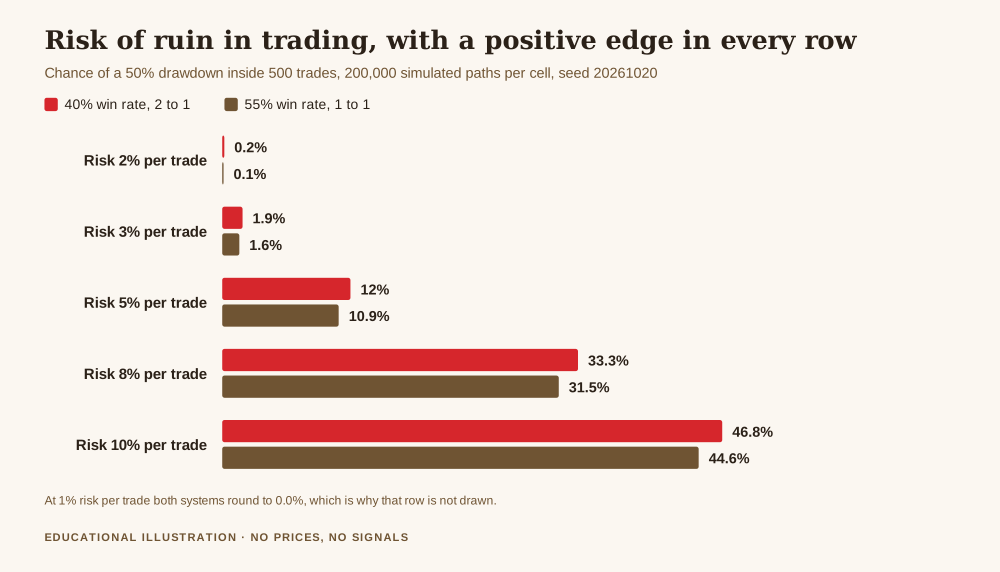
Take the first system, a 40 per cent win rate at 2 to 1, which earns 0.200 of a unit of risk per trade on average. Risking 1 per cent of equity per trade, the chance of a 50 per cent drawdown inside 500 trades rounds to zero. At 2 per cent it is 0.2 per cent. At 3 per cent it is 1.9 per cent. At 5 per cent it is 12.0 per cent. At 8 per cent, 33.3 per cent. At 10 per cent, 46.8 per cent.
Read that last line again. Same system. Same edge. Same market. The only thing that changed is the size of the bet, and the chance of the business failing went from a rounding error to a coin flip.
The second system in the chart, a 55 per cent win rate at 1 to 1, earns a thinner 0.100 per trade and behaves almost identically: 0.1 per cent at 2 per cent risk, 1.6 at 3 per cent, 10.9 at 5 per cent, 31.5 at 8 per cent and 44.6 at 10 per cent. A more comfortable win rate bought almost nothing. Position size did all of it.
Positive expectancy is not protection
This is the part that takes a while to accept, because it contradicts how most people think about trading.
Expectancy tells you where the average path ends up. Risk of ruin tells you how many paths never get there. A system with an edge of 0.350 per trade, the strongest in my simulation at a 45 per cent win rate and 2 to 1, still fails 16.1 per cent of the time at 10 per cent risk per trade. One account in six, destroyed by a strategy that was right about the market the whole time.
The reason is arithmetic rather than psychology. Losses compound against you faster than the same percentage gains recover. Drop 50 per cent and you need 100 per cent to get back. Size large enough and a perfectly ordinary run of bad luck moves you into territory where the remaining capital can no longer generate the returns the plan assumed. The edge is still there. The capacity to use it is gone. I wrote about the slower version of this problem in what a good expectancy ratio looks like, and this is the fast version.
The losing run you have to plan for
People underestimate streaks. Badly. So here is the same simulation asked a different question: what is the chance of hitting at least one losing run of a given length somewhere inside 500 trades?
With a 40 per cent win rate, which is entirely normal for a system that wins big when it wins, a run of 5 losses is a certainty at 100 per cent. A run of 8 happens in 97.0 per cent of careers. A run of 10 in 70.5 per cent. A run of 12 in 35.1 per cent.
Even at a 55 per cent win rate, a 5 loss run arrives 99.5 per cent of the time, an 8 loss run 36.9 per cent of the time, and a 10 loss run 8.8 per cent of the time.
So the eight losing trades in a row that made you question everything were not evidence that your system broke. At a 40 per cent win rate they were close to inevitable. The planning question is not whether that run arrives. It is what your position size does to the account when it does. Eight consecutive losses at 2 per cent leaves you down about 15 per cent, which is a bad month. At 10 per cent it leaves you down about 57 per cent, which is the end of the business.
What the inbox sounds like on the other side of that
I keep the messages people send me. About 93 of them mention blowing an account, which is a count of keyword matches in my inbox rather than a survey of anything, and the striking part is how rarely they describe a person who was wrong about the market.
One reader wrote: "I can easily grow account over time because I have the skills needed for trading, a single mistake like today account get wiped." That is the whole article in one sentence, written by somebody living inside the table above.
Another: "I had blown thru a couple accounts and been trying to get better at discipline." A third described the loop exactly: "I was liquidated with 100. I re-entered the profit I had made with 80 and I was liquidated again." A fourth: "This week I turned 100 into 800, blew it, turned that 480 into 900 this week, blew it." A fifth, more quietly: "Initially I had more and was trading good but blew almost everything a couple months ago."
Notice that the fourth one was right about direction repeatedly. Turning a sum into eight times itself is not the behaviour of somebody who cannot read a chart. It is the behaviour of somebody whose position size guarantees that being wrong once undoes being right eight times. The pattern in those messages is not a skill problem, and why most traders blow their accounts covers the rest of it.
What the regulator's number adds
You can object that my simulation is a model, and you would be right. So here is a figure from outside it.
When the European Securities and Markets Authority introduced its restrictions on contracts for difference sold to retail clients, it required firms to publish the percentage of their own retail accounts that lose money, and noted that national regulator analyses found 74 to 89 per cent of retail accounts typically lose money. The same measures cap retail leverage at 20 to 1 on gold and force a margin close out once account equity falls to 50 per cent of required margin.
That close out level is worth pausing on, because it is the regulator drawing the same line my simulation draws. Somebody decided that half your margin gone is the point at which the position should not continue. It is a reasonable place to put the word ruin.
And the 74 to 89 per cent figure is a useful corrective to the idea that the loss rate in this industry is explained by people picking the wrong direction. Direction is roughly a coin flip before costs. A failure rate that high needs a mechanism that is working against everybody, and the table above is one of them.
How a business actually sets the number
Run the logic backwards, which is what a business does. You do not start with a return target and discover your risk of ruin afterwards. You decide what probability of failure you are willing to run, then let that decide your position size.
Pick the failure probability you can live with. A real business does not accept a 10 per cent chance of ceasing to exist this year, so neither should this one. Something under 1 per cent is a sane starting point.
Then read the size off the table rather than off your confidence. For both systems above, 1 to 2 per cent of equity per trade keeps the ruin probability at or below 0.2 per cent across 500 trades. Three per cent pushes it towards 2 per cent, and 5 per cent takes it into double digits. That is the entire reason the one per cent convention exists, and the one per cent rule is worth the boredom.
Then write it down before you need it, because you will not do this arithmetic in the middle of a losing streak. It belongs in the same document as your cost lines and your limits, which is what the one page trading business plan is for. The sizing itself, trade by trade, is position sizing for gold trading, and the buffer that stops a bad month becoming a closure is a cash reserve.
What this article does not say
It does not say that 1 per cent risk makes you safe. The model assumes independent outcomes, and real trades correlate: three positions in gold during one news event are one position wearing three hats. Correlation makes the real number worse than the table.
It does not say these percentages are yours. Your win rate and payoff are whatever your own records say, not what I assumed, and the right move is to run the arithmetic on your numbers rather than borrow mine.
And it does not promise that small size produces profit. It does not. A negative edge sized small is a slower loss, not a business. Risk of ruin answers one question only, which is whether you survive long enough for the edge to matter, assuming you have one.
Get the free REX one page trading business plan, the document where your cost lines and your limits get written down before the market asks you about them. One email, no spam, unsubscribe anytime.
Get the free business plan →Frequently asked questions
What is risk of ruin in trading?
The probability that a run of losses takes your capital below a level you cannot operate from before your edge has time to show up in the results. It is a percentage you can compute, not an opinion.
Can a profitable system still blow up an account?
Yes, and that is the central finding. Every system in my simulation has a positive edge, and one with a 45 per cent win rate at 2 to 1 still halves the account 16.1 per cent of the time when 10 per cent of equity is risked per trade.
How much should I risk per trade?
Decide your tolerable failure probability first, then read the size from the arithmetic. In my simulation 1 to 2 per cent of equity per trade held the chance of a 50 per cent drawdown at or below 0.2 per cent over 500 trades, while 5 per cent took it into double digits. Your own win rate and payoff should replace my assumptions.
How long a losing streak should I expect?
Longer than feels reasonable. At a 40 per cent win rate, a run of 8 losses appears in 97.0 per cent of 500 trade careers and a run of 10 in 70.5 per cent. At 55 per cent, an 8 loss run still appears 36.9 per cent of the time.
Why measure ruin at 50 per cent rather than zero?
Because a halved account cannot run the business it was designed for. Recovering from a 50 per cent drawdown requires a 100 per cent gain, and the regulator uses the same threshold for its margin close out rule.
Does lower risk per trade just mean lower returns?
It lowers the return on the paths that survive and raises the number of paths that survive at all. Since the destroyed accounts earn nothing ever again, the trade is nothing like as unattractive as it first looks.
Where REX Trading Signal fits
REX Trading Signal is a free journal about running a trading account the way you would run any other business, with cost lines, limits and a plan written down before the market tests them. Nothing here is sold on a promise of returns. The free one page business plan is where the numbers in this article turn into a rule you can actually follow, and the piece underneath all of it is the one page trading business plan.
About the author. Rex writes REX Trading Signal. He spent a long time believing his problem was finding a better entry, and a considerably shorter time with a simulation running to discover it had been position size the whole way through. He would rather hand you the arithmetic than the conclusion.
This article is educational and is not financial advice. Trading gold and other leveraged products carries a high risk of losing money rapidly, and no entry, stop or target discussed should be treated as a signal. The finding that 74 to 89 per cent of retail accounts typically lose money, the retail leverage cap of 20 to 1 on gold, and the margin close out rule at 50 per cent of required margin are from the ESMA announcement linked above, which was retrieved and read before publication. Every other figure in this article is the output of my own Monte Carlo simulation under the assumptions stated in the text: fixed fractional risk of current equity, a fixed payoff multiple, independent outcomes, no costs, no slippage, no position size rounding, ruin defined as equity touching 50 per cent of its starting value at any point within 500 trades, 200,000 paths per cell and the random seed fixed at 20261020. Those assumptions are optimistic, because excluding costs and correlation makes survival look more likely than it is. The ruin probabilities of 0.2, 1.9, 12.0, 33.3 and 46.8 per cent for a 40 per cent win rate at 2 to 1, the matching 0.1, 1.6, 10.9, 31.5 and 44.6 per cent for a 55 per cent win rate at 1 to 1, the 16.1 per cent figure for a 45 per cent win rate at 2 to 1 risking 10 per cent, the expectancy figures, and the losing run probabilities of 97.0, 70.5 and 35.1 per cent at a 40 per cent win rate and 99.5, 36.9 and 8.8 per cent at 55 per cent, are all reproducible from that seed. The count of about 93 inbox messages mentioning a blown account is a keyword count in my own inbox, not a survey, and the quoted messages are real, anonymised, and lightly edited to remove identifying detail. No gold price is quoted anywhere in this article. Decide your own risk, and never trade money you cannot afford to lose.