
A member sent me his year end numbers last week, pleased, and asked what I thought. The account was up eight per cent. My first question was not about his win rate or his drawdown. It was whether he knew how to calculate real rate of return, because eight per cent is not a number yet. It is half of one. The other half is what a unit of money bought at the start of the year against what it buys now, and until you put those two together you do not know whether the business grew or just kept up.
Every other business owner I know does this instinctively. A shop owner who raised prices four per cent in a year where costs rose four per cent does not tell you he grew four per cent. He tells you he stood still. Traders are the only operators I meet who report a nominal number, alone, with a straight face, and then plan the next year around it.
How to calculate real rate of return, and the way almost everyone gets it wrong
Here is the formula. It is one line and there is nothing clever in it.
Real return = (1 + nominal return) / (1 + inflation) - 1
Most people do not use that. They subtract. Twelve per cent nominal, two and a bit per cent inflation, call it nine and a half and move on. Subtraction is an approximation, it is always wrong in the same direction, and it is always wrong by a predictable amount.
Take twelve per cent nominal and 2.27 per cent inflation, which is a number I will justify in a moment.
- Subtraction says 9.7300 per cent.
- The formula says 9.5140 per cent.
- The subtraction overstates the result by 0.2160 percentage points.
Now the part I find genuinely satisfying, because it turns a rule of thumb into something you can check. The relative size of that error is not approximately the inflation rate. It is the inflation rate, exactly. 0.2160 divided by 9.5140 is 2.2700 per cent. It falls straight out of the algebra: the difference between the two methods is the true real return multiplied by the inflation rate, every time, for any pair of inputs.
So the working rule is: subtracting overstates your real return by the inflation rate. At two per cent inflation you are flattering yourself by two per cent of the answer, which nobody would notice. At the sort of inflation plenty of countries have lived through recently, you are flattering yourself by ten or fifteen per cent of the answer, and that is the difference between a business that is growing and one that is quietly shrinking while its bank balance rises.
Where to get the inflation number without guessing
This is the step where most people stop, because inflation statistics are published in arrears, revised, and argued about. There is a cleaner source, and it is free.
The Federal Reserve publishes Selected Interest Rates, release H.15, every business day at 4:15pm. It contains two rows that, read together, hand you the market's own inflation number. One row is ordinary Treasury constant maturity yields. The other, a few lines below, is the inflation-indexed version of the same maturities, where the payout adjusts with the price level.
The nominal yield pays you a fixed number of dollars. The indexed yield pays you a fixed amount of purchasing power. The gap between them is what the market, with real money at stake, expects inflation to average over that horizon. It is called the breakeven rate.
From the release dated 25 September 2026, for figures as of 24 September 2026:
- 10-year nominal constant maturity: 5.18 per cent. 10-year inflation-indexed: 2.85 per cent.
- 5-year nominal: 5.03 per cent. 5-year inflation-indexed: 2.70 per cent.
- 30-year nominal: 5.47 per cent. 30-year inflation-indexed: 3.21 per cent.
Run those through the same formula rather than subtracting, and the breakeven inflation rates are 2.2687 per cent at five years, 2.2654 per cent at ten, and 2.1897 per cent at thirty. Three independent horizons landing within a tenth of a point of each other. I have used 2.27 per cent throughout this article.
Notice that the market itself gets quoted using the sloppy method. Every screen you will ever see reports the ten year breakeven as 2.33, because that is 5.18 minus 2.85. The honest figure is 2.27. Even the professionals publish the approximation.
What it does to a set of real numbers
Here is the same account read both ways, at 2.27 per cent inflation.
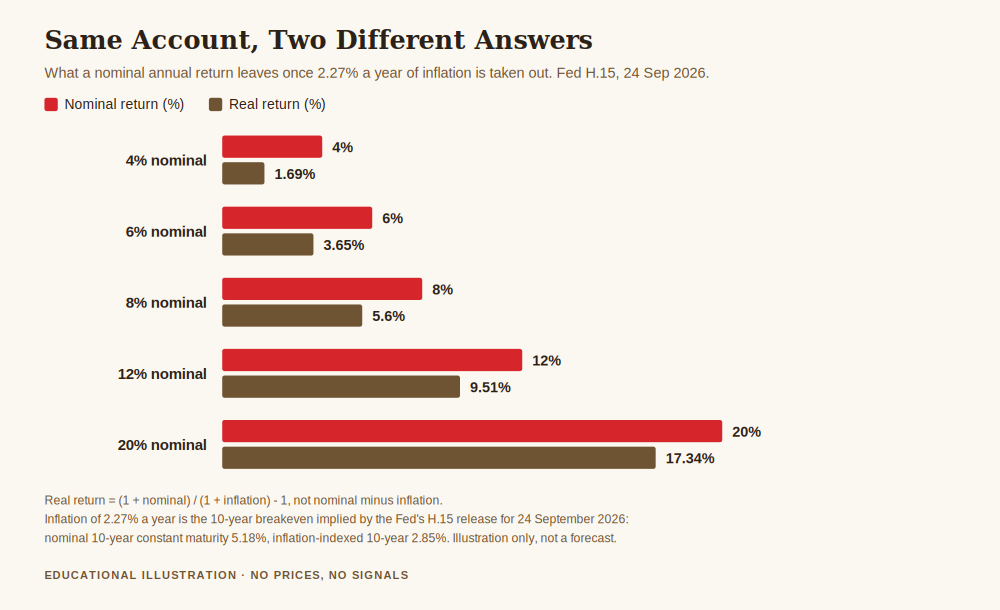
- 4 per cent nominal is 1.69 per cent real.
- 6 per cent nominal is 3.65 per cent real.
- 8 per cent nominal is 5.60 per cent real.
- 12 per cent nominal is 9.51 per cent real.
- 20 per cent nominal is 17.34 per cent real.
The member with his eight per cent year did not have an eight per cent year. He had a 5.60 per cent year. That is still a genuinely good year for a small operation and I told him so. But it is thirty per cent less than the number he was about to build his plans on, and the plans were the problem, not the result.
Why it gets worse the longer you run the business
One year of this is a rounding difference. The reason it belongs in your annual accounts rather than in a footnote is that the wedge compounds.
Take twelve per cent nominal, held steady, against 2.27 per cent inflation, held steady. Both assumptions are mine and neither is a forecast. The account multiplies as follows:
- After 5 years: money multiplies 1.7623 times, purchasing power 1.5752 times. The shortfall is 10.62 per cent.
- After 10 years: money 3.1058 times, purchasing power 2.4814 times. Shortfall 20.11 per cent.
- After 20 years: money 9.6463 times, purchasing power 6.1574 times. Shortfall 36.17 per cent.
- After 30 years: money 29.9599 times, purchasing power 15.2789 times. Shortfall 49.00 per cent.
Over a working life, at an inflation rate low enough that most people would not bother adjusting for it, roughly half the apparent growth is not growth. The bank statement is not lying. It is answering a different question from the one you are asking it.
The same thing said in the way that lands hardest: at eight per cent nominal, the money in the account doubles in 9.01 years. What it buys doubles in 12.71 years. That is three years and eight months of extra work hidden inside a number nobody adjusted.
The hurdle this gives you, which is the actual point
None of this is arithmetic for its own sake. A business needs a hurdle rate: the return below which the effort is not worth making, because the money had somewhere better to be. Real return arithmetic is how you set one that is not invented.
On the same H.15 figures, here are three hurdles, in ascending order of honesty.
Hurdle one, stand still. Clear 2.27 per cent nominal a year and your capital has not shrunk. Below that, the business is losing purchasing power while showing a profit.
Hurdle two, beat the shortest safe thing. Three month Treasury bills were at 4.08 per cent, which is 1.77 per cent real. That is the return for doing nothing at all, at very short notice, with no screen time. Any trading business that does not clear it is paying itself less than the money would have earned sitting still.
Hurdle three, beat the long safe thing. The ten year inflation-indexed Treasury was at 2.85 per cent real, equivalent to 5.18 per cent nominal at 2.27 per cent inflation, which is the ten year nominal yield exactly, as it has to be, since that is where the breakeven came from. This is the serious one. It is a locked-in real return, guaranteed in purchasing power, for ten years, with no drawdown, no decisions and no risk of ruin.
Put those together and the eight per cent year reads differently again. 5.60 per cent real, against a 2.85 per cent real alternative that required no work, is an excess of 2.75 percentage points of real return. That is what the whole year of screen time, discipline, losing streaks and risk actually bought. Whether it was worth it is a judgement about your own time, not a calculation, and I am not going to make it for you. But that is the number the judgement should be made on, not eight.
And a business returning four per cent nominal is 1.12 per cent behind a ten year Treasury before you count a single hour of labour. It is not a failing business. It is a business that is subsidising an activity, and the owner should at least know that is what is happening.
Get the free REX one page trading business plan, including the hurdle rate line most plans leave blank and where to source the numbers that fill it in. One email, no spam, unsubscribe anytime.
Get the free business plan →Frequently asked questions
How to calculate real rate of return if I do not know next year's inflation?
You do not need to know it, and nobody does. For results already in the books, use realised inflation for the period, published by your national statistics office. For a hurdle rate you are setting in advance, use the breakeven rate from H.15 at whatever horizon matches your planning, which is the market's own expectation with money behind it. Both are estimates. The point is not precision, it is that zero is a worse estimate than either of them, and zero is what you are using when you report a nominal number alone.
Should I use US inflation if I do not live in the United States?
No, and this is the most common way to get this wrong. Use the inflation rate of the currency you actually spend. If your account settles in dollars but you buy groceries in another currency, you have two separate problems: the real return of the account, and the exchange rate between it and your life. The H.15 breakeven answers the first only. Treat them separately or you will end up with a number that describes nobody's situation.
Is the breakeven rate a prediction of inflation?
It is an expectation priced by people with capital committed, which is not the same as a prediction and is certainly not a promise. It carries a risk premium and it moves daily. I use it because it is published, free, primary and dated, so anyone can check my arithmetic against the same release. Nothing in this article forecasts inflation, interest rates or gold, and none of these figures is a recommendation to buy a Treasury security.
Does this mean I should stop trading if I do not beat a Treasury?
That is not what the arithmetic says and I would be wary of anyone who turns it into that. A hurdle rate is an input to a decision, not the decision. A new operation in its first two years is buying skill, and comparing a learning year to a locked-in yield is comparing different things. What the hurdle does is stop you mistaking a nominal profit for growth, and stop you scaling up on a number that never existed. Read it next to how to calculate consistency in trading, because one good year is not evidence of anything on its own.
Does a higher return make the inflation adjustment matter less?
The opposite, and the chart shows it. The gap between nominal and real grows with the size of the return, because the correction is proportional. At four per cent nominal you lose 2.31 points to the adjustment. At twenty per cent you lose 2.66. The bigger the year you report, the bigger the absolute overstatement, which is exactly backwards from how people treat it.
Where did these numbers come from?
The interest rates are quoted from the Federal Reserve's H.15 release linked above, dated 25 September 2026, for figures as of 24 September 2026: three month Treasury bills on the secondary market at 4.08 per cent, and nominal and inflation-indexed Treasury constant maturities at five, ten and thirty years. Everything else is my own arithmetic on those figures using real return = (1 + nominal) / (1 + inflation) - 1. The 2.27 per cent inflation rate is the ten year breakeven computed the same way, 2.2654 per cent, rounded. The twelve per cent and eight per cent nominal returns in the compounding section are illustrative figures I chose, held constant, and are not results, forecasts or targets.
Where REX fits
REX Trading Signal is a free resource for people who want to run an account like a business rather than a hobby. The articles are free, the daily record on Telegram is free, and the one page business plan is free. There is no profit promise here and there never will be, because the arithmetic above is precisely the kind that makes profit promises impossible to make honestly.
If this is the part of the books you are working on, the break-even point of your trading business covers the cost side of the same question, and opportunity cost vs trade off covers what idle capital costs you while it waits. Both sit underneath the one page trading business plan template, which is where the hurdle rate line actually lives. The full library is at all REX articles.
About the author. Rex writes REX Trading Signal and treats an account as a business with books, costs and a hurdle rate rather than a scoreboard. He spent his first profitable years quoting nominal numbers to himself and is still slightly annoyed about how long it took to correct. Nothing in this article is financial advice or a recommendation to trade, and no entry, stop or target discussed should be treated as a signal.