
Most people arrive at swing trading by subtraction. They cannot sit at a screen all day, so they hold longer, and they assume they are doing the same job at a slower speed. That assumption is the expensive part, because risk management swing trading is not day trading with a longer timer on it. The position now sits through hours when you are asleep and the market is shut, and that changes what you are managing.
One reader put the reason for the switch better than I could: "My only issue is my time zone. I'll always miss half the trades." That is a sound operational reason to hold longer. It is not a reason to keep the same risk settings you used when you were watching.
This is an operations question, not a market view. Nothing below is a method for entering or exiting anything. It is the set of costs and exposures that attach themselves to a position purely because it stayed open, with the arithmetic done.
Risk management swing trading is a different job, not a slower one
When you day trade, you are present for the life of the position. If something breaks, you are there. Your risk control is mostly a decision you can still make.
Hold for days and that changes. For most of the position's life you are not available, the market may be closed, and your risk control is whatever you wrote down before you walked away. That is the real distinction. A day trader manages risk with attention. A swing trader has to manage it with structure, because attention is exactly the resource that is missing.
About 131 messages in my inbox cluster around protecting capital, counted by keyword rather than gathered in a survey, and the ones from longer term holders have a particular flavour. "This is safe minimum in case of losses etc to not be stressed too much," wrote one. "Just thinking, but I want to keep on the safe side, I will stick to what I'm doing first," wrote another. Both are describing the same instinct, which is right, and neither has yet been turned into a number. The rest of this article is about turning it into numbers.
You are holding through events that are printed in a calendar
The first thing a longer hold buys you is exposure to scheduled events, and the useful thing about scheduled events is that they are scheduled.
The Federal Reserve publishes its meeting dates a year ahead. The FOMC calendar lists eight scheduled policy decisions for 2026. Eight events in 365 days is one about every 45.6 days.
So how much of that do you actually absorb? Assume entry dates spread evenly through the year and meetings spaced evenly, which is roughly true and good enough for a planning number. A position held three days is open through a decision about 6.4 per cent of the time. Five days, 10.4 per cent. Ten days, 19.7 per cent. Three weeks, 36.9 per cent.
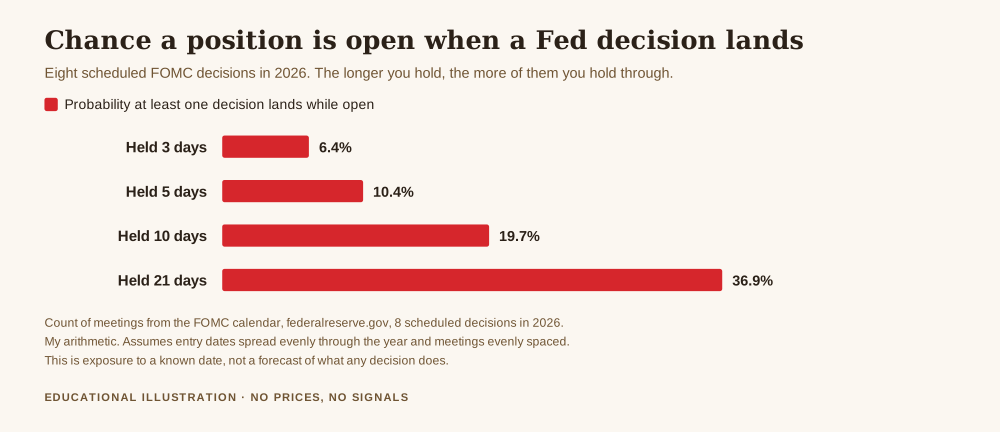
Read that last figure again. Hold for three weeks and better than one trade in three is open through a scheduled policy decision. That is not a forecast about what any decision does, and I am not suggesting the number tells you to avoid those dates. It tells you something simpler: this exposure is knowable before you enter, which means not knowing it is a choice. Our piece on building a pre market routine is where that check belongs.
Overnight, your stop is an instruction, not a seat belt
Here is the part that surprises people who move from intraday to multi day holds.
A stop order does not hold a price. It is an instruction to transact once a price is reached, and it fills at whatever is available when it triggers. While you are watching a liquid market, those two things are usually close enough that the difference does not register. Across a weekend or a gap, they can be a long way apart, because there were no prices in between for you to be filled at.
One reader described exactly the behaviour this produces: "When I get stressed, then I set a safe SL or break even just to now keep on losing." Moving a stop because of how the position feels is a symptom, and the condition underneath it is usually a position that was too large for a hold of that length. The stop is not the thing that failed. It was asked to do a job it cannot do.
The structural answer is not a cleverer stop. It is to size the position so that the gap you cannot control is survivable, and to stop treating the distance to the stop as the measure of your risk when the position will be unattended. That is also why a guaranteed stop, where a broker offers one, carries a cost: you are paying someone to take the gap risk you would otherwise carry yourself.
The rent: what the position costs purely for existing
A day trader's costs are mostly transaction costs. Hold overnight and a second meter starts, charged for time rather than for activity.
Work it in percentages so it applies to any account size. Assume a financing rate of 5 per cent a year on the notional value of the position. That rate is an assumption for the worked example, not a quote, and yours will differ by broker, by instrument and by direction. One night costs 0.014 per cent of notional. A week costs 0.096 per cent. Thirty nights costs 0.411 per cent. Ninety nights costs 1.233 per cent.
Those look small until you remember they are charged on notional, not on your equity. If your notional is ten times your account, which is a modest amount of leverage, a thirty night hold costs 4.11 per cent of your equity and a ninety night hold costs 12.33 per cent. The trade has to cover that before it has done anything for you. Day trading does not have this line item at all, which is the single clearest sense in which these two activities have different cost structures. We priced the same question from the frequency side in weekly trading against day trading.
Wider stops mean smaller positions, and this is where people invert it
A longer hold usually needs more room, because you are no longer trying to be precise about the next hour. More room means a wider stop. And here is where I see the most damaging mistake in this whole area, which is keeping the position size and accepting the wider stop.
Do that and you have not widened your stop. You have multiplied your risk.
The arithmetic is not difficult, which is why it is embarrassing how often it goes wrong. Hold the risk ceiling fixed, say 1 per cent of a 10,000 account, so 100 units at risk. If the stop is twice as wide, the position must be half the size. Three times as wide, a third of the size. Four times as wide, a quarter. The amount at risk never changes; the only thing that moves is how much you are holding.
That is the whole rule, and it is the one that makes longer holding sustainable. The reader who wrote "have just put my last money on the account, will try to trade safe now, not taking chances" is going to find out which way this works, and the difference between those two outcomes is one division. Our one per cent rule piece covers the ceiling itself, and how to manage risk in gold trading covers setting it while you are calm.
The hidden cost: evidence arrives much more slowly
There is one more thing a longer hold charges you, and it is not money.
We worked out recently that telling a genuine five point edge from luck takes roughly 784 trades, in how many trades you need to judge a strategy. Now apply that to a swing cadence. At two trades a week, which is 104 a year, reaching 784 trades takes 7.54 years. At five a week it takes 3.02 years. A day trader taking four trades a day across 250 sessions reaches it in 0.78 years.
Same evidence standard, wildly different waiting times. This has a practical consequence that has nothing to do with patience: if your style produces 104 data points a year, you cannot run your business on results alone, because results will not have told you anything reliable for years. You have to run it on process compliance, on whether the rules were followed, on whether position sizes matched the stop widths, and on whether the ceiling held. Those you can audit this month. Our note on running a weekly review is built around exactly that substitution.
What none of this says
It does not say swing trading is worse. It says swing trading has a cost structure that day trading does not have, and that the cost structure is knowable in advance.
It does not say avoid scheduled events, and it is not a view on what any Fed decision does. It says that holding longer increases the share of your trades that are open through them, and that this is arithmetic rather than opinion.
It does not tell you what stop distance to use, what size to trade or when to be in the market. Nothing here is a signal or an instruction. Every figure above is either read from a published calendar or computed from assumptions I have written out, so you can replace my assumptions with yours and get your own answer.
Get the free REX one page trading business plan, the operating rules on a single sheet, including the risk ceiling and the sizing rule this article runs on. One email, no spam, unsubscribe anytime.
Get the free business plan →Frequently asked questions
What is different about risk management swing trading, in one line?
The position stays open while you are not watching and while the market may be closed, so risk has to be handled by structure written in advance rather than by attention, and the position pays financing for every night it exists.
If I widen my stop, should I keep the same position size?
No, and this is the most expensive error in longer term holding. Keeping the size while widening the stop multiplies the money at risk by the same factor you widened by. To hold the risk ceiling fixed, a stop twice as wide needs half the size, three times as wide needs a third.
Does a stop loss protect me over the weekend?
Not in the way most people assume. A stop is an instruction to transact once a price is reached, and it fills at the next available price. If the market reopens away from your level, there were no prices in between to fill you at. Size for that possibility rather than assuming the stop caps the loss exactly.
How much does holding overnight actually cost?
At an assumed 5 per cent annualised financing rate on notional, one night is 0.014 per cent of notional, thirty nights 0.411 per cent, ninety nights 1.233 per cent. Because it is charged on notional rather than equity, at ten times notional to equity a thirty night hold costs 4.11 per cent of the account. Check your own broker's rate, which will differ.
How long before I know whether my swing strategy works?
Longer than feels reasonable. At the 784 trade standard for separating a five point edge from luck, two trades a week takes 7.54 years and five a week takes 3.02 years. That is why a lower frequency business has to be judged on process compliance in the short run, because results cannot do the job yet.
Where did these numbers come from?
The eight scheduled 2026 policy decisions are counted from the FOMC calendar on federalreserve.gov, linked above and checked on 29 October 2026. The 6.4, 10.4, 19.7 and 36.9 per cent figures, the financing costs, the sizing multiples and the 7.54 and 3.02 year figures are my own arithmetic, assuming entry dates spread evenly through the year, evenly spaced meetings, a 5 per cent annualised financing rate and the 784 trade standard from the earlier article. The reader quotes are real messages, anonymised, counted by keyword rather than surveyed.
Where REX Trading Signal Fits
REX Trading Signal is free to follow. The daily record goes up on Telegram with the losing days included. There is a free one page business plan for anyone who wants the operating rules in one document, including the risk ceiling and the sizing rule, and an optional Kit for people who want the full system. Nothing here promises a profit and nothing here is a signal service.
About the author. Rex writes REX Trading Signal. He runs the account as a business, which mostly means every position has a written cost and a written worst case before it is opened, not after. Nothing in this article is a recommendation to trade, and no entry, stop or target discussed should be treated as a signal.