
Every conversation about risk management future trading eventually arrives at the same wall, and it is not psychological. It is inventory. In the spot and CFD world you can size a position to almost any number you like, so the risk budget comes first and the position is cut to fit it. In futures the unit is fixed by the exchange, it does not care about your budget, and the only two questions left are how many units you hold and whether your account is large enough to hold one.
That makes this an operations problem rather than a trading one, which is the angle I care about. A business that cannot buy stock in small enough quantities has a working capital problem, not a merchandising problem.
Risk Management Future Trading Starts With a Number You Do Not Choose
The Commodity Futures Trading Commission publishes a weekly report of positions held in every major US futures market, and the header of each section states the contract size. In the report dated 15 September 2026, the gold section on COMEX reads, in capitals, contracts of 100 troy ounces. That is the standard unit. Open interest in it stood at 409,899 contracts, spread across 296 reporting traders.
The same report lists a second gold market: micro gold, contracts of 10 troy ounces, with open interest of 90,365. One tenth the unit, and a real market rather than a curiosity.
Those two numbers, 100 and 10, are the entire subject of this article. They are the granularity of your inventory. You can hold one unit or two units. You cannot hold 0.4 of one, no matter how sensible 0.4 would be for your account.
What an Ordinary Day Costs, Priced Against Your Account
Here is the arithmetic that decides whether a futures position belongs in your business at all. It needs no price level, only ratios.
Call the notional value of one contract, meaning 100 ounces at whatever gold happens to be worth, the size of the lump you are carrying. Now express your account as a fraction of that lump. A one per cent adverse move in the metal moves the whole lump by one per cent, and that loss lands on your account whatever size your account happens to be.
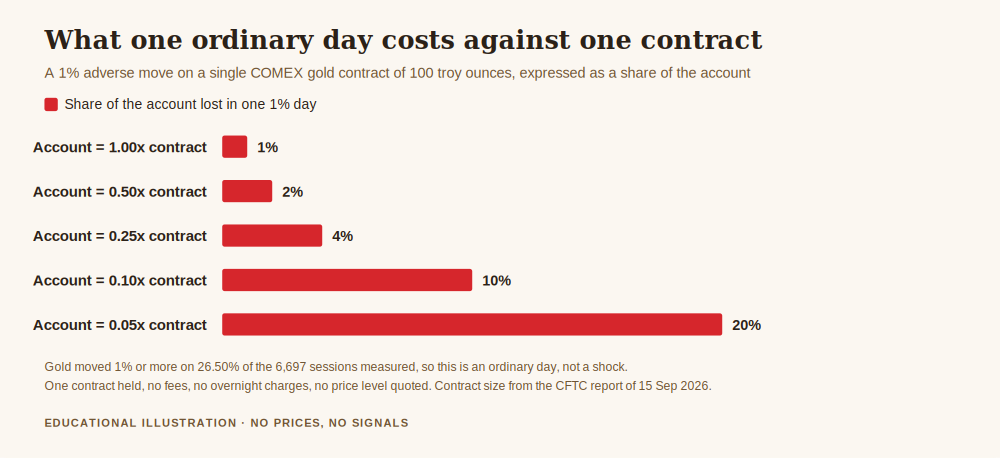
If your account equals the full notional of one contract, a one per cent day costs one per cent of the account. If your account is a quarter of that notional, the same day costs four per cent. At one tenth, ten per cent. At one twentieth, twenty per cent, from a move that is not news, not a shock and not anybody's fault.
And it really is not a shock. Measured on the London benchmark across 6,697 sessions from 2000 to September 2026, gold moved one per cent or more between consecutive prints on 26.50 per cent of them. Better than one session in four. Two per cent or more happened on 6.93 per cent of sessions, roughly seventeen times a year.
So the twenty per cent row is not a tail scenario. It is Tuesday, arriving about seventy times a year, at an account that should never have been holding a whole contract in the first place.
Assumptions, stated: one contract held, no fees, no overnight financing, no rollover effects, and adverse moves only, because this table is about survivability rather than expectation. Gold moving one per cent in your favour has exactly the same arithmetic and none of the consequences that matter here.
Margin Is Not the Number You Should Be Sizing From
The trap in futures is that the exchange tells you a number and it feels like the answer. Initial margin is what you must post to open the position. It is not what the position can cost you, and treating it as a proxy for risk is the most expensive category error in this market.
Margin answers the clearing house's question, which is whether you can be trusted with this lump overnight. Your risk budget answers yours, which is how much of the business a bad day may consume. Those two numbers are set by different people for different purposes and they happen to be denominated in the same currency, which is the whole reason anybody confuses them.
A business that sizes from margin is sizing from what its supplier will let it borrow rather than from what it can afford to lose. In every other industry that is recognised immediately as a failure of controls. It gets a different name here only because the platform displays it so helpfully.
What the Micro Contract Actually Solves
The ten ounce contract is not merely a smaller version of the same product. It changes what is possible in the account, because it changes the step size of every decision you make afterwards.
With a one hundred ounce unit, an account that can carry two contracts has exactly three states: nothing, half, and everything. There is no scaling, no partial exit that keeps a position on, no way to reduce exposure by a third. Every adjustment is a fifty per cent adjustment.
With the ten ounce unit the same account has twenty steps. Now you can take half off, keep a runner, size a second position that does not double your exposure, and express an opinion of moderate confidence with moderate size. A business with twenty possible order quantities runs differently from one with two, and the difference shows up as forced all-or-nothing decisions long before it shows up in results.
The open interest figures suggest the market agrees. Micro gold carries 90,365 contracts of open interest, which is a fifth of the standard market by contract count and about two per cent by ounces. That is a lot of people deliberately choosing finer granularity over convenience.
Get the free REX one page trading business plan, the sheet where your risk limit, your review schedule and the measurements you actually trust live together instead of in your head. One email, no spam, unsubscribe anytime.
Get the free business plan →Four Checks Before a Contract Belongs in the Account
One, work out the ratio first. Account value divided by the notional of one contract. That single number tells you, before anything else, what an ordinary day does to you. If the answer sits in the bottom rows of the table above, the contract is too big for the business, and no stop placement fixes a unit that is too large.
Two, decide what a gap does. A stop is an instruction, not a guarantee of price, and futures close and reopen. Between two prints the market can relocate, and the fixed unit means you cannot reduce the damage by holding less than one contract. The only lever available before the fact is whether you hold the position at all.
Three, price the carry. Futures roll. Positions held across expiry have to be moved to the next contract, and that has a cost and an administrative burden that a spot position does not. If your holding period crosses an expiry, the roll is part of the trade rather than an afterthought.
Four, write the maximum inventory down. Not the maximum you can post margin for, the maximum number of contracts the business will hold at one time, decided when nothing is happening. This is the same discipline as the trading 1 percent rule, applied to a product whose unit size makes the rule harder to honour and therefore more necessary to write down.
What This Does Not Say
It does not say futures are dangerous and spot is safe. The lump is visible in futures and hidden in spot, which is arguably the better arrangement. A CFD position of equivalent size carries the same exposure with less ceremony, and plenty of people take it without ever computing the ratio above.
It does not quote a price, a margin requirement or a cost. Exchange margins change, brokers add their own, and any figure printed here would be stale before you read it. Ratios do not go stale, which is why the table is built from them.
It also does not forecast. The 26.50 per cent figure describes twenty six years of history. The next twenty six can be calmer or wilder, and the arithmetic of the fixed unit holds either way.
Frequently Asked Questions
How big is one gold futures contract?
The standard COMEX gold contract covers 100 troy ounces, and the micro covers 10. Both sizes are printed in the CFTC's weekly position report, which is where the figures in this article come from.
Can I use the same one per cent risk rule on futures?
You can, but only if the unit is small enough to express it. With a fixed contract size the rule stops being a slider and becomes a yes or no question: either one contract fits inside your limit or it does not, and if it does not, the answer is a smaller contract or no position.
Is initial margin the same as my risk?
No. Margin is a deposit the clearing house requires to carry the position. Your risk is what the position can cost you, which is driven by the full notional value of the contract and has no upper bound at the margin figure.
Why hold micro contracts instead of one standard one?
Granularity. Ten small units give you twenty possible position sizes and the ability to scale out, where one large unit gives you on and off. The total exposure can be identical; the number of decisions available to you is not.
Where did these numbers come from?
Contract sizes and open interest are from the CFTC Commitments of Traders report dated 15 September 2026. The frequency of one and two per cent moves was calculated from the published London gold auction history, 6,697 consecutive sessions from 2000 to 18 September 2026. The cost table is division, with the assumptions stated next to it.
Where REX Trading Signal Fits
REX is free to follow. Daily XAUUSD analysis on Telegram with the reasoning stated before the outcome is known, losing days included, plus a free one page business plan for anyone who wants their limits written down in one place. Nothing here promises a profit and nothing here is a signal service.
The plan this sits inside is the one page trading business plan template. The limit it is meant to protect is in the trading 1 percent rule, and the instrument specific version of the same argument is in how to manage risk in gold trading. The position and contract size data is published by the Commodity Futures Trading Commission, and the price history behind the frequency figures is published by the London Bullion Market Association. More about who writes this is on the about page.
About the author. Rex writes REX Trading Signal and treats an account as a small business with inventory, fixed costs and a set of books that has to balance. He has more time for a spreadsheet that says no than for a setup that says yes. Nothing in this article is a recommendation to trade, and no entry, stop or target discussed should be treated as a signal.
Disclaimer: This article is general educational content about futures contract specifications, position sizing and account risk. It is not financial advice, not investment advice and not a recommendation to buy, sell or hold any instrument, product or firm. Contract specifications, margin requirements and fees are set by exchanges and brokers and change over time, so verify current terms with primary sources before acting. Figures are calculations from the stated public data and stated assumptions, not predictions or performance claims. Trading leveraged products carries a substantial risk of loss and most retail accounts lose money.