
Somebody asked me last week what the maximum lot size forex brokers allow actually is, and I gave the useless honest answer first, which is that it depends on the broker. Then I asked what they were really trying to work out, and we got somewhere. They were not curious about a number in a contract specification. They wanted to know how big they were allowed to go. Those are different questions with different answers, and the gap between the two answers is where most trading businesses quietly die.
So let me do this the way a business would. There are several ceilings, they come from different places, and only one of them is yours. I will show you how to work out which one binds, and I will do it with arithmetic that never once needs to know what gold costs today.
Four Different Things a Platform Means by Maximum Lot Size Forex
Start with the platform, because that is where people look first. MetaQuotes publishes the properties a terminal reads from the broker's server, and in the symbol properties reference there are four separate volume limits. Four, not one. That alone should tell you the question has more than one answer.
- The minimum volume for a deal, the smallest ticket you may send.
- The maximum volume for a deal, the largest single ticket.
- The volume step, the granularity between allowed sizes.
- The maximum aggregate volume of an open position and pending orders in one direction.
Read that fourth one twice, because it is the one people trip over. A trader who wants 50 lots, sees a 20 lot cap per ticket and splits the order into three, has not outsmarted anything. That fourth limit adds up everything working in the same direction, resting orders included. The workaround was anticipated by whoever wrote the server software, which is generally the case with workarounds.
Here is the important bit though. The terminal does not set a single one of those numbers. It reads them and displays them. They are your broker's numbers, and so are your spread, your commission, your swap and your margin requirement. Choosing a platform does not change any of them, which is a point I made at more length in the piece on choosing a broker like a business partner.
The Ceiling the Broker Sets, and the One You Set
Two calculations answer "how big can I go", and they almost never agree.
The first is the margin ceiling. Your equity times your leverage gives the notional you are allowed to control, and dividing by the price and the contract size turns that into lots. That is the broker's answer, and it is the number people mean when they ask about maximum lot size.
The second is the risk ceiling. If your rule book says you risk at most a fraction of equity per trade, and your stop sits a certain distance from your entry, then the largest position that respects the rule is your equity times your risk fraction, divided by the stop distance, and again divided by price and contract size. That is your answer.
Now divide the second by the first, and watch what happens. Equity cancels. Price cancels. Contract size cancels. What survives is your risk fraction, divided by the product of your stop distance and your leverage. That is the entire relationship, and it contains no market data whatsoever:
Your ceiling, as a share of the broker's ceiling, equals your risk per trade divided by your stop distance times your leverage.
Put the ESMA retail numbers in. Under the measures ESMA agreed for retail CFD clients, leverage on gold is capped at 20:1 and on major currency pairs at 30:1. Risk 1 percent with a stop 1 percent from entry at that 20:1 cap and the answer is 5.00 percent. Your own rule book permits you one twentieth of what the broker will happily let you open.
Move the dials and it moves as you would expect. A tighter half percent stop takes you to 10.00 percent. A 100:1 account takes you down to 1.00 percent, and a 500:1 account to 0.20 percent. At 500:1 the broker's maximum is five hundred times your maximum. That is not a facility. That is a cliff with no fence on it.
What Happens If You Actually Use It
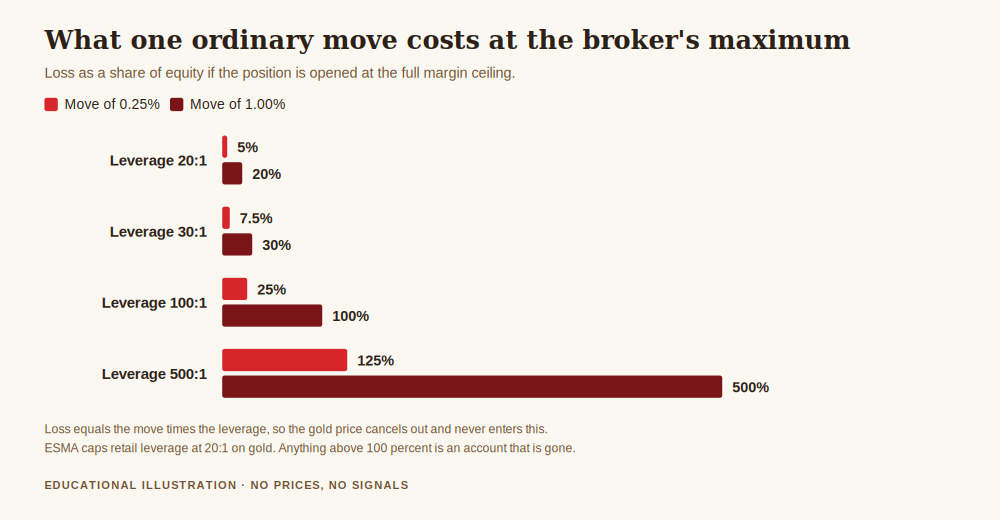
Suppose somebody ignores all of that and opens at the margin ceiling. What does an ordinary move cost them?
At that size the notional is equity times leverage, so an adverse move of a given fraction costs that fraction times the leverage, as a share of the whole account. Once again the price cancels out. There is nothing to look up.
A move of 0.25 percent, which is a quiet hour in gold and not an event anybody would write about, costs 5 percent of the account at 20:1, 25 percent at 100:1 and 125 percent at 500:1. A one percent move costs 20 percent, 100 percent and 500 percent. The last two columns are not losses. They are the end of the business, and note that no stop loss protects you inside them, because the account is gone before the stop is reached.
The forced exit arrives even earlier than that. Those same ESMA measures require a provider to close out a retail account when equity falls to 50 percent of the margin required to maintain the position. Open at the full ceiling and that arrives after an adverse move of one over twice the leverage: 2.50 percent at 20:1, 1.67 percent at 30:1, 0.50 percent at 100:1 and 0.10 percent at 500:1. At 500:1 your entire trading business fits inside a tenth of a percent. The high maximum lot size did not buy you capacity. It bought you a shorter distance to the exit, and it charged you nothing for it, which is how you know who it was designed for.
The same analysis found that 74 to 89 percent of retail accounts typically lose money, with average losses per client between 1,600 and 29,000 euros. I do not quote that to be gloomy. I quote it because it is the population the leverage tiers were sold into, and any business plan that assumes you are automatically the exception is not a plan.
The Arithmetic, Once, With Every Assumption Named
Let me do one case end to end so nothing is hidden. Assume 10,000 units of account currency, the 20:1 gold cap, a house rule of 1 percent risk per trade, a stop 1 percent from entry, and gold's 100 ounce standard lot.
The margin ceiling in notional terms is equity times leverage, so 200,000. The risk ceiling in notional terms is equity times risk divided by stop distance, so 10,000. Ten thousand out of two hundred thousand is 5.00 percent, which is exactly what the formula said it would be without any of these numbers being specified.
Turn it into lots only at the very last step, when a price exists, by dividing the notional by the price times the contract size. Both ceilings get divided by the same thing, which is precisely why the ratio between them survives whatever price you put in, today's or next year's. That is a useful property in a business: it means the control does not need maintaining when the market moves.
None of these figures are quotes, and none of them are recommendations. The risk fraction and the stop distance are assumptions I picked to show the shape, and the right values for your business belong in your own written rules, which is what how to manage risk in gold trading and position sizing for gold trading are for.
What a Business Does With This
A business does not treat a supplier's capacity as its own operating limit. A restaurant with a walk-in that holds a month of stock does not order a month of stock. The freezer's capacity is a fact about the freezer.
So the practical version is short. Work out your risk ceiling in lots before you open the ticket, not after. Write the number down. If it is far below what the platform offers, that is the system working, not a limitation to route around. And if you ever find yourself reaching for higher leverage specifically so a bigger position becomes possible, notice what you are actually doing: you are not increasing your capacity, you are shortening the distance between an ordinary Tuesday and a closed account. The one metric worth watching here is whether your position sizes are set by your own arithmetic or by what the platform will accept, and that belongs in the metrics every trading business should track.
Get the free REX one page business plan, the sheet where your risk ceiling gets written down before the market asks you to improvise one. One email, no spam, unsubscribe anytime.
Get the free business plan →Frequently Asked Questions
What is the maximum lot size forex brokers actually allow?
It varies by broker and by instrument, and your platform reads it from the server rather than setting it. More usefully, there are four separate platform limits: the minimum ticket, the maximum single ticket, the step between sizes, and the maximum total across everything you have working in one direction. Check all four in your own contract specification, because the fourth one catches people who split orders.
Why does the ratio not depend on the gold price?
Because both ceilings are computed from the same notional and then divided by the same price and the same contract size, so those factors cancel. What is left is your risk fraction over your stop distance times your leverage. That is a genuinely useful property: the control does not need recalculating when the market moves.
Does higher leverage let me trade bigger safely if I use a tight stop?
Higher leverage raises the broker's ceiling, and it does not change your risk ceiling at all, because your risk ceiling never mentioned leverage. What it does change is how quickly a forced close-out arrives if you use the extra room. Under the ESMA rules that close-out is at 50 percent of required margin, which at 500:1 is a move of about 0.10 percent.
Is a bigger lot the fastest way to grow the account?
It is the fastest way to change the account in both directions, which is not the same thing. The arithmetic above is neutral about which direction. What it does say is that at the broker's ceiling a single ordinary move settles the question permanently, and a business that can be ended by one Tuesday is not really operating.
My broker is not in the EU, so do the ESMA numbers apply to me?
The caps and the close-out rule do not apply to your account unless your provider is covered by them. The arithmetic does apply, because it is arithmetic. Put your own leverage and your own broker's close-out threshold into the same formulas and you will get your own numbers, which are the ones that matter.
Where REX Fits
REX Trading Signal is free to follow, with daily XAUUSD analysis and the reasoning stated before the trade, and an optional Kit for people who want the operating side written down properly. Nothing here is a promise of profit, and a channel that made one would be telling you something about itself rather than about the market.
The operating side is the whole point. The one page trading business plan template is the pillar this sits under, because a ceiling you have not written down is a ceiling the market will pick for you. Position sizing for gold trading is the calculation itself, and how to manage risk in gold trading is where the risk fraction in that calculation comes from.
About the author. Rex writes REX Trading Signal. He is interested in the unglamorous half of this business, the costs, the controls and the review dates, on the view that the interesting half takes care of itself once the dull half is written down.
Disclaimer: This article is general educational content about position limits in a trading business. It is not financial advice, not investment advice, and not a recommendation to open, hold or close any position, or to use any particular broker, platform or leverage level. The four platform volume limits are quoted from the MetaQuotes symbol properties reference, and the 20:1 and 30:1 retail leverage caps, the 50 percent margin close-out rule, the negative balance protection and the 74 to 89 percent retail loss range are from the measures agreed by ESMA, which apply to retail clients in the European Union and may not apply to your account. Every percentage, ratio and worked example is my own arithmetic on assumptions stated in the text, namely the account size, the risk fraction, the stop distance and the 100 ounce standard lot, and none of them is a quote, a target or a description of anyone's results. No gold price level is quoted anywhere in this article. Trading leveraged products carries a high risk of losing money rapidly, and no entry, stop or target discussed should be treated as a signal. Consider your own circumstances and speak to a licensed professional in your jurisdiction before making decisions about your money.