
The question usually arrives dressed as a career question. Someone has been trading their own account for a while, they have decided they want to do this with more capital than they own, and they want to know how prop firm vs hedge fund compares as a way of getting there.
Treated as a career question it produces a fairly useless answer, because both look like the same thing from the outside: a person, more capital than they personally have, a share of what that capital produces. Treated as a business question it produces a much better answer, because the two are not variations on one business. They are two different businesses with different customers, different legal furniture and different products.
So that is how this article treats it. Not which pays better, which is a question the arithmetic below answers in about a minute, but which business you are actually equipped to run.
Prop Firm vs Hedge Fund: Whose Money Is It
Everything else follows from one question, so it is worth getting it out of the way first.
At a proprietary trading firm, the capital belongs to the firm. It is the firm's own money, put at risk by the firm's own decision, and you are engaged to trade it under a set of rules the firm writes. You are, in business terms, a contractor with a performance agreement. You do not have investors, because the firm is not your investor. It is your counterparty.
At a hedge fund, the capital belongs to outside investors. It has been pooled from people who handed it over on the strength of a promise about how it would be managed. You are not a contractor in that arrangement. You are a fiduciary, which is a substantially heavier thing to be, and most of the difference between the two businesses is the weight of that word.
Notice what this does to the risk. A prop trader who has a terrible quarter loses their arrangement with the firm. A fund manager who has a terrible quarter has to explain it to people whose retirement is inside the number, and has to keep explaining it, in writing, on a schedule.
The Line Where the Paperwork Starts
There is a fairly bright regulatory line between these two businesses, and it is drawn at the moment you pool other people's money.
In the United States, an operator who pools participants' funds to trade commodity interests falls under the Commodity Futures Trading Commission's framework for commodity pool operators. The CFTC states plainly on its commodity pool operator page that In 1984 the CFTC delegated the registration of Commodity Pool Operators to the National Futures Association
, and that is where such registrations are processed. Registrations can be checked by anyone through the NFA's BASIC lookup, and investment adviser records through the SEC's adviser search.
None of that applies to a person trading a firm's own capital, because there is no pool and no participants. That single fact is why one of these businesses can be started in a fortnight and the other cannot.
Whether any specific arrangement triggers registration depends on the jurisdiction, the structure and the instruments, and is a question for a lawyer rather than a blog. The point for a business plan is simpler: one path has an exemption question in it and the other does not.
How Each Business Pays, on the Same Assumptions
Now the arithmetic. Every figure here is computed from stated assumptions and none of it is a forecast. The return used below is a comparison input, chosen to make the fee structures visible, not a return anyone should expect.
Assume one hundred thousand of capital and a gross return of twenty percent across a year, so twenty thousand of gross profit in both cases.
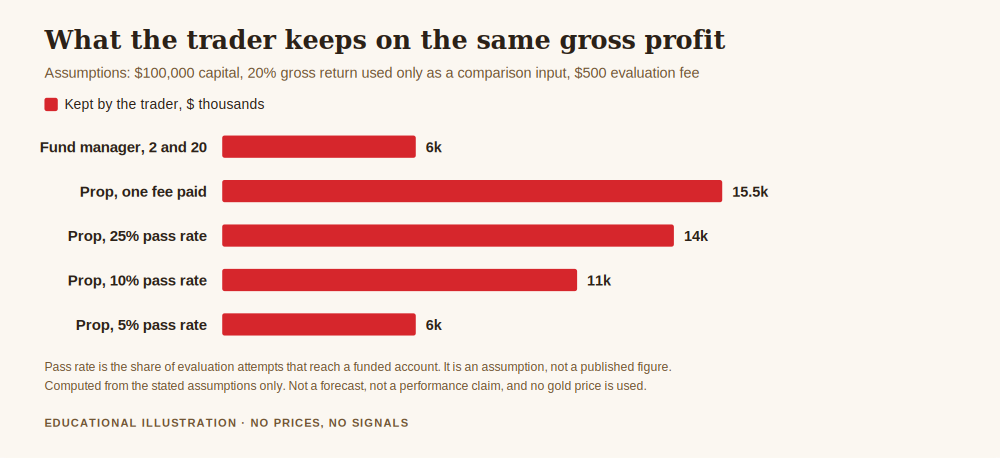
The classic fund fee structure is two and twenty, meaning two percent of assets annually plus twenty percent of the profit. On those numbers the manager receives two thousand in management fee plus four thousand in performance fee, so six thousand in total. The investor keeps fourteen thousand, which is fourteen percent on their hundred thousand.
A prop arrangement typically has no management fee, an up front evaluation fee, and a profit split. Assume an eighty twenty split in the trader's favour and a five hundred evaluation fee. The trader receives sixteen thousand less the five hundred, so fifteen thousand five hundred. The firm keeps four thousand plus the fee.
Set those side by side and the prop trader takes home nine thousand five hundred more than the fund manager did on the identical gross profit. That looks decisive, and for a single funded account on a good year it is.
It is also the most misleading number in this article, for two reasons that the next two sections are about.
The Line Item Prop Traders Leave Out
The five hundred in the calculation above is the fee for one attempt. It is not the cost of getting funded, and a business plan that treats those as the same number is wrong in a way that compounds.
The cost of getting funded is the fee divided by the proportion of attempts that succeed. If one attempt in ten reaches a funded account, the expected cost of a funded account is five thousand, not five hundred. At one in twenty it is ten thousand. At one in four it is two thousand.
Those pass rates are assumptions, and deliberately so, because they are the one input a candidate cannot verify from outside and the one that decides the whole calculation. Any figure a firm publishes about them is marketing unless it is audited, and the honest position is that you do not know yours until you have your own record of attempts.
This is ordinary business arithmetic and it is not unique to trading. Any business with a customer acquisition cost computes it this way, on attempts rather than on successes, and the ones that compute it on successes go out of business while believing they are profitable.
Run it once more with that correction. At a twenty five percent pass rate the prop trader's fifteen thousand five hundred becomes fourteen thousand. At ten percent it becomes eleven thousand, still comfortably ahead of the fund manager's six thousand.
At five percent it becomes six thousand exactly, which is the fund manager's number to the dollar. That is not a coincidence arranged for effect, it is just where these particular assumptions cross, and it is the most useful line in the whole comparison. The advantage everybody quotes is real, and it is entirely a function of a number nobody publishes. Move the pass rate and the answer moves with it, all the way to nothing.
What Each Business Actually Sells
Here is the second reason the headline comparison misleads, and it is the more important one.
The prop trader sells execution inside someone else's rules. The product is compliance with a drawdown limit and a consistency requirement, demonstrated repeatedly. The customer is one firm. Acquisition is cheap, in that anyone can pay the fee tomorrow, and the relationship ends the moment a rule is breached, whatever the reason.
The fund manager sells a track record and the trust that sits on top of it. That product takes years to manufacture, cannot be bought, and is destroyed considerably faster than it is built. Acquisition is expensive and slow. In exchange the relationship survives a bad quarter, because it was sold on a multi year basis to people who were told to expect bad quarters.
That is the real trade. One business is easy to enter and easy to be removed from. The other is hard to enter and hard to be removed from. Neither is the better answer in the abstract. They are answers to different questions about what you want your working life to be exposed to.
There is also a durability point worth stating, because it does not show up in either fee calculation. The fund's two percent management fee is charged on assets whether the year was good or not. Nobody defends it as a reward, because it is not one. It is what pays for the business to still exist after a flat year, and a prop arrangement has no equivalent line. That is a structural difference in survivability, not a difference in generosity.
Get the free REX one page trading business plan, the sheet where your risk limit, your costs and your review schedule live on a single page instead of in your head. One email, no spam, unsubscribe anytime.
Get the free business plan →Which One Are You Equipped to Run
Strip out the ambition and four questions decide it.
The first is whether you can produce a documented record. Not a screenshot of a good month, a continuous record with the losing periods still in it. Without one there is no fund, because there is nothing to sell. With one you have the beginning of the only asset that business has.
The second is whether you can operate inside rules you did not write and cannot appeal. Prop firms enforce drawdown limits mechanically. A trader who is right about the market and wrong about the rule is still out. If that arrangement would make you argue, the prop path will be a short one.
The third is whether you can afford the acquisition cost honestly computed, on attempts rather than on hopes, from capital you can lose without it changing anything else in your life.
The fourth is whether you want investors. This is the one people skip, and it is the one that changes your calendar most. Investors mean reporting, explanations, redemption requests at the worst possible moment, and a legal structure you maintain whether or not you feel like it. Some people find that a fair price for durable capital. Others discover, expensively, that they wanted to trade rather than to run a firm.
Answer those four honestly and the question mostly answers itself, which is generally how it goes once a career question is rewritten as a business question.
Frequently Asked Questions
Prop firm vs hedge fund, which one pays more?
On the assumptions in this article, a single funded prop account keeps more of an identical gross profit, because there is no management fee and the split favours the trader. That advantage shrinks as the evaluation pass rate falls, and at a five percent pass rate the two come out level. The comparison also covers one account in one good year and ignores the durability of the two businesses, which is the more important difference.
Do I need to register to run a hedge fund?
Pooling other people's money to trade generally brings you inside a registration framework, and in the United States commodity pool operator registrations are processed by the NFA under the arrangement described on the CFTC page linked above. The specifics depend on jurisdiction, structure and instruments, and it is a question for a lawyer rather than an article.
Is the evaluation fee really a cost of doing business?
Yes, and it should be recorded as one. The figure that belongs in a plan is not the fee for one attempt but the fee divided by your pass rate, because that is what a funded account actually costs you on average.
Can I do both at once?
People do, but notice they are then running two businesses with different reporting obligations and different definitions of a bad month. That is a capacity question about your week rather than a strategy question.
Does a prop firm give me real capital?
Read the agreement rather than the marketing page, because arrangements differ and some are structured so that what you receive is a payment based on simulated performance rather than a share of live trading profit. Which one you have signed changes the business you are in, so it is worth knowing before the first payout rather than after.
Where did the numbers in this article come from?
The registration statement is quoted from the CFTC page linked above, checked live before publication. Every other figure is computed from assumptions stated in the text, namely one hundred thousand of capital, a twenty percent gross return used purely as a comparison input, a two and twenty fee structure, an eighty twenty split, a five hundred evaluation fee and pass rates of five, ten and twenty five percent. None of them is a forecast or a performance claim.
Where REX Fits
REX Trading Signal is free to follow. Daily XAU/USD analysis with the reasoning written down before the trade, losing days included, on Telegram. There is a free one page business plan for anyone who wants their limits and costs in one place, and an optional Kit for people who want the full system. Nothing here promises a profit, and nothing here is a signal service.
Both paths are businesses, and a business needs its numbers written down before it needs ambition. The one page trading business plan template is the pillar this article belongs under, how do prop firms make money explains the other side of the prop arrangement, and what happens if you fail a prop firm challenge covers the outcome the pass rate above is really about. More about who writes this is on the about page.
About the author. Rex writes REX Trading Signal and treats an account as a business with books, limits and a review schedule rather than a series of opinions. He is unreasonably interested in the costs people leave off the plan, which is usually where the plan fails. Nothing in this article is a recommendation to trade, and no entry, stop or target discussed should be treated as a signal.
Disclaimer: This article is general educational content about business structures in trading. It is not financial advice, not investment advice, not legal advice and not a recommendation to use any firm, fund or product. Regulatory wording is quoted from the source linked in the text and may change, and registration requirements vary by jurisdiction. Trading leveraged products carries a substantial risk of loss and most retail accounts lose money. Figures are illustrative calculations from stated assumptions, not predictions or performance claims.