
Ask is working capital just equity and you will get a yes from a surprising number of people who otherwise keep decent books. The two numbers sit near each other on the same statement, they are both described with words like "what the business is worth", and in a very simple operation they can even come out close together. They are not the same thing, they answer different questions, and the difference is the reason a trading business with a healthy net worth can still fail to pay a tax bill. One number tells you what you own after everything you owe. The other tells you whether you can get through the next twelve months without selling something you need.
Is working capital just equity, or two answers to two questions
Start with the definitions, because both of them are published by bodies with no interest in making this sound clever.
The Securities and Exchange Commission's Beginners' Guide to Financial Statements gives the accounting equation in capitals: ASSETS = LIABILITIES + SHAREHOLDERS' EQUITY. A company's assets must equal the sum of its liabilities and its equity. Rearrange it and equity is what is left of everything you own once everything you owe has been taken off. That is a measure of net worth, and it covers the whole balance sheet with no regard for timing.
The same guide gives working capital separately, as a formula: Working Capital = Current Assets minus Current Liabilities. It describes working capital as the money left over if a company paid its current liabilities, and notes that these are debts due within one year of the balance sheet date.
Look at what changed between those two sentences. Equity uses all assets and all liabilities. Working capital uses only the current ones, meaning the things that turn into cash or come due inside a year. Equity is a question about worth. Working capital is a question about timing. That is the whole distinction, and everything below is a consequence of it.
The Internal Revenue Service puts the equity side in plainer language for a one person operation in Publication 583, its guide for people starting a business: a balance sheet shows the assets, liabilities, and your equity in the business on a given date. Note "on a given date". A balance sheet is a photograph, not a film, which is exactly why the timing question has to be asked separately.
Books A, a trading business on an ordinary month
Abstractions do not settle this. A worked example does. Here is a one person trading operation, with figures I have made up to be ordinary rather than flattering, in whatever currency your account is denominated in.
What it owns. Cash in the broker account, 12,000. Cash in the business bank account, 3,000. A data and charting subscription paid annually with nine months still to run, carried as a prepaid expense at 900. A computer and two monitors, net of depreciation, 1,800.
What it owes. Tax on this year's profits, due in four months, 4,200. A credit card balance covering platform and server charges, 800. The remainder of a loan taken to buy the kit, with two years left to run, 1,200.
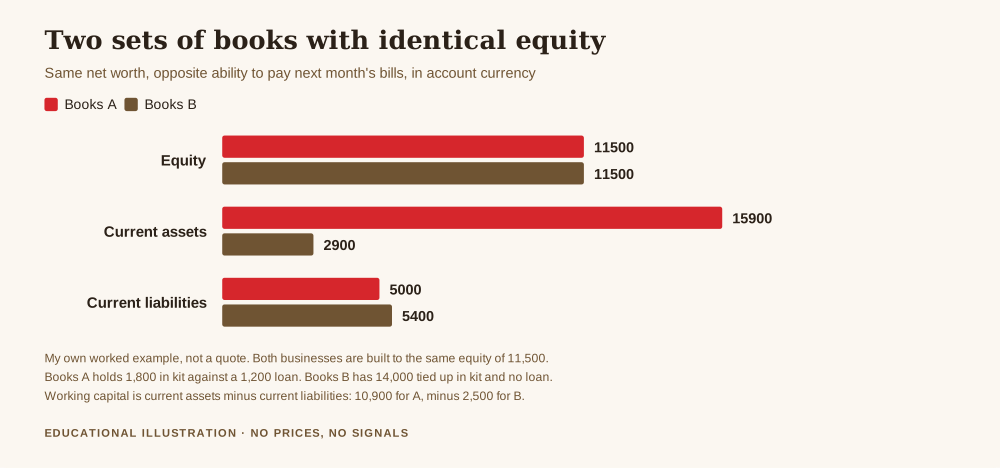
Total assets are 17,700. Total liabilities are 6,200. So equity is 11,500, computed as 17,700 minus 6,200.
Now ask the other question. Current assets are the ones that become cash within the year: 12,000 plus 3,000 plus 900, which is 15,900. The computer is not in that list, because selling your monitors is not a liquidity plan. Current liabilities are the ones falling due within the year: 4,200 plus 800, which is 5,000. The equipment loan's remaining 1,200 is not current, because it is not due yet.
Working capital is therefore 15,900 minus 5,000, which is 10,900. Equity is 11,500. Close, but not equal, and the gap is not an error.
Books B, the same equity and a much worse month
Here is a second business built deliberately to have the identical equity of 11,500, so that the only thing changing is where the money sits.
What it owns. Broker account, 2,000. Business bank account, 500. Prepaid software, 400. A full office build, desk, chairs, three screens, a second machine and a serious internet contract, net of depreciation, 14,000.
What it owes. Tax due next month, 4,200. Credit card, 1,200. No loan, because the office was paid for in cash out of a good year.
Total assets are 16,900, total liabilities are 5,400, so equity is 11,500. Exactly the same net worth as Books A.
Current assets are 2,000 plus 500 plus 400, which is 2,900. Current liabilities are 4,200 plus 1,200, which is 5,400. Working capital is 2,900 minus 5,400, which is minus 2,500.
Two businesses, identical equity, and one of them is 2,500 short of covering what falls due inside the year. Books B is not insolvent. On a net worth basis it is doing fine, and if you asked it what it was worth it would give the same answer as Books A. It simply cannot pay next month without selling a monitor, borrowing, or taking money out of the market at whatever moment the bill arrives rather than the moment the setup appears.
That last clause is the part that should concern anyone running an account as a business. A liquidity shortfall does not politely wait for a good week. It forces a withdrawal on a date chosen by a tax authority, and a forced withdrawal is a trade you did not plan, taken at a size you did not choose, for a reason that has nothing to do with the market.
The identity that connects the two numbers
There is a clean relationship underneath all of this, and once you have seen it the confusion does not come back.
Equity is total assets minus total liabilities. Split both sides by timing: total assets are current assets plus non-current assets, and total liabilities are current liabilities plus non-current liabilities. Substitute and rearrange, and you get:
Working capital = Equity minus (non-current assets minus non-current liabilities)
Check it against both examples. Books A: equity 11,500, non-current assets 1,800, non-current liabilities 1,200, so 11,500 minus 600 equals 10,900. Correct. Books B: equity 11,500, non-current assets 14,000, non-current liabilities 0, so 11,500 minus 14,000 equals minus 2,500. Correct.
Read the formula in words and it tells you the one condition under which the original question gets a yes. Working capital equals equity only when your non-current assets exactly equal your non-current liabilities, which for most one person trading businesses means only when you own no long lived kit at all and owe nothing long term. The moment you buy a machine, the two numbers separate by the value of that machine, and they stay separated until it is fully depreciated.
Which is why the answer to the question in the title is: no, except in a special case that almost never holds, and the size of the gap is precisely the amount of your net worth you have parked somewhere it cannot help you next month.
All of those figures are computed from the stated balance sheets rather than quoted from anywhere. The assumptions are the ones written out above: the amounts are illustrative, depreciation is already applied, the prepaid subscription is treated as a current asset because it covers the next nine months, and nothing is discounted for time.
Get the free REX one page business plan, the operating structure in one place, including where the money sits and what has to be covered before the next contribution. One email, no spam, unsubscribe anytime.
Get the free business plan →What to do with this at your next review
This is a bookkeeping distinction with an operational use, so here is the use.
Once a month, split your own balance sheet by timing before you look at the bottom line. Put everything that becomes cash inside a year on one side: broker cash, bank balances, money owed to you, prepaid subscriptions. Put everything falling due inside a year on the other: tax, cards, subscriptions you have committed to, any loan instalments landing in the next twelve months. Subtract. That number, not your equity, is what tells you whether the next twelve months are funded.
If it is negative, the business is not necessarily in trouble but it is on a clock, and you now know roughly when the clock runs out. The useful responses are all boring: hold back more cash before buying kit, move a purchase into next year, set aside tax as it accrues instead of when it is demanded, or keep a reserve sized against the bills rather than against a feeling. None of that is a trading decision, which is exactly why it tends to get skipped.
The current ratio is the same measurement expressed as a multiple, current assets divided by current liabilities. Books A sits at 3.18. Books B sits at 0.54. Below 1.0 means current liabilities exceed current assets, which is the definition of negative working capital. It is a quick thing to compute and a hard thing to argue with.
Frequently asked questions
Is working capital just equity under another name?
No. Equity is total assets minus total liabilities and covers the whole balance sheet. Working capital is current assets minus current liabilities and covers only the items that turn into cash or fall due within a year. They coincide only when non-current assets equal non-current liabilities, which for a one person trading business normally means owning no long lived equipment and carrying no long term debt.
Can working capital be negative while equity is positive?
Yes, and the worked example above shows it: equity of 11,500 with working capital of minus 2,500. It happens whenever a large share of net worth is tied up in things that cannot be converted to cash quickly, such as equipment bought outright, while the bills falling due in the next year are not covered by cash and near cash.
Is the cash in my broker account a current asset?
Cash held in the account and available to withdraw behaves as one on your own books, since it converts to cash inside a year. Margin posted against an open position is a different matter, because it is not freely available while the position is live. If you want the number to be useful rather than flattering, count only what you could actually withdraw without closing a trade you intended to keep.
Which number should I track if I only track one?
Working capital, because it answers the question that can end a business in the short term. Equity tells you how the years have gone. Working capital tells you whether the next twelve months are funded, and an operation stops because it ran out of cash on a particular Tuesday rather than because its net worth was insufficient in principle.
Where do these definitions come from?
The accounting equation and the working capital formula quoted here are from the Securities and Exchange Commission's Beginners' Guide to Financial Statements, linked below, which also gives the one year test for current liabilities. The description of a balance sheet as showing the assets, liabilities and your equity in the business on a given date is from the Internal Revenue Service's Publication 583 for people starting a business. Both are linked at the end.
Where this leaves you
REX Trading Signal is free to follow and stays free. The daily record goes up including the quiet days and the losing days, there is a free one page business plan for anyone who wants the operating structure in one place, and there is an optional kit for people who want the longer version. Nothing here promises a return, because nobody can promise you one, and nothing here recommends any broker, product or instrument.
The foundation under this article is the one page trading business plan. Beside it, the equity side of the same statement is in what balance sheet equity is, the account structure that makes the split possible in the first place is in what a chart of accounts looks like, the timing rule that decides when an item lands on the books at all is in cash basis vs accrual accounting, and the practical fix for a thin current position is in how to build a cash reserve for your trading business.
Outside sources used here: the accounting equation stated as assets equals liabilities plus shareholders' equity, the formula working capital equals current assets minus current liabilities, the description of working capital as the money left over if a company paid its current liabilities, and the one year test for current liabilities, are all from the United States Securities and Exchange Commission, Beginners' Guide to Financial Statements. The statement that a balance sheet shows the assets, liabilities and your equity in the business on a given date is from the Internal Revenue Service, Publication 583, Starting a Business and Keeping Records. Every figure in the two worked balance sheets is computed from the amounts stated in the text, so you can rebuild both with your own numbers.
About the author. Rex writes REX Trading Signal and treats an account the way an operator treats a business, with limits set before the week starts and a review that happens whether the month was good or bad. He has more time for a boring balance sheet than for a good month, on the grounds that one of them tells you whether you will still be here next year. The definitions here are quoted from the official sources linked above, the two balance sheets are illustrative examples computed from the figures stated in the text rather than anyone's real books, this article is educational and is not investment, tax, accounting or legal advice, your own tax treatment and reporting obligations depend on where you are and how your business is structured so check them with a qualified professional, nothing here recommends any broker, platform, product or instrument, and no entry, stop or target discussed should be treated as a signal.